
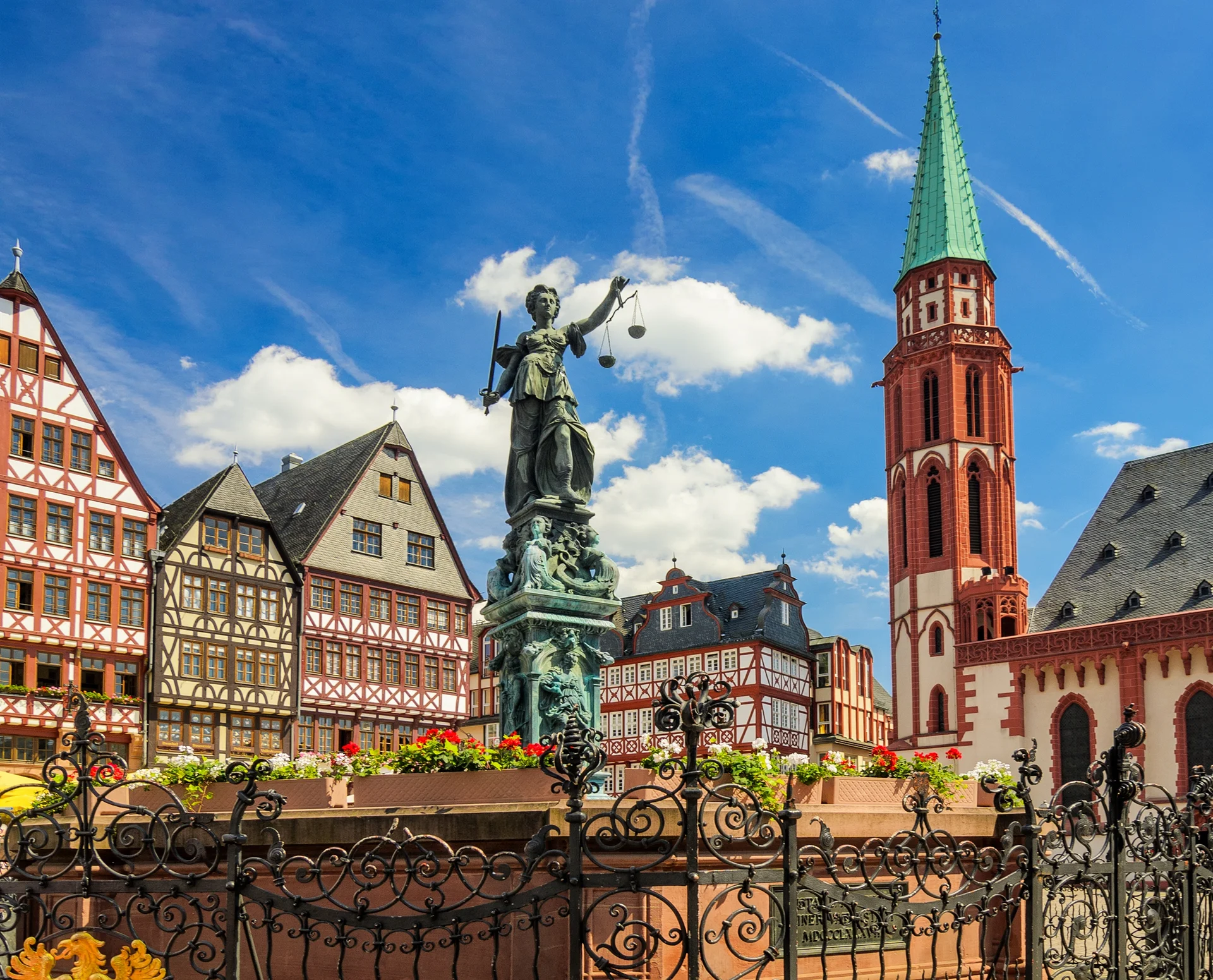
Römerberg, the medieval heart of a financial giant
The uneven cobblestones echo under your feet, half-timbered facades stand out against a sky that is often gray, and in the center, the statue of Justitia has brandished her scales for centuries. The Römerberg seems frozen in a reconstructed Middle Ages, yet it pulses with the rhythm of a city firmly turned toward the future.
Why does the Römerberg remain the beating heart of Frankfurt am Main?
Since the 9th century, this square has served as the forum for the city. Markets, trade fairs, knightly tournaments, public executions, and imperial coronations have taken place here for over a thousand years. By the 16th century, it was considered the most beautiful square in the Holy Roman Empire. In 1405, the city council acquired two patrician homes belonging to a wealthy merchant to establish the city hall, the Römer. Over the centuries, other buildings were added to the architectural complex.
The bombings of the Second World War reduced the square to ashes. In the 1980s, the city launched a meticulous reconstruction project. The six half-timbered houses of the Ostzeile, the eastern row, were reborn in 1986 based on historical plans. The result is divisive: some see a German Disneyland, while others applaud the commitment to preserving architectural memory. Regardless of the verdict, the square functions and attracts thousands of visitors daily.
The Römer and its imperial secrets
The city hall displays its characteristic Gothic facade with three stepped gables. This instantly recognizable silhouette symbolizes the power of the free city. Inside, the Kaisersaal (Imperial Hall) preserves its frescoes depicting the 52 emperors of the Holy Roman Empire. It was in this room that lavish banquets were held following imperial coronations. Between 1562 and 1792, ten emperors received their crowns in the nearby cathedral before feasting here.
Access to the interior of the Römer is limited to specific periods and events. The ground floor now houses the civil registry office where Frankfurt am Main residents get married. A fun anecdote: couples who tie the knot here traditionally receive a bell as a gift, a symbol of marital happiness in local culture.
The Fountain of Justice and the Ostzeile
In the center of the square sits the Gerechtigkeitsbrunnen (Fountain of Justice). The goddess Justitia stands at the top, holding a scale and a sword. An intriguing detail is that her eyes are not blindfolded, unlike the usual representation of justice. This statue dates to 1611 and is the first public fountain in the city. During imperial coronations, red and white wine would flow from its taps so the people could toast to the health of the new emperor.
The multicolored half-timbered houses of the Ostzeile make up the most photographed postcard setting. Their names evoke medieval signs: At the Grand Angel, At the Little Angel, At the Gold Key. The ground floors house cafes and tourist restaurants, while the upper floors are used as offices. In the evening, the lighting highlights the dark wood structures against the light-colored facades.
Friendly tip: visit the square in the early morning hours, around 7 a.m. to 8 a.m., when the tourists are still asleep. The low light enhances the half-timbering and you can take photos without anyone in the frame. The cobblestones glisten with dew and the medieval atmosphere feels authentic. The Thursday morning flower market adds a touch of genuine local color.
Memory and festivities on the cobblestones
A discreet plaque embedded in the cobblestones commemorates the book burning of May 10, 1933, when the Nazis burned thousands of books on this square. This dark reminder contrasts with the joy of the events that enliven the Römerberg today. The Christmas market, one of the oldest and most famous in Germany, transforms the square into a winter village during the four weeks of Advent. The wooden stalls overflow with handcrafted decorations, grilled sausages, and steaming Glühwein.
The Easter market in the spring and the wine festival in the summer also draw crowds. Open-air concerts regularly resonate between the historic facades. The Alte Nikolaikirche (Old Saint Nicholas Church) closes the southern corner of the square with its red silhouette. Built in the 13th century, it now serves as an exhibition and concert venue.