
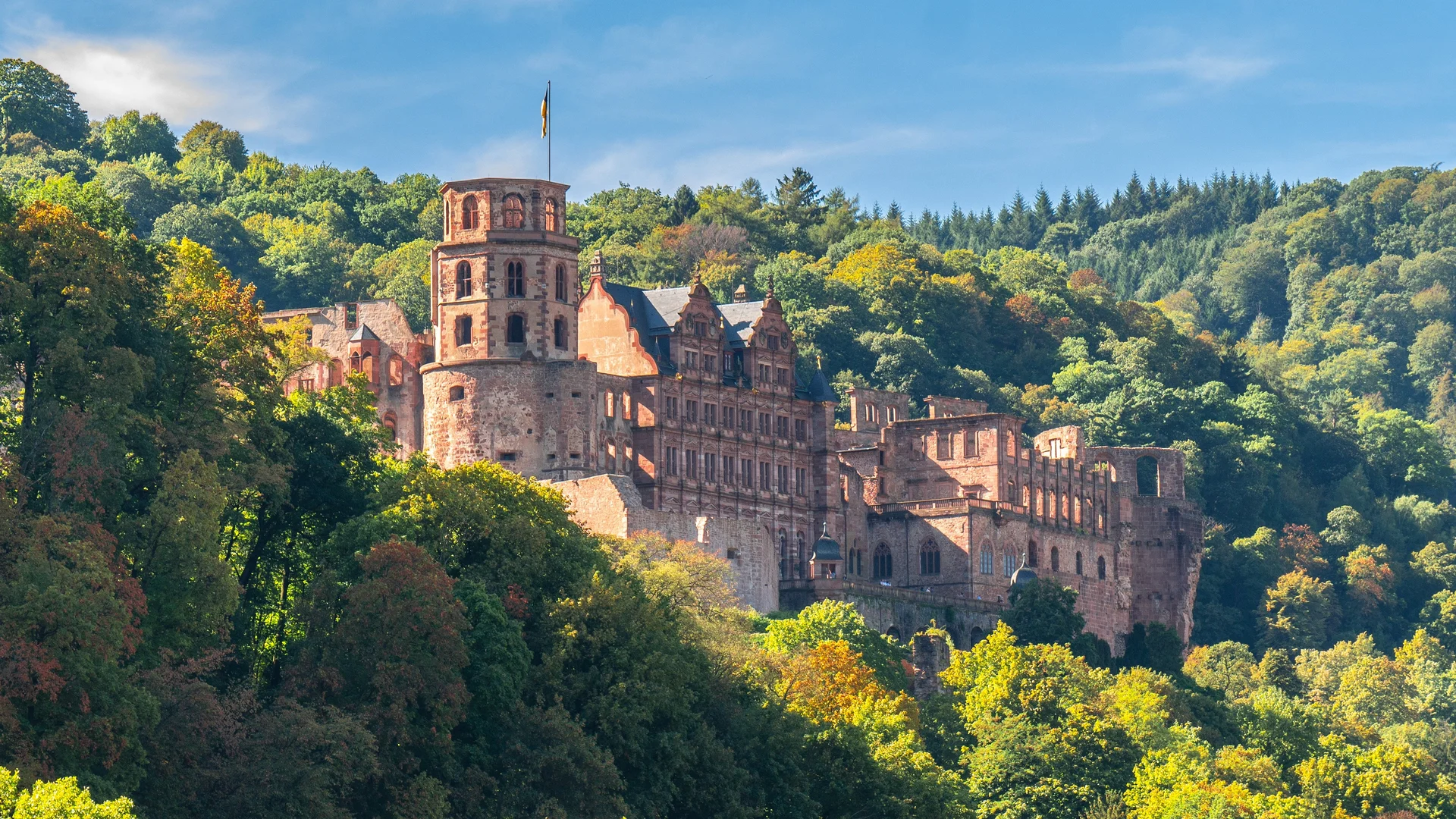
Visiting Heidelberg Castle
You get the most impressive view of the red sandstone ruins of Heidelberg Castle from the Philosophenweg (Philosophers' Walk), which runs along the opposite bank of the Neckar. Once the seat of the powerful prince-electors of the Palatinate, the site became a major symbol of Romanticism, bolstered by Victor Hugo in his travelogues, Le Rhin, Lettres à un Ami (The Rhine, Letters to a Friend).
A symbol of Palatine power
Construction of Heidelberg Castle began in the 13th century to defend the Neckar valley. At the time, it served as the residence for the prince-electors of the Palatinate of the Rhine. Starting in 1356, these counts gained the right to join six other provinces in electing the Holy Roman Emperor. The structure suffered heavy damage during the Thirty Years' War. Decades later, it was bombarded twice by French forces during the War of the Grand Alliance, a campaign intended to expand the reach of Louis XIV to the east.
Exploring the ruins of Heidelberg Castle
Despite several attempts at restoration, the castle was eventually abandoned when the seat of the Palatinate moved to Mannheim, followed by the fall of the dynasty in the 18th century. Today, you can walk through the ruins, which display quintessential Renaissance architecture. The chapel remains a standout, featuring an altar and organ with distinct Gothic details. Surrounding the castle, you can still see remnants of the Palatine gardens. These were once a lavish hillside estate designed by Salomon de Caus, featuring intricate grottos and water features.
Opening hours
| Monday | 09:00-18:00 |
|---|---|
| Tuesday | 09:00-18:00 |
| Wednesday | 09:00-18:00 |
| Thursday | 09:00-18:00 |
| Friday | 09:00-18:00 |
| Saturday | 09:00-18:00 |
| Sunday | 09:00-18:00 |

I highly recommend visiting Heidelberg Castle, which I found very interesting. The site is huge and will keep you busy for at least two hours. You will get to check out both the interior and the castle gardens. Its elevated position offers a magnificent view of the surrounding area. It is a tourist spot that attracts a lot of people in the summer, so do not be surprised.