
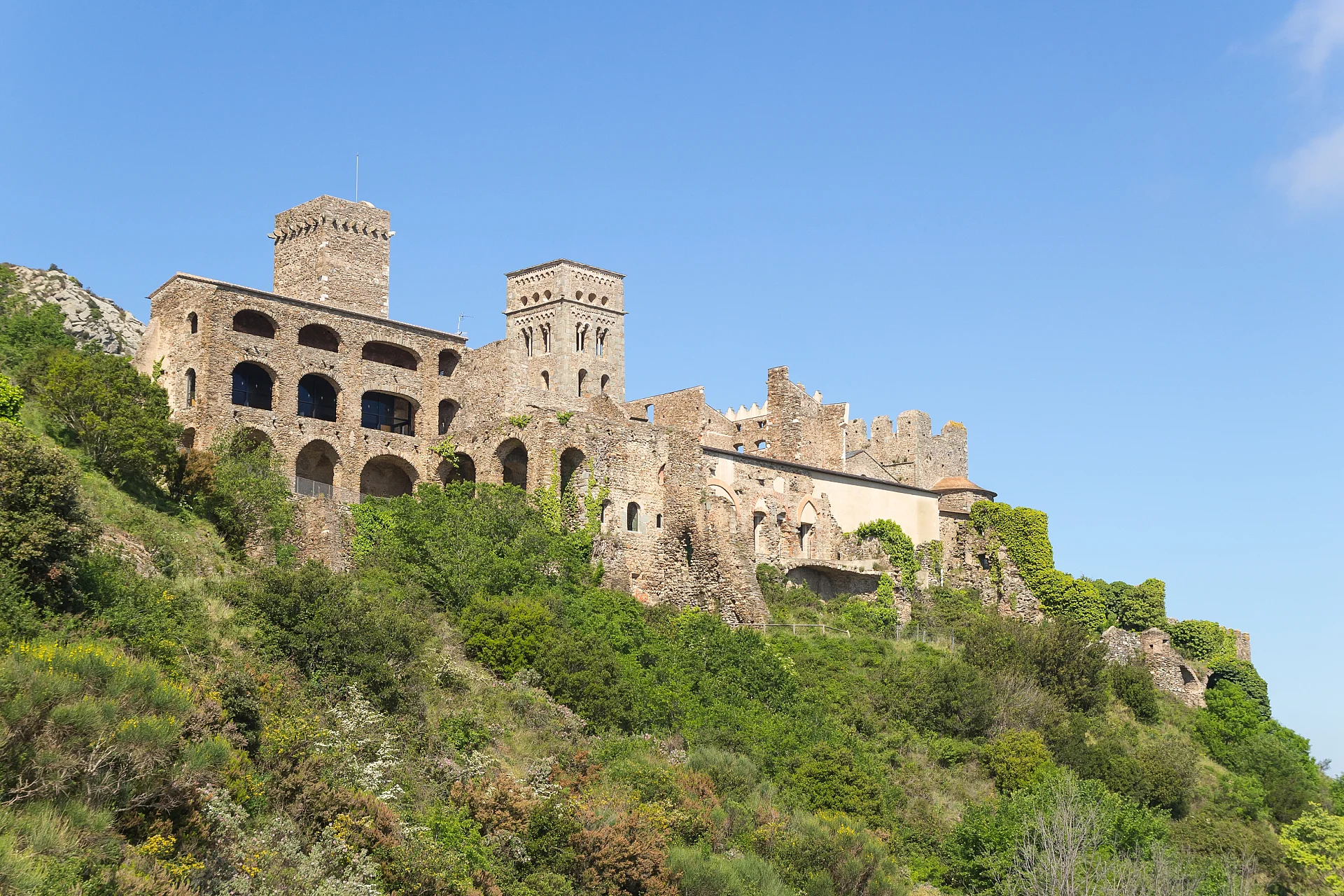
The monastery suspended between sky and Mediterranean
At an elevation of over 500 meters, clinging to the rugged slopes of the Albera Massif, the Monastery of Sant Pere de Rodes looms over the entire Costa Brava. On clear days, you can see the Pyrenees in one direction and the Gulf of Roses in the other. The tramontane wind blows almost constantly across this rocky promontory, carving out the silence as much as the stone.
Why visit the Monastery of Sant Pere de Rodes?
Founded around the 10th century by Benedictine monks, this monastery was for centuries one of the most powerful monastic centers in Catalonia. Its isolated, hard-to-reach position made it as much a spiritual fortress as a strategic refuge from the pirates and invaders that once threatened the coastline.
Gradually abandoned beginning in the 17th century, the site was looted and left in ruins for nearly two hundred years before undergoing a patient restoration that began in the 20th century. Today, it is designated as a Bien Cultural d'Interès Nacional (Cultural Asset of National Interest) and remains one of the most complete examples of Lombard Romanesque art in Spain.
Romanesque architecture that tells a thousand-year story
The abbey church, with its single nave and three apses, impresses with the stark simplicity of its volumes. The columns of the cloister, carved from local pink marble, still feature sculpted capitals with motifs that remain difficult to interpret, blending Carolingian and Mediterranean influences.
The bell tower, though partially collapsed, retains a proud stance despite centuries of neglect. It is worth a close look to understand the construction ingenuity of the era, featuring the blind arcades typical of Lombard Romanesque architecture found in other buildings throughout the region.
The most spectacular view on the Costa Brava
Many visitors arrive as much for the panoramic views as for the monastery itself. From the terraces and the remains of the nearby Castell de Sant Salvador (Castle of Saint Salvador), the landscape plunges toward the Cap de Creus and the jagged coves of the coast. Sunsets here are a regular draw for photographers and hikers alike.
Friendly tip: Come early in the morning or late in the day. The site is fully exposed to the south and gets very hot in the summer, with almost no shade on the parking lot or the access paths.
Best for
- Fans of Romanesque architecture and medieval history
- Hikers looking for a viewpoint over the Costa Brava
- Photographers seeking low-angle lighting
Less ideal for
- Those with limited mobility, as the site includes stairs and uneven ground
- Travelers without a vehicle, as the access road is winding and isolated
Opening hours
April to September: daily from 10:00 AM to 8:00 PM.
October to March: daily from 10:00 AM to 5:30 PM.
Annual closure: December 25 and 26, as well as January 1 and 6.
Entry to the site is permitted until 30 minutes before closing time.
How long for this activity
Plan on 1 hour 30 minutes to 2 hours to explore the entire site and take in the views. A half day is recommended if you also want to hike the surrounding trails.
*Information subject to change

Even though it is not in Cadaqués itself, I recommend taking a small detour to visit the Monastery of Sant Pere de Rodes. It is perched in the mountains. The view is truly breathtaking. There is a serene and spiritual atmosphere there. Plan for at least a few hours on site to see everything and take in the vibe.