
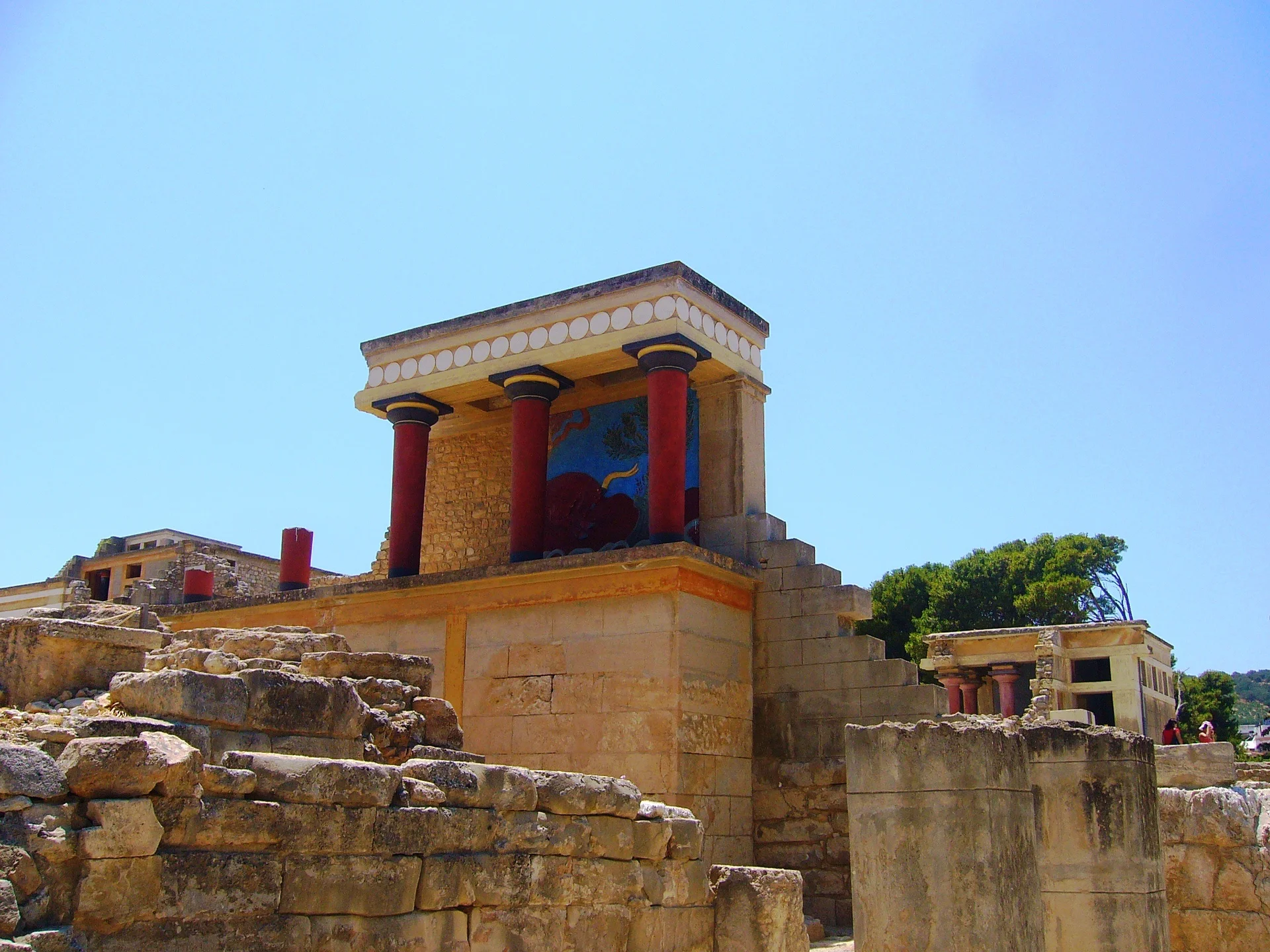
Visiting the Palace of Knossos
During the Bronze Age, palaces served as the hearts of Minoan civilization, and everything revolved around them. The Palace of Knossos was one of the most significant, covering two of the roughly five hectares that made up the settlement. Today, it stands as a major archaeological site, dating from 2000-1350 BCE, discovered in 1878. Intensive excavations led by Arthur Evans revealed the palace along with a nearby villa and a cemetery, discoveries followed by a restoration that remains a subject of debate. Located 5 km from Heraklion, the Palace of Knossos remains a must-see landmark.
An open-air maze
It overlooks the Kairatos valley and is said to have been the seat of King Minos himself. The legend of the Minotaur and its famous labyrinth hangs over the site, where a thousand rooms interlocked, accessed through various entryways. Built without fortifications, the Palace of Knossos was a true labyrinth that strikes visitors first by its sheer scale. Surrounding a vast central courtyard, four wings housing workshops, shrines, and various storehouses hint at the rich daily life that once unfolded here. The throne room, whether belonging to Minos or a priestess remains unknown, is decorated with frescoes featuring griffins. West of the main palace, a smaller structure emerges, dating from the 17th to 15th centuries BCE. Monumental facades, upper levels, a basin, lightwells, staircases, royal apartments, and a water management system show just how complex and advanced Minoan culture was. In the procession corridor, frescoes burst with color beneath columns, while giant storage jars, the pithoi, fill one wing of the palace. A tomb, a mansion with a pillar hall, and a high priest's house complete this grand site, which can sometimes disorient visitors through its reconstructions while offering a rare encounter with a remarkable vanished civilization.
Opening hours
*Information subject to change

I found the visit to this palace very interesting. I recommend you opt for a guided tour, which will help you get a better sense of what it was like back then. I don't think the building is in such bad shape after all. I learned a lot and was still impressed by it.