Visiting Saxon Switzerland
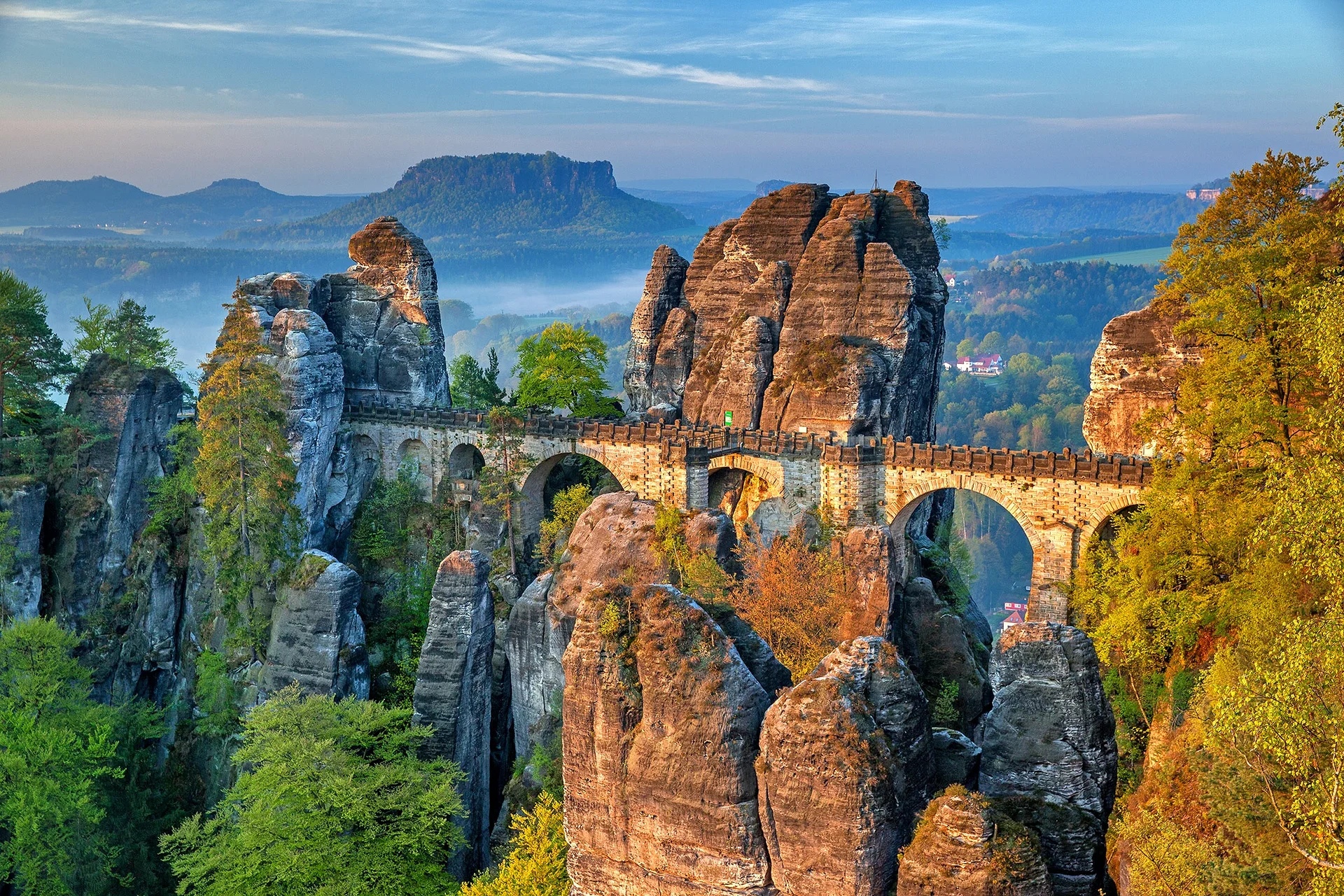
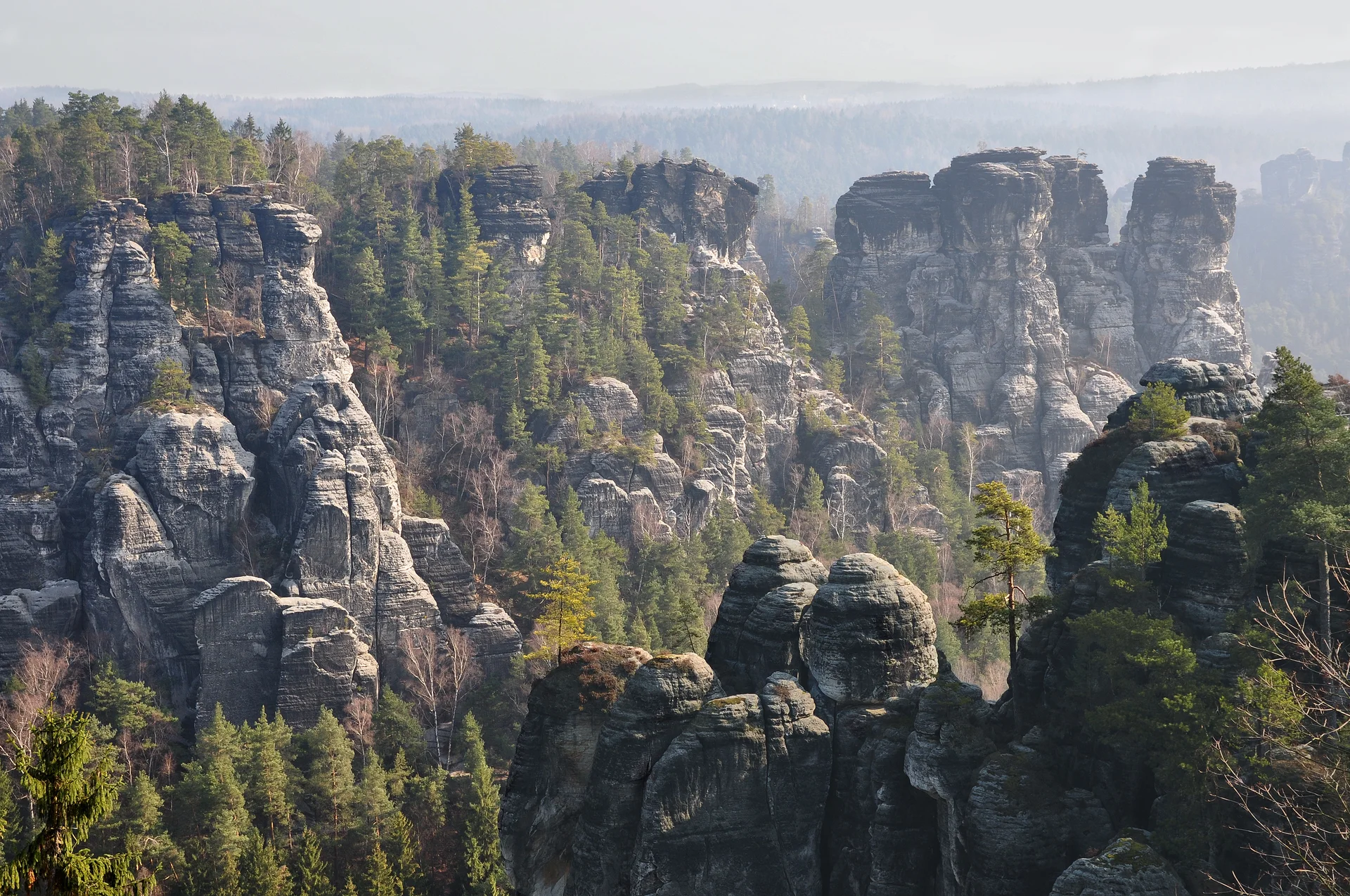
A sandstone massif along the Elbe, south-east of Dresden, up to the Czech border. Over millions of years, water carved the plateau into towers, needles and deep gorges, covered with pines and beeches. Above the valley, the Bastei Bridge spans the rocks, and Königstein Fortress sits on top of a stone table mountain.
In the 18th century, two Swiss painters living in Dresden recognised the landscapes of their homeland here and gave the region its name. Part of the massif is now a national park. You come to walk among the rocks, to climb, to sail down the Elbe on a paddle steamer and to sleep in small spa towns.
You'll love it if
- You love hiking, ladders and viewpoints
- You want to combine nature with an art city like Dresden
- You're after spectacular scenery without high mountains
Look elsewhere if
- You don't like walking or climbing steps
- You avoid weekend crowds at famous sights
- You want the sea or guaranteed sunshine
The must-sees
-
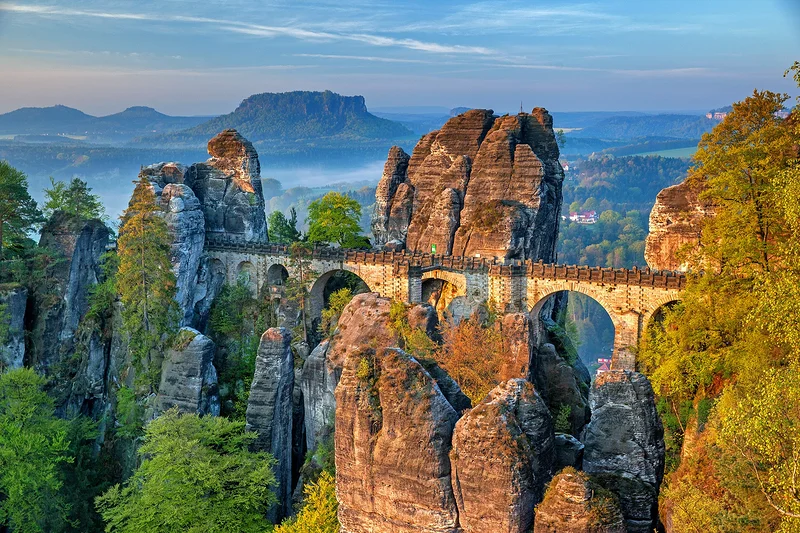
1 The Bastei Bridge +1 rec
A 19th-century stone bridge thrown between sandstone needles, nearly two hundred metres above the Elbe. Walk up from Rathen on a stepped path, early in the morning: the coaches arrive mid-morning.
-
One of the largest hilltop fortresses in Europe, set on a rock table above the Elbe. Its ramparts run all around the plateau, with a breathtaking view over the valley and the sandstone mountains. Allow half a day.
-
3 The Schrammsteine Hiking
A ridge of jagged rocks above Bad Schandau, crossed by iron ladders and narrow passages. At the top, the viewpoint takes in the whole region. Wear good shoes and leave any fear of heights at home.
-
4 The Kirnitzsch tram Experience
From Bad Schandau, an old tram climbs the wooded Kirnitzsch valley to a small waterfall. It has been running for more than a century. It's the starting point of several hikes to the Kuhstall, a giant stone arch.
-
5 The Felsenbühne theatre Show
In Rathen, an open-air stage is set between sandstone walls. From May to September, operas, plays and fairy tales are staged there, with the rocks as scenery. Book ahead, and bring a jacket: in the evening the bottom of the gorge stays cool.
The classic trap
Visiting the Bastei on a summer Saturday in the middle of the day. The car parks overflow and you cross the bridge in single file. Come on a weekday or very early, park down in Rathen and walk up: you'll avoid the crowds and see the morning light on the rocks.
Our itineraries in Saxon Switzerland
| Length | Route | What you see |
|---|---|---|
| 2 days | Pirna › Rathen and the Bastei › Königstein | The old town, the stone bridge and the fortress |
| 4 days | Pirna › Bastei › Königstein › Bad Schandau › Schrammsteine | The great sights, then the ridges and the Kirnitzsch valley |
| 1 week | The Malerweg, the Painters' Way, stage by stage | The whole massif on foot, from gorges to viewpoints |
Start with Pirna and its old town, then head to Rathen to climb up to the Bastei. The next day, visit Königstein fortress and go on to Bad Schandau. Got a week? Follow the Malerweg, a trail of about a hundred kilometres linking the finest viewpoints in eight stages.
When to visit Saxon Switzerland
| Appeal | Season | Temperatures | Highlight | Crowds and prices |
|---|---|---|---|---|
| WinterDec. to Feb. | -4 to 4 °C | Frosted rocks and quiet trails | Low | |
| SpringMarch to May | 2 to 19 °C | Green beeches and cool hiking | Medium | |
| SummerJune to Aug. | 12 to 25 °C | Boats on the Elbe and open-air theatre | High | |
| AutumnSept. to Nov. | 4 to 19 °C | Russet forests and mist over the valley | Medium |
Our advice
Come in May, June or September: the trails are good, the boats are running and the sights are less overrun than in summer. In October the forests turn russet and mist rises from the Elbe in the morning. Avoid summer weekends at the big sights.
Getting to Saxon Switzerland
-
By plane to Prague or Berlin The simplest
Prague has direct flights from London and many UK cities and is about an hour and a half's drive from Bad Schandau. Berlin is a little over two hours by train to Dresden; Dresden's own airport has few flights from the UK.
-
By train along the Elbe Without a car
Eurocity trains between Berlin and Prague stop in Dresden and Bad Schandau, and the local S-Bahn runs up the Elbe valley to Pirna, Rathen, Königstein and Bad Schandau. The region is easy to explore without a car.
-
By boat on the Elbe For a day out
From Dresden, paddle steamers sail up the Elbe to Bad Schandau in a few hours, from late spring to autumn. The trip is slow: save it for a day out rather than your arrival.
Once there, the train runs along the Elbe and serves almost every village in the valley. Ferries link the two banks at Rathen, Königstein and Bad Schandau. For the plateaus and hilltop villages such as Hohnstein, take the bus or a car.
Getting around Saxon Switzerland
The regional train is your best friend: it follows the Elbe valley every half hour. Ferries cross the river, buses climb to the plateaus, and the little Kirnitzsch tram runs up its valley. On foot, a dense network of waymarked trails links all the sights.
Good to know
Some trails use iron ladders and narrow stairways: check the difficulty before setting off with children. In the national park, stay on the marked paths. A regional day ticket often covers trains, buses and ferries at once.
What to eat in Saxon Switzerland
- Saxon Sauerbraten: marinated roast beef with a gingerbread sauce and potato dumplings.
- Kartoffelsuppe: potato soup with sausages, the dish of the mountain huts after a hike.
- Quarkkäulchen: small pancakes of quark and potato, fried and sweetened.
- Eierschecke: Dresden's three-layer cake of quark and egg custard.
- Elbe wines: dry whites from the slopes between Dresden and Meissen, among the most northerly in Europe.
- Saxon beers: local breweries serve their pils and dark beers in the inns.
To eat like the locals, stop at a Baude, a mountain inn beside a trail, for soup or a roast. In the afternoon, you'll find homemade cakes in the village cafés. In the evening many kitchens close early: book before you head out walking.
Where to stay in Saxon Switzerland
| Area | What for | Good to know |
|---|---|---|
| Pirna | Old town, train, gateway to the region | The most practical |
| Rathen and Wehlen | Bastei, open-air theatre, Elbe | The most spectacular |
| Königstein | Fortress, Lilienstein, hikes | The most central |
| Bad Schandau | Spa, Schrammsteine, tram | The most complete |
| Hohnstein and Sebnitz | Gorges, plateaus, hilltop villages | The quietest |
How much does a trip in Saxon Switzerland cost?
| Trip | Length | Budget per person |
|---|---|---|
| Budget (guesthouse, train, inns) | 4 days | €300 to €450 |
| Comfort (hotel on the Elbe, boat, restaurants) | 4 days | €550 to €850 |
| Luxury (spa hotel, wellness, fine dining) | 4 days | €1,000 to €1,600 |
- Transport: a regional day pass covers trains, buses and ferries and saves you the car.
- The fortress: entry is charged, so allow half a day to make the most of it.
- Paddle steamers: one way is often enough, coming back by train.
- The season: outside German school holidays you often pay less.
- The inns: their dishes of the day are the best deal in the region.
Traditions and way of life in Saxon Switzerland
In the 18th century the Swiss painters Adrian Zingg and Anton Graff, living in Dresden, found the landscapes of their homeland in these rocks and named them Saxon Switzerland. The Romantics came after them, including Caspar David Friedrich: today the Malerweg, the Painters' Way, follows in their footsteps.
At the end of the 19th century the region became one of the birthplaces of free climbing. Climbers opened routes on hundreds of sandstone towers, without chalk or added bolts, following rules still respected today. Spot a figure on a needle above the path? They may be climbing by those century-old rules.