
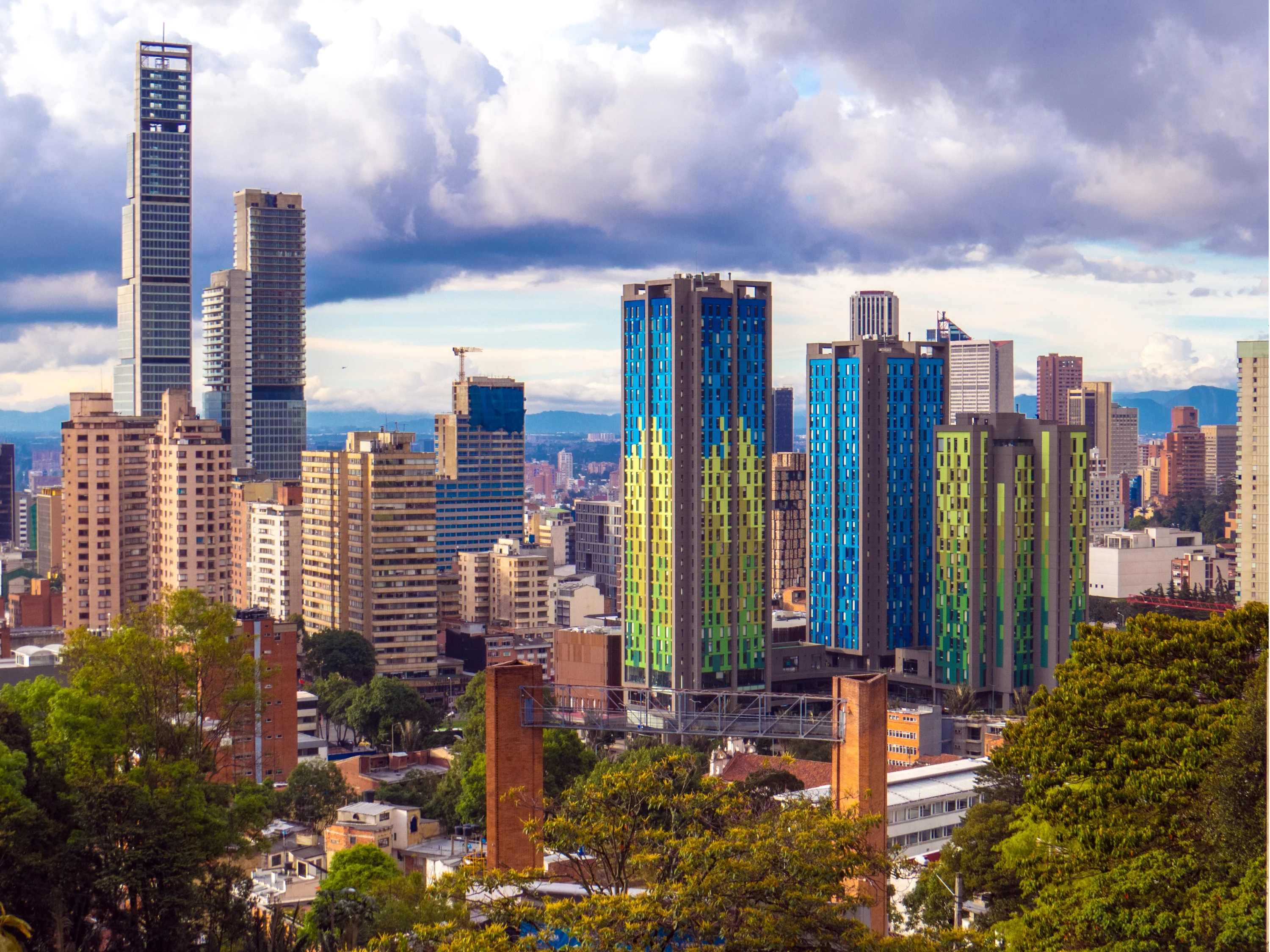
Where to stay in Bogotá: the 5 neighborhoods to know in 2026
In Bogotá, you pick your neighborhood by a calle number. The city sits at 2,640 meters on an Andean plateau, and its streets are counted: the calles climb from south to north, and the higher the number, the calmer, pricier and further from the historic center the neighborhood is. La Candelaria fits below Calle 20, the Centro Internacional between 26 and 36, Chapinero from 45 to 100, Usaquén from 110 upward. A single avenue strings them all together, the Carrera Séptima, and on Sunday mornings it belongs to bicycles.
Dorms rent for $14 to $21* a bed, a well-kept three-star asks $34 to $79*, and the big hotels of Chapinero, Usaquén or Salitre go anywhere from $101* up to $340*. Fifteen addresses checked one by one, and the three members who have rated the city, who talk about traffic, altitude and air more than museums: all three are quoted, because they settle the question of where to sleep better than any monument.
One day is enough to soak up its authentic markets, the charming historic center, the local rumba scene, or even to get tired of its constant traffic jams, its altitude, and its pollution spikes.
Compare hotel prices in Bogotá
In a hurry? Find the best accommodation deals in 3 clicks.
Compare live deals from Booking, Expedia, Agoda and other partners.
At a glance: our picks by traveller type
Pick the profile that suits you to head straight to the recommended neighborhood.
The neighborhood map in Bogotá
Get your bearings on the neighborhoods and must-see sights before choosing where to drop your bags. Click a name to jump to its description.
La Candelaria Historic center, below Calle 20: Plaza de Bolívar, Gold Museum, Botero Museum, Chorro de Quevedo, Monserrate
for museums on foot, painted facades and the Monserrate funicular
La Candelaria is the city of 1538, sloping up against the mountain: cobbled streets, low houses with ochre and blue walls, wooden balconies, and a museum every hundred meters. The Plaza de Bolívar is its base, with the cathedral, the Capitol and the presidential palace; two streets higher, the Botero Museum, free, and the Casa de Moneda; on the Carrera Séptima, the Gold Museum and its dark rooms where pre-Columbian pieces float in the light. To the north, the little square of the Chorro de Quevedo, its storytellers and its chicha bars; above it, the Monserrate funicular climbs to 3,150 meters. The downside: the neighborhood empties at night and the sloping streets turn dark; you go home by app taxi after ten in the evening, and one member review recalls what the air of the center costs.
There are too many cars, and aside from a few streets, walking around is not pleasant. And the pollution! By the second day, I had a nosebleed!
Where to stay in this neighborhood
Hotel De La Opera Luxury
Calle 10, right beside the Colón theater and across from the San Carlos palace: two colonial houses joined together, an indoor pool, a spa, two restaurants, and balconies over the roofs of La Candelaria. Eight hundred reviews, 8.4.
Masaya Collection Camelia Mid-range
Carrera 2, five minutes from the Luis Ángel Arango library: a four-star in an old house, a breakfast the reviews mention first, and 9.3 on nearly five hundred reviews, at the price of a big hotel elsewhere.
The Cranky Croc Hostel Budget
Calle 12D, three hundred meters from the Chorro de Quevedo: garden, terrace, a restaurant with vegan options, dorms and family rooms, and 9.2 on more than six hundred reviews, the best hostel score in the center.
Pros
- Plaza de Bolívar, the Botero Museum and the Gold Museum on foot
- The Monserrate funicular fifteen minutes' walk away
Cons
- The streets empty and darken after ten in the evening
- The traffic and the air of the Séptima at rush hour
Centro Internacional and La Macarena Calles 26 to 36: National Museum, Torre Colpatria, bullring, Independence Park, La Macarena
for the National Museum, the 1970s towers and the restaurants of La Macarena
Between Calle 26 and the national park, the city built its modernity: the Torre Colpatria, fifty floors from 1979, the red-brick bullring, the Tequendama hotel of 1953, and the National Museum, housed in the cross-shaped penitentiary of 1874. The Museum of Modern Art and the planetarium close off Independence Park. Behind, against the mountain, La Macarena: stepped streets, brick houses, and the highest density of small restaurants in the city, from bistro to arepa counter. The TransMilenio stops at Museo Nacional, on the Séptima. The downside: Calle 26 is an urban expressway, and the neighborhood is a place you pass through, not one for evenings.
Where to stay in this neighborhood
GHL Hotel Tequendama Bogotá Luxury
Carrera 10 and Calle 26: the city's historic grand hotel, opened in 1953, renovated without erasing its lounges, a morning buffet that six thousand reviews mention, and three-star rates for a five-star of another era. 8.8.
Casa Macarena Mid-range
Next to the National Museum: eight apartments, each designed after an architect, from Le Corbusier to Rogelio Salmona, with kitchen and fireplace. Only about fifty reviews, 8.9.
ibis Bogota Museo Budget
Fifty meters from the National Museum: chain rooms with no surprises, free parking, and more than five thousand reviews that give the location a 9.1. Breakfast costs extra.
Pros
- The National Museum and the Museum of Modern Art on foot, La Candelaria twenty minutes away
- The restaurants of La Macarena, the TransMilenio on the Séptima
Cons
- Calle 26 and its eight lanes to cross
- An office district, quiet in the evening and empty on Sundays
Chapinero, Zona G, Zona T and Parque 93 Calles 45 to 100: Zona G, Zona T, Parque de la 93, El Chicó, Calle 72
for dining, going out and sleeping in the Bogotá that works
Chapinero is fifty calles long, and each set of ten has its use: around Calle 70, the Zona G, two streets of restaurants in brick houses; around 82, the Zona T, its bars and its terraces laid out in a T; at 93, the Parque de la 93, a square of lawn ringed by cafés, and behind it El Chicó, its villas and its small colonial museum. In between, office towers, shopping malls and the chain hotels. You walk here in the evening, you run here on Sundays on the closed Séptima. The downside: no monuments, and a taxi to reach La Candelaria, forty minutes at rush hour. One member review sums it up.
You can easily party here every weeknight if you want to. The downside is getting around.
Where to stay in this neighborhood
Four Seasons Hotel Casa Medina Bogota Luxury
On the Séptima at the level of the Zona G: a 1946 house with beamed ceilings and stone fireplaces, a listed monument, a restaurant under a glass roof and a spa. A hundred and forty reviews, 9.
The Click Clack Hotel Bogotá Mid-range
Carrera 11, two minutes from the Parque de la 93: a design hotel with a rooftop bar and a breakfast that thirteen hundred reviews mention, 9.6 for location. The cheapest rooms are small.
Vecinos by La Palmera Budget
Near the church of the Porciúncula, Calle 72: an adults-only hostel, garden, shared kitchen, beds with curtain and socket, a do-it-yourself breakfast. More than four hundred reviews, 8.4.
Pros
- The restaurants of the Zona G and the bars of the Zona T on foot
- The safest streets in the city for walking home at night
Cons
- Nothing to visit: you sleep here to go out and to work
- Forty minutes by taxi to La Candelaria at rush hour
Usaquén and the north From Calle 110 upward: Usaquén square, Sunday flea market, Hacienda Santa Bárbara, Unicentro
for the colonial village inside the city, the Sunday market and families
Usaquén was a village before it was a neighborhood, and it has kept the square: a white church of 1665, low houses, restaurants in the patios and, on Sundays, the flea market that spills into every street around. Next door, the Hacienda Santa Bárbara, a colonial farm turned shopping mall, and Unicentro, the oldest in the city. This is the north of Bogotá families, with wide pavements, parks and recent chain hotels. The downside: an hour's drive to La Candelaria, and an evening life that ends with dinner.
Where to stay in this neighborhood
Sonesta Hotel Bogotá Luxury
Carrera 15A, facing Unicentro: rooms in grey tones with king beds, two restaurants, a spa and free parking. Fourteen hundred reviews, 9.3, the best score in this guide.
Hampton by Hilton Bogota Usaquen Mid-range
Carrera 7 and Calle 118, five minutes from the square: hot breakfast included, free parking, a gym, and nearly nine hundred reviews that give the location a 9.3.
Hotel Casona Usaquen Budget
Calle 117, a hundred meters from the square: a low house with terrace and restaurant, single to triple rooms, and nine hundred reviews that mention the neighborhood first, where you walk home at night. 8.6.
Pros
- The square, its restaurants and the Sunday market on foot
- The quietest streets in this guide, and the best-rated hotels
Cons
- An hour's drive to the historic center
- Nothing to see on weekdays beyond the square
Teusaquillo, Salitre and the west West: Parkway, National University, El Campín stadium, Corferias, Salitre Mágico, Maloka, botanical garden
for the airport, the Corferias trade fairs and children
Teusaquillo is the neighborhood of 1930s English-style houses, brick and little gardens, around the Parkway, a planted avenue where people walk their dogs. To the west begins the Salitre: the Corferias exhibition center, El Campín stadium and its football Sundays, then the botanical garden, the Salitre Mágico amusement park and the Maloka science museum. El Dorado airport is a quarter of an hour away by Calle 26. The hotels here are new, chain-run, and full of conferences on weekdays. The downside: nothing old, and half an hour of TransMilenio to reach La Candelaria or Chapinero.
Where to stay in this neighborhood
Grand Hyatt Bogota Luxury
Calle 24A, two kilometers from Corferias: a new tower with garden, pool, spa and restaurants, and 9.2 on eight hundred reviews, fifteen minutes from the airport.
Hotel Fontana Bogotá - Corferias Mid-range
Nine minutes' walk from Corferias, in Teusaquillo: a three-star with garden and gym, coffee and tea at any hour, and 9.1 on seven hundred reviews, the best balance between score and price in this guide.
Bendito Hostels Budget
Carrera 16 and Calle 40A, two streets from the Parkway: dorms of four to ten beds in a Teusaquillo house, and thirteen hundred reviews at 8.9.
Pros
- The airport fifteen minutes away, Corferias on foot
- The botanical garden, Maloka and Salitre Mágico for children
Cons
- Nothing old to see, the center half an hour away by TransMilenio
- The hotels fill up and get pricier during trade fairs
Our tips for booking the right place
- Altitude first: Bogotá sits at 2,640 meters, and the plane drops you there in one go. On the first day, walk slowly, drink water, eat a light dinner, and keep Monserrate, at 3,150 meters, for the second or third. A hotel on flat ground, in Chapinero or Usaquén, spares the slopes of La Candelaria to lungs still short of breath in the first hours.
- On Sunday, the Séptima belongs to bicycles: From seven in the morning to two in the afternoon, the Ciclovía closes more than a hundred kilometers of streets to cars, the Carrera Séptima first among them, from La Candelaria to Usaquén. It is the only moment when the city can be crossed from one neighborhood to the next without a traffic jam: renting a bike near the hotel and riding up the calles is the best tour of Bogotá, and it is free.
- TransMilenio, app taxi, never a hailed car: The TransMilenio, buses on dedicated lanes, serves the Séptima, Calle 26 and the Avenida Caracas: fast, packed, to be avoided with luggage. Everything else is done by app taxi, never by a taxi hailed in the street at night. Allow forty minutes between La Candelaria and the Parque de la 93 at rush hour, twice that on a rainy Friday.
- A jacket all year round: There are no seasons, there are hours: eight degrees at dawn, twenty at noon, a downpour in the late afternoon almost every day from April to May and from October to November. The hotels have no air conditioning and often no heating: a south-facing, sunny room beats a north-facing one, and an extra blanket is asked for at reception.
- The streets south of Calle 6 and the Santa Fe district, west of La Candelaria, where the cheap hotels sit next to the streets you do not cross at night.
- A hotel in Fontibón or the free-trade zone, near the airport, for anything other than a dawn flight: warehouse districts, far from everything.
- A street-side room on Calle 26 or the Avenida Caracas: the TransMilenio passes every minute from five in the morning to midnight.
FAQ: where to stay in Bogotá
Which neighborhood should you stay in for a first time in Bogotá?
Where to stay cheaply in Bogotá?
How many nights should you plan in Bogotá?
Is Bogotá safe for a traveler?
How do you get to the center from the airport?
How much does a night in Bogotá cost?
 Keep exploring
Things to do in Bogotá
Keep exploring
Things to do in Bogotá
Comments (0)
No comments yet. Be the first!