
A destination still sunny in September
The end of summer was approaching, all my coworkers were coming back from vacation with a tan, and I was pale and tired. September was looking gloomy for me, since I hadn't been able to take any summer break because of work. So I finally caved and, with the agreement of my project manager, who still had the tan lines of his sunglasses visible on his sun-kissed face and took pity on me, I checked out tour operators' websites to find some sun. And right there, I found an 8-day trip to the Canary Islands, more specifically to the island of Fuerteventura.
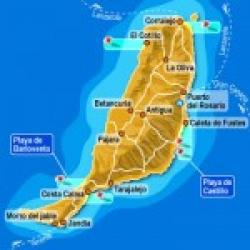
I had never thought about going there, but I must admit that after talking about it with people around me, it's a destination famous for sunshine and still relatively low costs. For example, my trip cost me 430 euros per person, breakfast and dinner buffet included in a three-star hotel.
So it was while doing some research that I learned the Canary Islands are actually one of the Spanish federated states or "autonomous communities," just like the Balearic Islands, Andalusia, the Basque Country, or Catalonia, for instance. I was heading to Spain, but judging by the photos of this volcanic island in the Atlantic Ocean, a complete change of scenery was guaranteed.
Indeed, after a flight of a little over four hours on an EasyJet plane (though it seems there are shorter ones), I landed at the small El Matorral airport located just south of the capital of Puerto del Rosario. Before landing, I could already see that a change of scenery was definitely in store: long beaches, arid volcanic landscapes, no doubt about it, I was far away from France!
Practical information about Fuerteventura
The great thing about the Canaries is that you get a complete change of scenery without too many formalities. Even though you leave Paris and get closer to the Tropic of Cancer, you are still in Spain! Also, as a member of the European Union, arrival checks are no longer mandatory. But hey, just to be safe and because you're flying, bring at least a national ID card, or even your passport, and you'll have peace of mind.
As for money, the local currency is the euro. Credit cards are accepted in all tourist areas, whether to pay for hotels, restaurants, rentals, etc. There are ATMs in the major towns.
Checking into our hotel
After landing and picking up our luggage, we were greeted by a woman representing the agency of the tour operator we had chosen. We then took a bus toward our three-star hotel ("Lobos Bahia"), located toward the north of the island in Corralejo. In the parking lot, on the way to the bus, I was struck by the strong wind blowing. I then remembered reading that the area is also a top spot for surfers and windsurfers.
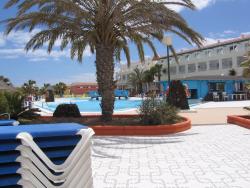 Arriving near the hotel, we noticed that real estate development was very present: a dozen hotels were popping up out of the ground and the horizon was filled with cranes. You can feel that tourism is developing at a rapid pace. I would learn later that Fuerteventura had fallen a bit behind in that regard and was trying to catch up.
At the hotel, the guide let us check into our rooms.
Ours was located on the second floor, with a balcony offering a lovely view of the hotel pool.
The room was spacious and consisted of a living room, a bathroom, and a bedroom with two single beds (no double bed despite our request) side by side. The only somewhat negative point: we had to make sure to tightly close the French door leading to the balcony because the strong wind blowing through the rubber insulation created a kind of whistling sound that quickly became getting on our nerves.
Activities offered by the hotel
Once we had changed and freshened up, we all met at the scheduled time for a short briefing meeting about the activities within the hotel and, more generally, on the island during our stay. One of the activities offered to us was a quad bike tour. We signed up for it for the day after next.
At the end of this little get-together, the staff offered us a welcome drink made of rum and honey. Pretty nice, but still a bit strong... We were then led over to the buffet where, accompanied by our guide who explained what was in front of us, we tried several specialties: chorizo, olives, and potatoes with bell pepper and cilantro sauces. Next up was seafood, notably fried calamari seasoned with garlic and meant to be dipped in a sauce. To wrap things up, after a lovely cheese board and fresh fruit, we finished with a dessert that looked like caramel custard, "leche asada".
 After that heavy meal, a little digestive stroll was in order! So we took a walk around the park before heading out of the hotel and walking along the waterfront toward a huge sandy expanse. And there came the surprise: among the rocks along the path, squirrels came right up to see us, trying to snag a bite to eat. Their cute little faces and frantic appetites were a huge hit with the German and British tourists strolling along the coast.
The path was lined with pine trees. Canary Island pine trees are practically an endemic species. They have the distinct feature of having three needles, which seemed to delight the little rodents.
After a thirty-minute walk back (since the nearest town was still quite far on foot...), we made it back to our hotel. Every evening, a DJ spun tunes in a room turned into a disco. Perhaps because of the season, not many people were partying there, so we had the whole dance floor to ourselves! Word is that this kind of spot is really taking off, hotels included.
Over the next few days, we split our time between the hotel's 3 pools and the scheduled activities. To be fair, though, the wind never left us, and on the rare occasions when clouds rolled in to block the sun, the breeze felt very chilly. From what one of the hotel staff tried to tell us, that is just the risk you take when visiting around mid-September.
Excursions and discovering Fuerteventura
Quad biking
Among our outings, we tested out the 4x4 quad bike tour. We headed out in a group by bus to the rental site in the north of the island near Corralejo, and we had a blast since the wide-open sandy plains are perfect for that kind of fun. Plus, our accompanying guide pointed out the island's varied volcanic and sandy landscapes. You do not need to be an expert driver to tame these machines; driving them is pretty straightforward and we were well looked after.
During our excursion, we noticed all the ads for the Corralejo Natural Park. We went back a few days later as part of a planned excursion with the other hotel guests.
The Corralejo Natural Park
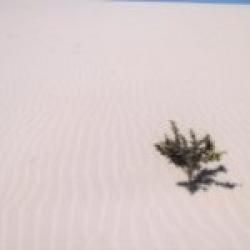 The white sand dunes completely shape the landscape. In fact, you are practically at the edge of the Sahara Desert. The colors are gorgeous, especially when the sun makes the dunes look like they are glowing right before it dips down toward the sea. Honestly, it was well worth seeing, so when I realized I had left my camera back in the hotel room, I had a few regrets... Sorry, I can only show you pictures of it I found online!
The dunes have been classified as a Natural Park since 2002.
Note: the tour was given in German, English, or Spanish, but for our group, our guide provided simultaneous translation.
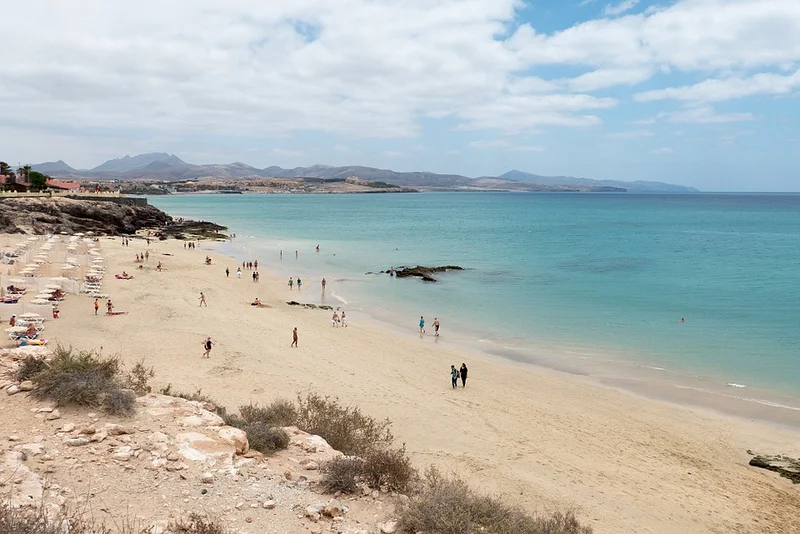
Once you cross through them, you plunge toward an unbelievably blue sea. The beach is stunning and long, and honestly, it felt like paradise!
Water sports and surfing
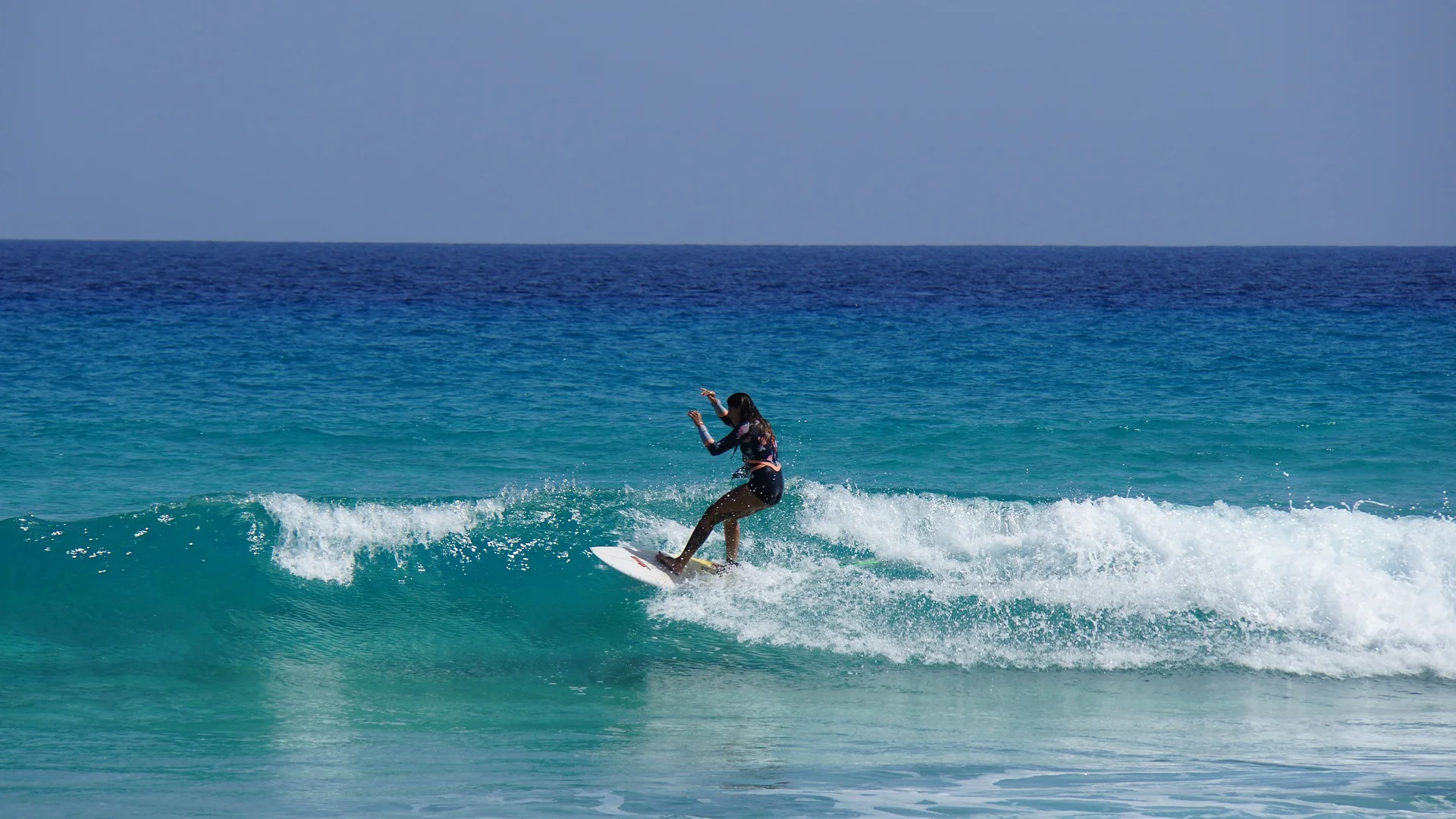
The only downside if you are not a fan of water sports: more wind, again and again! Perfect for windsurfing or surfing (though you still need to watch out for currents and waves), the breeze cooled things down whenever the sun got a bit too intense.
The area is truly famous for board sports fans, but judging by the size of those swells, you really need a solid foundation to handle it. I am not sure a beginner would have much fun out there. Just getting past the break requires serious arm strength. And after that, you have to be tough because the wipeouts were pretty spectacular. In any case, for locals and seasoned athletes (including some French folks who came all the way from Biarritz for their annual pilgrimage), Fuerteventura has several great spots.
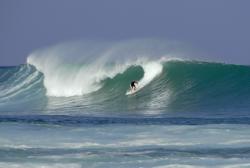
That goes for other places in the Canaries too, and enthusiasts can easily track down info on surfer websites and blogs.
The downside of that wind was that as soon as the sky got even slightly overcast, you had to fight the urge to put your T-shirt back on.
Either way, the place really invites you to slow down, meditate, and just lounge around... Now that truly felt like a real vacation!
For once, even though I could see that the Corralejo area was really geared toward tourism, the sheer size of the beach meant we weren't packed on top of one another. By walking just a little bit, it was possible to feel like we were enjoying these landscapes all to ourselves and savor a bit of privacy.
Visiting the capital, Puerto del Rosario
It is hard to describe the city, as it has a hodgepodge architecture and, unfortunately, we hadn't brought our guidebook with us. We no doubt missed some sights worth seeing, but we still managed to notice a few houses and churches with surprising styles. Sometimes, certain buildings even show traces of Andalusian culture or, in other cases, signs that looked like Mayan symbols (mind you, I have to admit I don't know enough about history here and I might be making a huge blunder...). But in any case, it was a far cry from the villages of small, square white houses we spotted on our way to the Corralejo National Park.
The visit was pretty short, but anyway, we hadn't found that many activities to do. So we headed back to the hotel to soak up the sun by the pool.
The night before we left, the tour operator and the hotel organized a small traditional party where singers were accompanied by musicians playing the "timple", a small four-string guitar. You will see a lot of them in souvenir shops. There were also larger instruments that produced the same sound as mandolins. Once again, we drank and ate local specialties.
Conclusion
To wrap things up, I would tell you that I went there for the sun and was pleasantly surprised to also find plenty to see in an area I thought was exclusively dedicated to lazy beach lounging or sports. Plus, you really do feel like you've traveled somewhere totally different. The red island, as it is nicknamed, offers landscapes I hadn't seen anywhere else. The only slightly less positive point is the lack of cultural opportunities. Aside from all the information you can get about nature or church visits, I wasn't offered many tours related to the island's history. But honestly, I didn't really go there for that anyway. So, when it comes to unwinding and taking a total break, go for it! To guarantee yourself some sunshine, aim for July, August, and mid-September, and make the most of it!

Comments (0)
No comments yet. Be the first!