
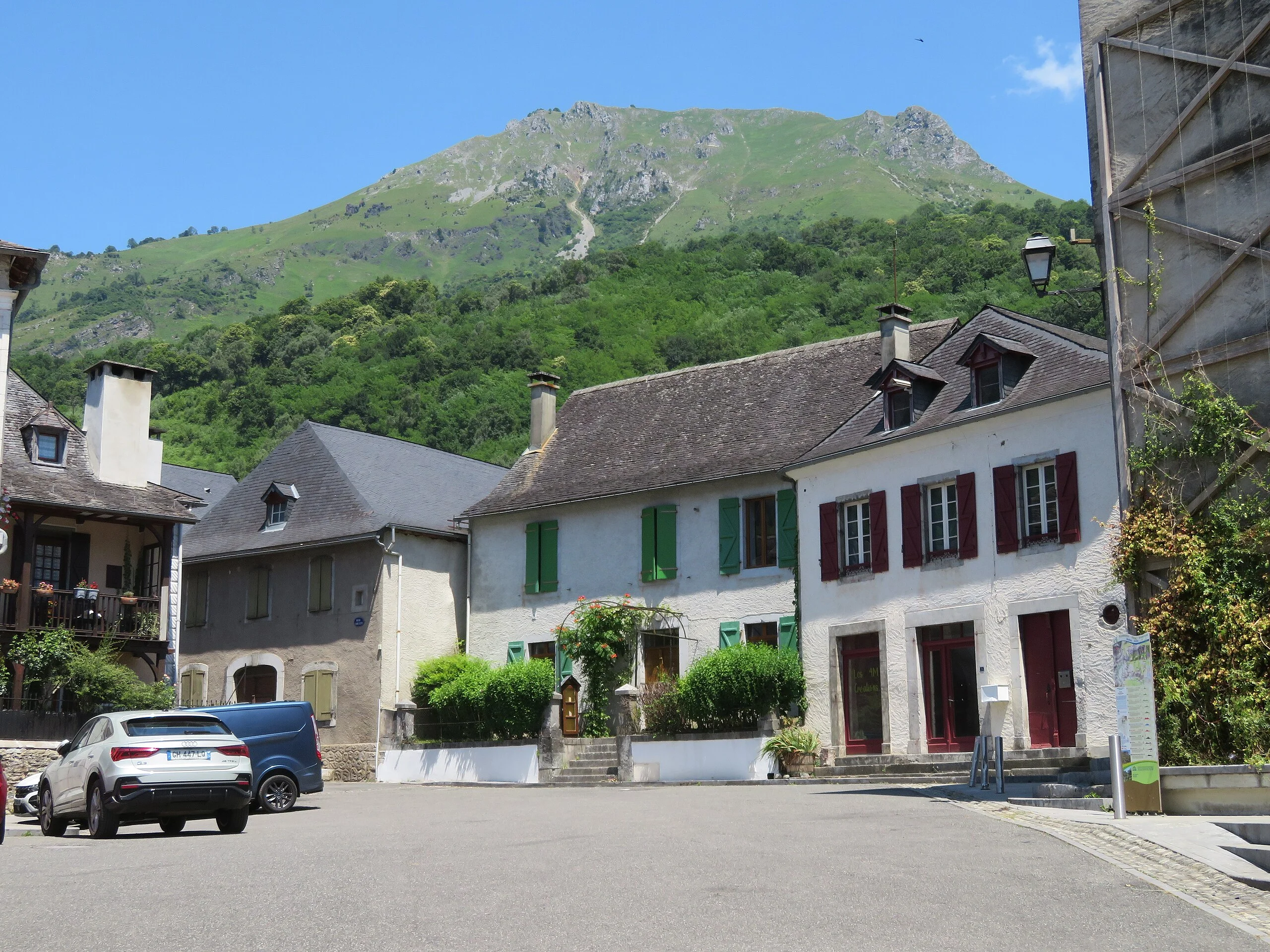
Its name seems to be derived from the root betu (betulla meaning birch in Latin), which also signifies a place where birch trees grow. …So, you’re asking yourself… well, what about the name??..... Pfft, no patience at all! The name, then, is Bedous.
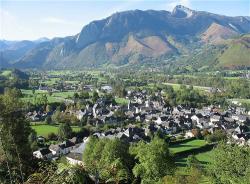
The town serves as the small economic capital of the region, hosting the largest market in the canton and providing administrative services like its gendarmerie, middle school, and tourist office. That said, its economy is primarily agro-pastoral, focused on farming and livestock (cattle and sheep). Farmhouse cheese production is also a key resource.
There is a slate quarry in the commune, with the stone traditionally used for roofing on Béarnais (or Souletin) homes.
Humans have been present in the Aspe Valley since prehistoric times, and their presence in Bedous is proven by the discovery of a burial cave and a few protohistoric pottery shards. Excavations have uncovered an ancient road that connected Oloron to the Somport pass, a very old story, then ;-)
Bedous developed along the old pilgrimage route to Santiago de Compostela, which followed the path of an ancient Roman road. This antique route connected Beneharum (modern-day Lescar), passed through Ilhuro (the ancient name for Oloron), and led to Caesar Augusta, Zaragoza on your maps (no, not on mine). Emerging from the Suzou gorge, this old road offers a superb view from the top of a hill, not just of the village of Bedous at its feet, but of the entire vast, circular basin surrounded by an impressive mountain cirque.
From Orcun to Accous, the old road carries on the legacy of the former Roman route. 1.5 km from Bedous, it runs alongside the former Suberlaché baths to the right, which were later turned into a summer camp… lovely summer camps, indeed. This is actually where the Abbey of Saint-Jean-de-Laxé was located in the Middle Ages. The valley's jurats (local magistrates) used to meet there, and it was where the manuscripts of the local laws and charters were kept, as well as where pilgrims were welcomed. (Yes, indeed… pilgrims… always the pilgrims!)
Legend has it that the King of England stayed there in 1288. It was later destroyed by a fire and then fell victim to a flood of the Gave river. Today, only its memory remains. A real shame.
You cross through Bedous via Rue Notre-Dame. The village grew to the left and right of this street, as well as around the first parish church dedicated to Our Lady, which gave the street its name. We don't know much about the church, other than that work was done on it in 1696, followed by restorations between the 17th and 18th centuries on the walls, the vault, the bell tower, and the roof.
During the Revolution, it was transformed into a guardhouse, then a meeting place for citizens, before being used as a warehouse for firewood and ammunition. It was destroyed in the early 19th century, and today only its site remains.
The secular abbey (abbadie or appatie in Béarnais) was located next to this church. This building passed through several families: the Abadies until the early 17th century, the Lasalles during the 17th century, the Moutengous afterwards, and the Fourcades until the 19th century. By the end of the 18th century, it was in ruins and used as a barn, then it was rehabilitated and rebuilt in the early 19th century. Nothing remains of its medieval character… but the building is still beautiful.
Bedous and its town center
Rather than the modern part of the village bordering the national road, you might prefer the Place de l'Hôtel de Ville, the starting point for a walk through the old town with its historic houses. This central square in Bedous is Place F. Sarrailhe. With its 13th-century noble house (in ruins since the 17th century) and the Château Lassalle (12th century), which was converted into a retirement home and overlooks the Gabarret stream, the Place François-Sarraillé, opened in the 19th century, forms the historic heart of Bedous.
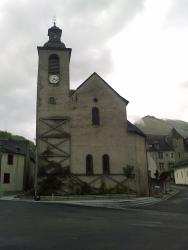
The town hall has curved facades on one side and covered walkways on the other. At the end stands the Saint-Michel church, rebuilt in 1631 in a Romanesque style. There are many houses from the same period, often featuring beautiful carved stone lintels.
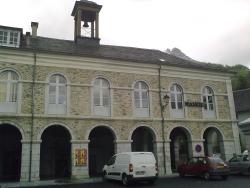
Leaving the village, the pilgrim passes two manors.
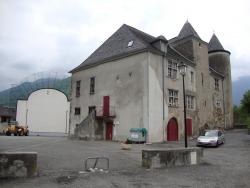
The Château Lassalle (17th century),
flanked by round turrets, overlooks the Gabarret, a torrent descending from the perched village of Aydius, from a terrace. It has been converted into a retirement home.
The Château Laclède (17th century),
on the other bank, features a tower and a stepped gable. It was built by a family that provided great civil servants to the Kingdom of Béarn and Navarre. The Aspe Valley was made famous by the Laclède family, whose three generations left behind stories of adventure and glory.
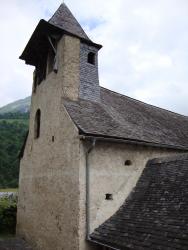
The hamlet of ORCUN is located on the south side of BEDOUS. It is an integral part of the town, but once held the status of an independent parish. Mentioned as early as the 12th century, it had its own chapel. This chapel, partially Romanesque, underwent restorations in the 17th and 18th centuries. In 1740, the church was vaulted with wood and received rich furnishings and galleries. A porch was created on the south side. Further restorations took place in the 1990s after the chapel was classified as a historical monument.
Miller, you're sleeping… your mill is going too fast….
A flour mill starting in 1836, it operated at full capacity for over a century, right up until the 1950s. In 1958, it saw the last of the mountain wheat harvests. In 1965, people were still coming to grind a little bit of ancient wheat and corn. After a period of inactivity, it was restored to preserve this heritage that had been the heartbeat of several generations of the same family.
Reopened to tourists, school groups, and seniors in the summer of 1993, it is now part of a complex featuring a river for trout fishing, two environmental interpretation trails (water and landscape), a bread-making workshop for children with an attached bread oven, an orchard of fruit trees, and a museum dedicated to wheat, flour, bread, water, and more.
A charming mountain village that you would be wrong to skip…


Encore moi et mes questions : Mais qu'est-ce donc une abbaye laïque, si ce n'est une belle oxymore ?
Petite explication de texte rien que pour vous...
Une abbaye laïque est une fondation du Moyen Âge, dans le piémont occidental du nord des Pyrénées. L'adjectif laïque indique que l'établissement n'appartenait pas à un ordre religieux. On peut identifier une centaine d'abbayes laïques, dont certaines par conjecture seulement, du fait de la disparition des textes.
Quand à demander si c'est un oxymore..L'oxymore permettant de décrire une situation ou un personnage de manière inattendue, suscitant ainsi la surprise, exprime donc ce qui est inconcevable. et crée donc une nouvelle réalité poétique en rendant compte aussi de l'absurde....donc oxymore l'abbaye laïque?...Non, puisqu'elle n'est pas religieuse....ah ah ! épaté hein???