

An investor eyeing a European golden visa in 2026 usually thinks about the investment threshold first. That is a priority mistake. The real hurdles lie elsewhere: underestimated processing times, incomplete source-of-funds documents, and suspended programs whose actual status nobody checked before signing.
Every year, well-informed applicants lose months, and sometimes their deposit, to preventable mistakes. The 2025-2026 data on Portugal, Greece, Cyprus, Malta, and Hungary shows a clear gap between advertised and actual timelines. This guide details seven of the most frequent mistakes, and how structured guidance, like that from Global Residence Index, helps you avoid them.
Key takeaways
- Choosing the wrong residency program can cost you months of wasted effort.
- Incomplete source-of-funds documents remain the leading cause of rejection.
- Suspended programs, like those in Spain or the UK, require up-to-date checks before you commit to anything.
- Post-approval taxes often catch poorly prepared new residents off guard.
- A reliable, specialized attorney makes the difference between an approved application and a rejected one.
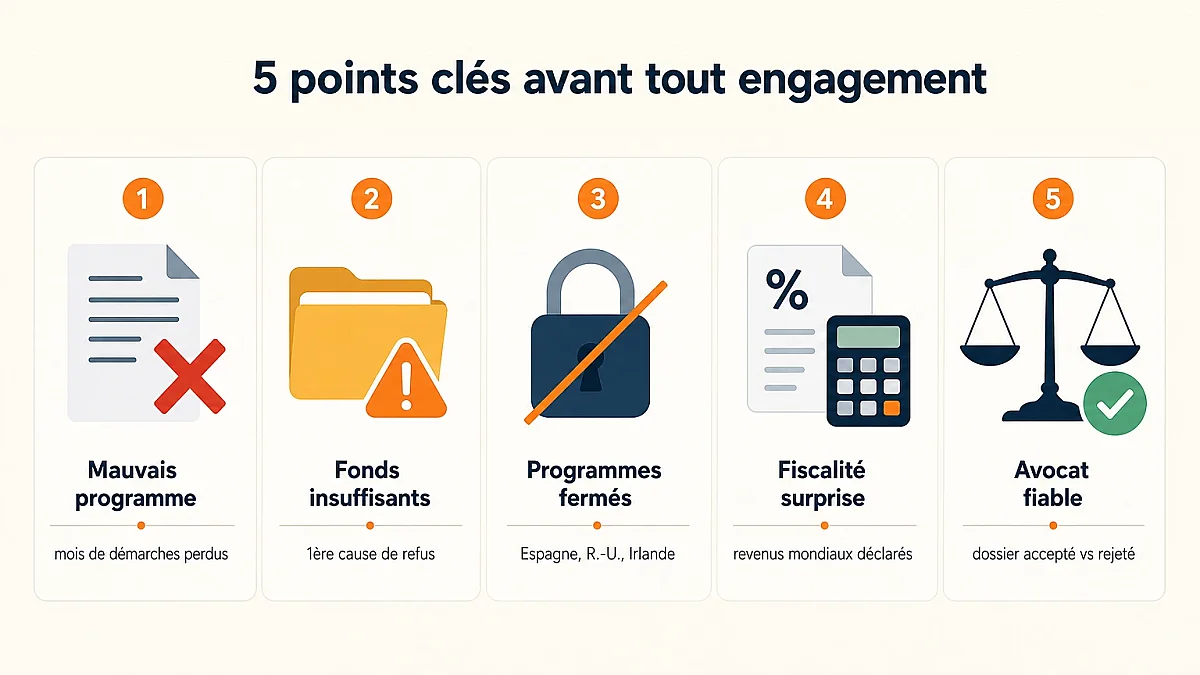 5 key points to prepare for a Golden Visa
Why so many applicants get it wrong in 2026
The golden visa landscape has changed rapidly. Spain has scrapped its program, Ireland has closed its own, and the UK has ended its investor route. Yet applicants continue planning based on outdated rules.
Portugal, Greece, Cyprus, Malta, and Hungary remain active, but their eligibility conditions and processing times shift every six months. Relying on outdated information remains the most frequent source of costly mistakes.
Mistake #1: choosing a program without assessing your real situation
Many applicants confuse residency by investment with citizenship by investment. The first gives you a renewable residence permit, the second a passport, often in just a few months for the Caribbean.
An investor looking for a fast European passport is barking up the wrong tree with a Portuguese or Greek residency program, which lead to European citizenship only after several years of legal residence.
Ignoring real mobility goals
A Portuguese or Hungarian residence permit gives you access to the Schengen area for travel, but not the right to work across the entire European Union without extra steps. Clarifying your real goal, whether it is mobility, taxes or a passport, helps you avoid choosing an unsuitable program.
Mistake #2: Underestimating actual processing times
Portugal also requires 90 business days to make a decision on an application. In practice, the average observed in 2026 far exceeds this timeframe, with files running anywhere from 12 to 24 months, and sometimes longer depending on the AIMA agency's backlog.
Advertised delays versus actual delays
Greece has cut its processing times to a minimum of 14 months for a large portion of recent applications, compared to 18 months previously. Italy remains the exception with a ministerial pre-approval processed in about 30 days for a complete application.
Applications stalled due to document delays remain frequent. An applicant planning on the basis of marketing timelines of 6-8 months often finds themselves waiting 12-18 months in reality, or even longer.
To calmly compare European residency by investment programs, it is best to consult up-to-date processing data rather than generic estimates put forward by certain real estate intermediaries.
Caution
Never plan around marketing timelines of 6 to 8 months. The actual wait time seen in 2026 is more like 12 to 18 months, or even longer depending on the program.
Mistake no. 3: submitting incomplete source of funds documents
Source of funds remains the most frequent reason for refusal for a European golden visa. Authorities want clear traceability of where the invested money comes from, not just proof of solvency.
What authorities are actually expecting when it comes to due diligence
Due diligence, that verification of the origin and legality of funds, requires consistent bank statements spanning several years, sales contracts, deeds of gift and related tax documents. An isolated wire transfer with no history almost always triggers an additional request, or even a denial if the response is delayed.
Portuguese and Greek authorities also check for any ties to money laundering or corruption cases. A foreign investor whose funds pass through opaque jurisdictions will see their application scrutinized longer, sometimes suspended for several months.
Common criminal record and background check errors
Background checks systematically include a criminal record check in your current country of residence and in all countries where you have lived over the past ten years. An undeclared minor past conviction almost always surfaces during the review process and complicates your file much more than the conviction itself.
A well-prepared residency by investment application anticipates these checks before submission, rather than dealing with them reactively during the review.
Mistake #4: ignoring the real status of programs in 2026
The European regulatory landscape has changed faster than most applicants realize. Confusing a suspended program with an active one remains an expensive and avoidable mistake.
Spain, United Kingdom, Ireland: where things stand with suspensions
Spain has scrapped its real estate golden visa. The UK shut down its investor route for security reasons. Ireland has ended its immigrant investor program. These three closures render a large part of the guides still in circulation obsolete.
Impact of post-2024/2025 regulatory narrowing on new applicants
Portugal, Greece, Cyprus, Malta, and Hungary remain active residency programs, but each has tightened its eligibility requirements or investment threshold since 2024. The European Commission continues to push for stricter EU regulation on these schemes.
Checking the exact status of a program before any financial commitment is no longer optional. It is the first step in any serious citizenship-by-investment or residency-by-investment application.
Mistake #5: overlooking the tax consequences after getting your status
Getting a residence permit is just a first step. The taxes that follow often catch applicants off guard who were solely focused on getting their application approved.
Global income tax return and double taxation
Becoming a tax resident in a European country generally means reporting your worldwide income, not just your local earnings. Without a solid understanding of double taxation treaties, you could end up taxed twice on the exact same income.
Portugal has changed its old non-habitual resident regime, replacing it with a revised tax framework that has different rules. Many applicants are still planning around the old system, which no longer applies to newcomers.
What the automatic exchange of information (CRS) changes
The Common Reporting Standard requires banks to automatically transmit financial information between tax authorities. A new resident can no longer rely on opacity between jurisdictions to manage their taxes.
Anticipating this automatic exchange before your move prevents unexpected tax audits the year after you obtain your status.
Mistake #6: choosing the wrong lawyer or authorized agent
Choosing the right intermediary matters just as much as the quality of the application itself. A bad specialized lawyer can turn a strong case into an avoidable refusal.
Red flags to watch out for in an investment contract
Some warning signs should raise red flags before you sign anything:
- Promises of guaranteed approval or unrealistic processing times.
- No verifiable license with local authorities.
- Pressure to wire funds before the official due diligence process is complete.
- A lack of transparency regarding fees tied to the proposed investment fund.
Why intermediary due diligence matters just as much as candidate due diligence
Checking the references, licenses, and background of your real estate broker or lawyer helps you avoid many common pitfalls in this industry. Having structured support, like the kind offered by Global Residence Index, lowers that risk by working directly with the relevant government agencies.
Mistake #7: forgetting minimum residency requirements once you get your status
Many applicants think getting their residence permit wraps up the whole process. In reality, every program requires a certain amount of time spent in the country to keep your status or eventually get European citizenship.
Status loss and renewal refusal: the most common cases
Renewal can be denied if minimum stay requirements are not met, or if proof of income documents are missing. These denials often happen years after the initial investment, when your guard is down.
Portugal, Greece, Cyprus, Malta, Hungary: different requirements
Portugal requires short but regular stays. Greece and Cyprus impose different conditions depending on the type of permit. Malta and Hungary apply their own presence rules, to be verified on a case-by-case basis before committing to a European golden visa.
How to secure your application before committing
Avoiding these mistakes calls for structured guidance rather than sales pitches. Global Residence Index works directly with the relevant authorities to build strong applications, program by program, before any final financial commitment.








Comments (0)
No comments yet. Be the first!