
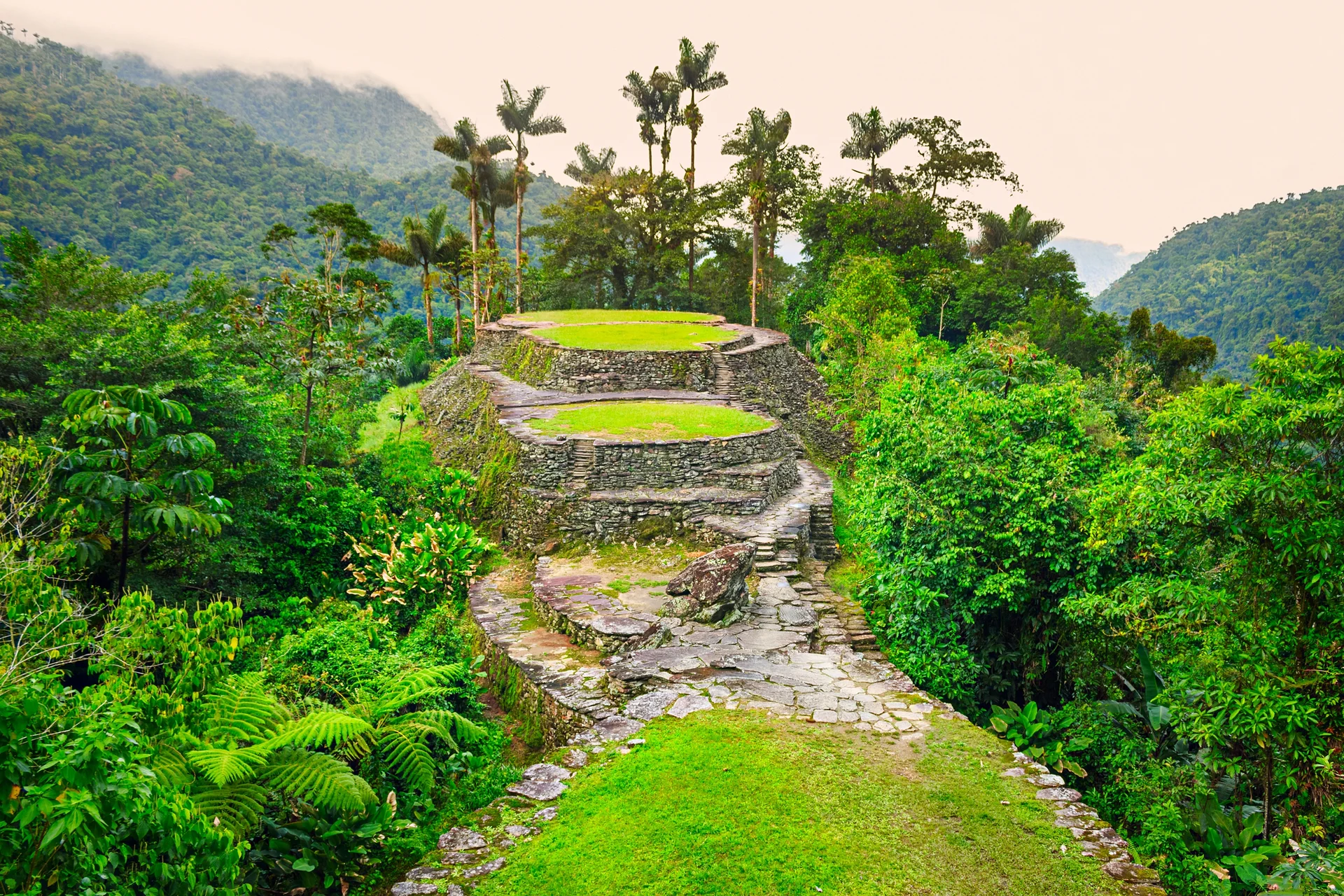
Visiting Lost City, the forgotten archaeological jewel of the Sierra Nevada
Deep in the impenetrable Colombian jungle, where morning mists cling to the steep slopes of the Sierra Nevada, near Santa Marta, stands one of the best-preserved archaeological wonders in the Americas: the Lost City, also known as Teyuna. This thousand-year-old stone city still defies those who dare to venture along its ancestral trails.
Why set out to discover Teyuna?
Built around 800 AD by the Tayronas, Teyuna predates Machu Picchu by 650 years. This pre-Columbian metropolis served as the political, economic, and spiritual hub for a vast network of interconnected villages that housed between 2,000 and 8,000 people at its peak. Abandoned in the 16th century during the Spanish invasion, it remained hidden until 1972, when grave robbers stumbled upon its stone stairs.
Unlike standard tourist sites, Teyuna is only accessible after a multi-day trek. This relative isolation preserves its authenticity and limits visitors to a maximum of 250 people per day, ensuring an intimate experience with history.
The initiation of the hike
The trek to Lost City spans 47 kilometers (about 29 miles) and represents as much of a physical challenge as a spiritual journey. Expect four days of hiking through humid tropical jungle, with daily segments lasting 5 to 8 hours depending on conditions. The trail winds through lush vegetation, crosses the Buritaca River multiple times, and climbs to an altitude of 1,200 meters (nearly 4,000 feet).
Rudimentary camps dot the route, offering welcome recovery in what is locally nicknamed the Infierno Verde (Green Hell). Temperatures hover around 30°C (86°F) with humidity nearing 100%, while mosquitoes are a constant companion, particularly aggressive during the rainy season.
Pro tip: Pack light but plan for one complete change of clothes per day. In this level of humidity, nothing truly dries. Guides also recommend merino wool socks, which handle moisture much better than cotton.
The mysterious architecture of the sacred terraces
Arriving at Teyuna, after the final ascent of 1,200 stone steps carved into the mountainside, reveals a striking sight. More than 169 circular and rectangular terraces are tiered along the steep slopes, connected by a complex web of stairs, irrigation canals, and paved paths. Each terrace, measuring on average 45 meters long by 18 meters wide (about 148 by 59 feet), once supported homes, granaries, or ceremonial spaces.
The retaining walls, sometimes reaching 7 meters (23 feet) in height, demonstrate remarkable technical skill. Built without mortar, these structures have withstood earthquakes and tropical storms for over a millennium. At the center of the complex, the Grande Terrasse (Great Terrace) served as the main plaza where ceremonies led by the mamos, the Tayrona spiritual guides, took place.
A site that remains alive
For the Kogui, Arhuaco, and Wiwa indigenous communities who descend from the Tayronas, Teyuna remains a sacred site. These contemporary guardians consider the Sierra Nevada the Heart of the World and still perform secret pilgrimages to the city. Their occasional presence on the site reminds us that this "lost city" was never truly abandoned in the collective imagination of these peoples.
A window into the Tayrona civilization
Teyuna showcases the sophistication of a society that mastered terrace farming, goldsmithing, and long-distance trade. The Tayronas excelled in gold work, creating ritual jewelry of extraordinary finesse using the lost-wax technique. Their trade networks stretched from the Caribbean coasts to the Andean highlands.
What these ruins tell us about the Tayrona to date:
- Over 500 terraces spread across 300,000 square meters
- A sophisticated hydraulic system with canals and drainage
- Communication routes linking the city to coastal villages
- Specialized craft workshops in each district
Only 10% of the site has been excavated to date, hinting at the scale of discoveries yet to come. Archaeologists estimate that the original urban complex extended well beyond the currently accessible zone, with suburbs and satellite sites still buried under the vegetation.
Opening hours
*Information subject to change