
The Tayrona Gold Museum, a colonial jewel housing pre-Hispanic history
Within the air-conditioned dimness of the Casa de la Aduana (Customs House), the gold of the Tayrona people catches the light just as it did a thousand years ago on the peaks of the Sierra Nevada. This 18th-century colonial building, one of the oldest standing in Colombia, now protects some of the most precious archaeological collections in the country. Each piece chronicles the history of a sophisticated civilization that worked gold with unmatched precision.
Why is the Tayrona Gold Museum so compelling?
This museum, opened in 2014 after a meticulous restoration, is more than a simple repository for ancient artifacts. It serves as a living bridge between the pre-Columbian past and the Caribbean present, creating a dialogue between the Nahuange and Tayrona cultures that prospered between 200 and 1600 AD, and their modern descendants, the Kogui, Wiwa, Arhuaco, and Kankuamo people who still inhabit the Sierra.
The Casa de la Aduana itself has a history full of twists and turns. It has served as a palace, a hotel, and offices for the United Fruit Company, but it is best known as the place where Simón Bolívar rested after his death in 1830. Its walls have absorbed three centuries of urban change, battles against pirates, banana trade, and modern tourism.
Permanent collections, a treasure of 565 objects
Tayrona goldsmithing, sacred and political art
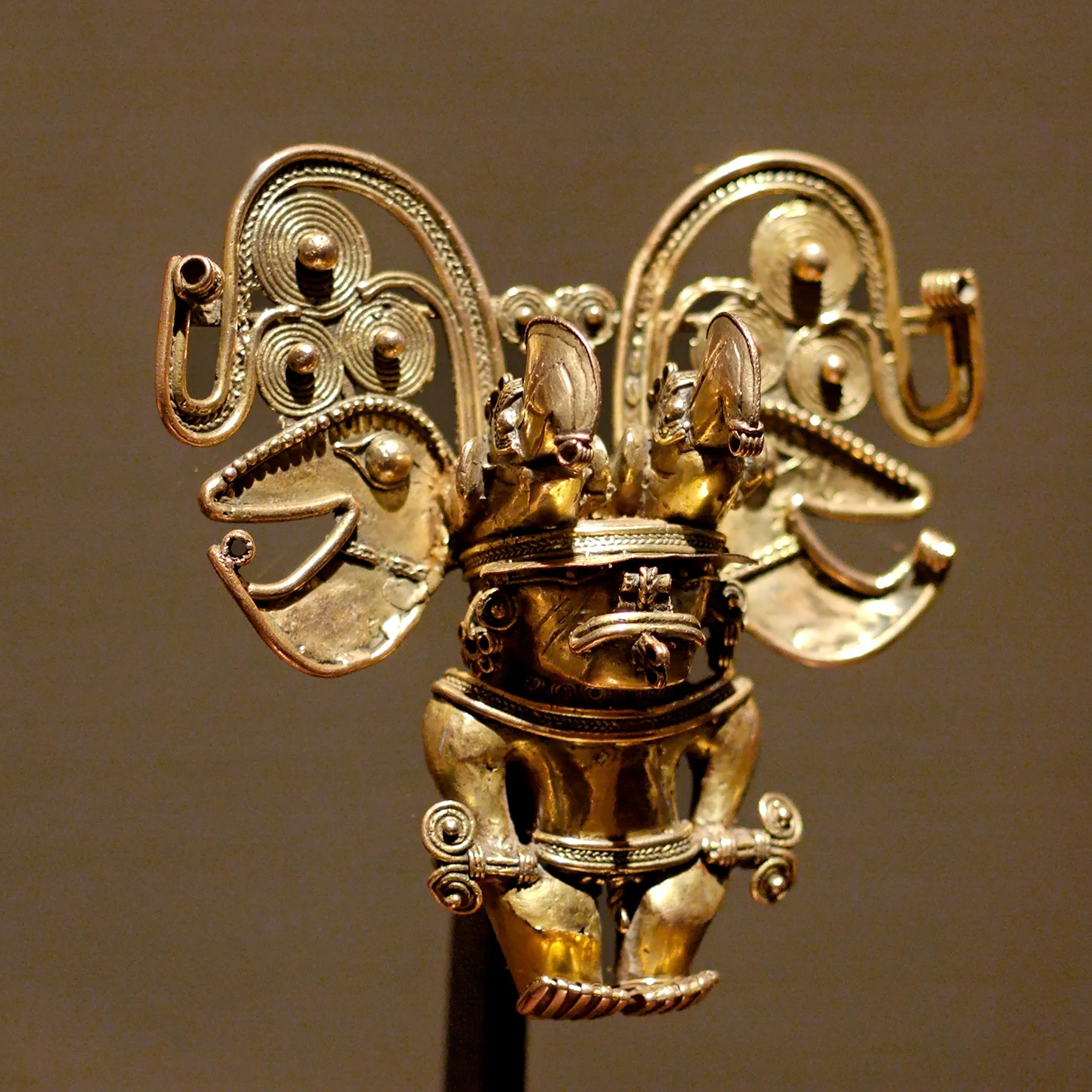
The 207 gold pieces on display reveal the technical mastery of the Tayrona. Anthropomorphic figurines, ornaments for men and women, and representations of sacred animals: every object served a ritual or political purpose. Bat-men, considered extremely powerful, appear frequently in the display cases alongside frogs, felines, and birds.
Gold was more than just jewelry. It was a sacred metal used in religious ceremonies and to accompany the deceased into the afterlife. Shamans and caciques (chiefs) wore these pieces to assert their spiritual and political authority.
Beyond the gold
The museum also displays 86 ceramics, 151 stone objects, 18 shell items, and 9 bone tools. These pieces offer a look into the daily lives of the societies that populated the Sierra Nevada for two millennia. Manufacturing techniques evolved significantly between the Nahuange period (200 to 900 AD) and the Tayrona period (900 to 1600 AD).
The four thematic rooms, a journey through time
The museum layout is organized around four narrative spaces that interact with one another:
- Sociedades prehispánicas (Pre-Hispanic Societies): A deep dive into the Nahuange and Tayrona cultures, their social organization, beliefs, and relationship with the sacred territory.
- La gente del Magdalena (The People of the Magdalena): An exploration of current communities and the cultural diversity of the department, connecting ancestral past with the living present.
- Historias desde la Casa de la Aduana (Stories from the Customs House): A narrative of the founding of Santa Marta, the battles, port trade, the railroad, and the banana industry.
- Bolívar estuvo aquí (Bolívar was here): A room dedicated to the Liberator who died in Santa Marta and whose body was held in this very house before his repatriation to Venezuela.
Friendly tip: Arrive early in the morning, right at the 9 a.m. opening on weekdays. You will enjoy a more intimate visit and better lighting conditions for photography where permitted. The museum may limit access during peak times to protect the collections. The descriptions are bilingual in Spanish and English, which makes it easy for international travelers to understand the exhibits.
Experiencing the museum to the fullest
Free guided tours are offered every Tuesday and Wednesday afternoon. On Thursdays, tours adapted for Colombian Sign Language are available for deaf visitors. The building is fully wheelchair accessible thanks to an elevator that reaches the second floor.
The cultural program is regularly enriched with lectures, workshops, and conversations on the anthropology and archaeology of northern Colombia. These events are often broadcast live on the social media channels of the Banco de la República (Bank of the Republic). The museum also houses a vivero (nursery) dedicated to endangered species from tropical forests, as part of a partnership with the Station Biological Foundation.
Located in the heart of the historic center of Santa Marta, on the Plaza de Bolívar, the museum fits perfectly into a walking route that includes the cathedral and paved colonial streets. The fact that it is completely free, which is rare for a museum of this caliber, makes it accessible to everyone and a mandatory stop before or after a trip to Tayrona National Park.
Opening hours
| Monday | Closed |
|---|---|
| Tuesday | 09:00-17:00 |
| Wednesday | 09:00-17:00 |
| Thursday | 09:00-17:00 |
| Friday | 09:00-17:00 |
| Saturday | 09:00-17:00 |
| Sunday | 10:00-15:00 |
Last entry 30 minutes before closing.
*Information subject to change