
Hierapolis, the Sacred City at the Gates of the Underworld
The stone rows of the Roman theater stand out against the Anatolian sky, towering over the white travertine terraces of Pamukkale. Further down, fallen columns tell two millennia of history. Around a paved street corner, a cavern breathes out toxic vapors: welcome to the gate of the underworld, where ancient priests communicated with Pluto.
Why discover Hierapolis?
Founded in the 2nd century BC by Eumenes II, king of Pergamon, the city takes its name from Hiera, wife of the hero Telephus. A sacred city in Greek, it lives up to its name completely. Its thermal springs drew travelers from across the entire Mediterranean basin for centuries to heal their ailments.
Hierapolis reached its peak under the Roman Empire in the 2nd and 3rd centuries, following a total rebuilding after the earthquake of 60 AD. The city also became an important Christian center: Saint Philip, one of the twelve apostles, was martyred and buried here. Listed as a UNESCO World Heritage Site since 1988, it forms a unique complex with Pamukkale blending natural wonders and archaeological remains.
The Roman theater, an architectural jewel
You cannot miss the theater overlooking the site. Built during the reigns of Hadrian and Septimius Severus, this monumental structure could seat between 10,000 and 15,000 spectators. Its facade stretches over 100 meters, organized into two seating tiers of 26 rows each.
The most fascinating aspect is the sculpted reliefs of the stage, finely carved into marble. They portray deities and scenes from Roman mythology. Despite the earthquakes that ravaged the region over the centuries, the theater survived thanks to the strength of its vaulted underground passageways. From the top of the seating rows, the view takes in the entire site and the limestone terraces of Pamukkale gleaming below.
Friendly tip: head up to the theater in the late afternoon, around 5 PM to 6 PM in summer. The low sunlight highlights the sculpted reliefs and the heat becomes manageable. If you visit in winter, take advantage of the nighttime illumination of the main monuments: the sight is magical and you completely escape the crowds.
The necropolis, memory of the centuries
The northern necropolis ranks among the largest in Türkiye with over 1,200 tombs. It stretches for several kilometers along the road leading to the northern entrance of the site. Hellenistic tumuli, Roman sarcophagi decorated with bas-reliefs, and house-shaped tombs show the diverse burials that reflect the cosmopolitan nature of the ancient city.
Several Jewish tombs reveal the significant Jewish community that lived in Hierapolis. You will also find the famous tomb of Marcus Aurelius Ammianos, whose relief displays the oldest known example of a crank and connecting rod mechanism. Certain sarcophagi bear detailed inscriptions noting the professions of the deceased and their good deeds.
The unique atmosphere of this necropolis, with its tombs scattered through the pine-dotted scrubland, invites quiet reflection. You gain a better understanding of why so many sick people came to spend their final days in this spa town renowned for its healing properties.
The Plutonium and underground mysteries
The gateway to the underworld
Near the Temple of Apollo lies a small cave that the ancients viewed as the entrance to the realm of Hades. The Plutonium takes its name from Pluto, the Roman god of the dead. Geothermal carbon dioxide vapors escape from this cavity, proving fatal to anyone who ventures inside.
Ancient accounts by Strabo and Damascius describe the ritual ceremonies that took place there. The eunuch priests of Cybele, the only ones able to hold their breath or familiar with the air currents, entered unharmed while sacrificial animals died instantly. Birds drawn by the warm air dropped dead above the cavern.
The site today
Rediscovered in 1965 by Italian archaeologists and reopened to the public in 2022, the Plutonium remains active as toxic gases continue to escape from it. For safety reasons, direct access to the cave is prohibited, but you can view the site from a wooden walkway. A replica of the statue of Hades and Cerberus was put back in its original spot during the restoration.
Other treasures of Hierapolis
The antique pool of Cleopatra
Between the archaeological museum and the Temple of Apollo, the antique pool offers a unique experience. Its 36°C thermal waters are dotted with submerged columns and marble blocks that collapsed during earthquakes. Swimming among these ruins creates a surreal feeling, as though you are floating through history.
Legend has it that Cleopatra herself bathed in these waters with their regenerative properties. Access to the pool requires an extra fee of 220 TRY (about $4.50*) not included in the general admission ticket. Bring a swimsuit and towel.
The agora and the baths
The 2nd-century agora, a vast rectangular square, served as the commercial and political center of the city. Porticoed shops welcomed merchants coming from all over Anatolia. Nearby, the large baths built from massive stone blocks without mortar now house the archaeological museum. Its collections display magnificent sculpted sarcophagi, divine statues, and everyday objects.
The colonnaded street and the Gate of Domitian
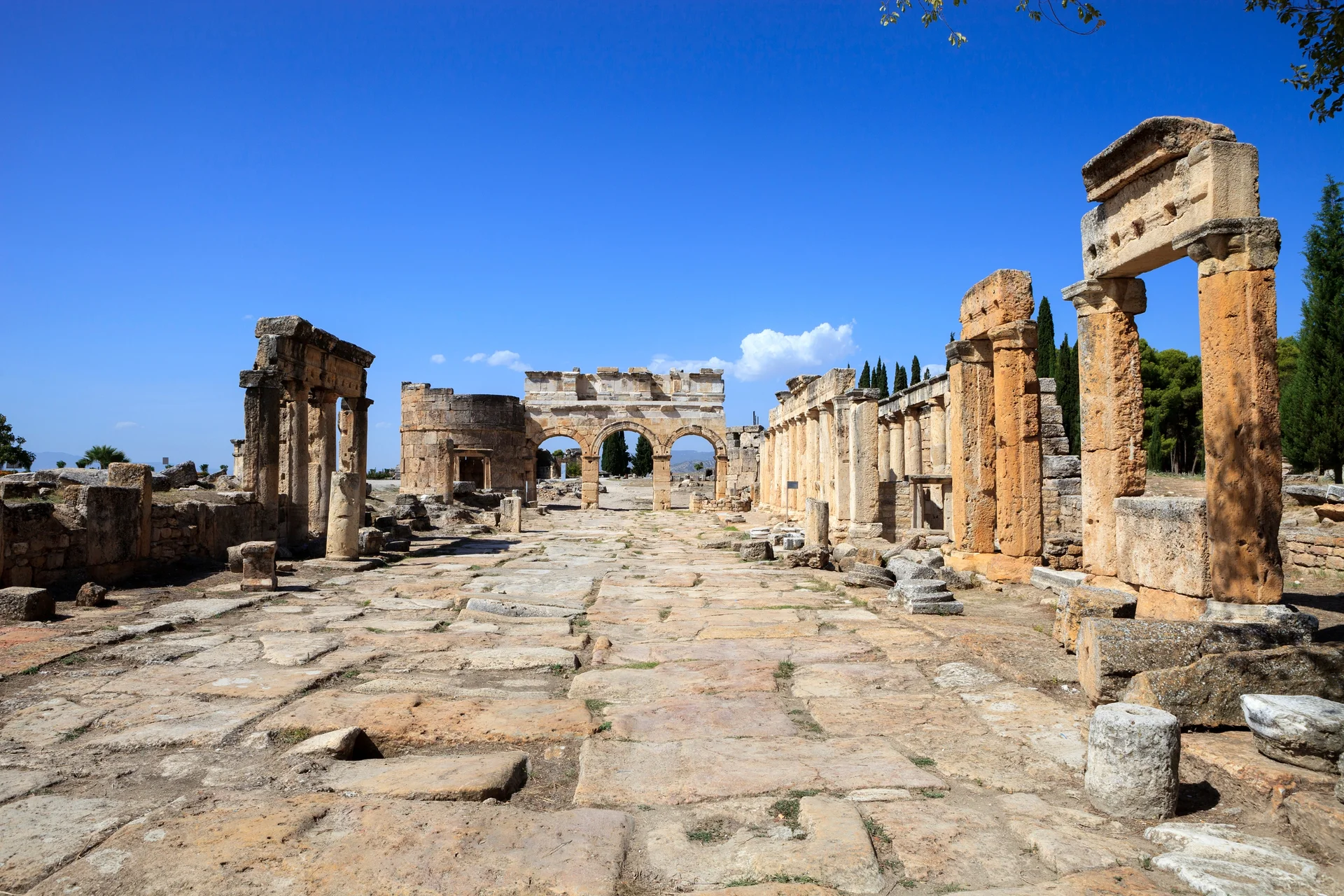
Frontinus Street, a long colonnaded thoroughfare, crosses the city for over a kilometer. It connects the south gate to the imposing Gate of Domitian in the north, a monumental three-arched gateway built in 82-83 by the proconsul Julius Frontinus. The remnants of the public latrines next to the gate, complete with decorative columns, showcase the refinement of Roman urban life.
The Martyrium of Saint Philip
At the top of a monumental staircase outside the northwest ramparts, the octagonal martyrium of Saint Philip impresses with its clever spatial layout. Radiating chapels, polygonal rooms, and triangular spaces frame the central octagon to form a square structure. This masterpiece of early Christian architecture from the 4th to 6th centuries marks the spot where the apostle was reportedly martyred and buried.
Friendly tip: if you have limited time, prioritize the theater, the necropolis, and the Plutonium. Rent an electric golf cart at the entrance (around 730 TRY, about $15*, for an hour) because the site is massive and the distances between monuments are substantial, especially under the summer sun. The drivers know the best photo spots.
Opening hours
- April to September: 6:30 AM to 8:00 PM
- October to March: 8:00 AM to 6:00 PM
Antique Pool:
- April to September: 8:00 AM to 8:00 PM
- October to March: 8:00 AM to 5:00 PM
*Information subject to change

Apart from the Roman theater, the ruins are in pretty bad shape and it is quite difficult to get a sense of what the place must have been like in the past. It was clearly a huge thermal center, frequented by Roman emperors!
On the other hand, the setting, especially Pamukkale, is exceptional.