
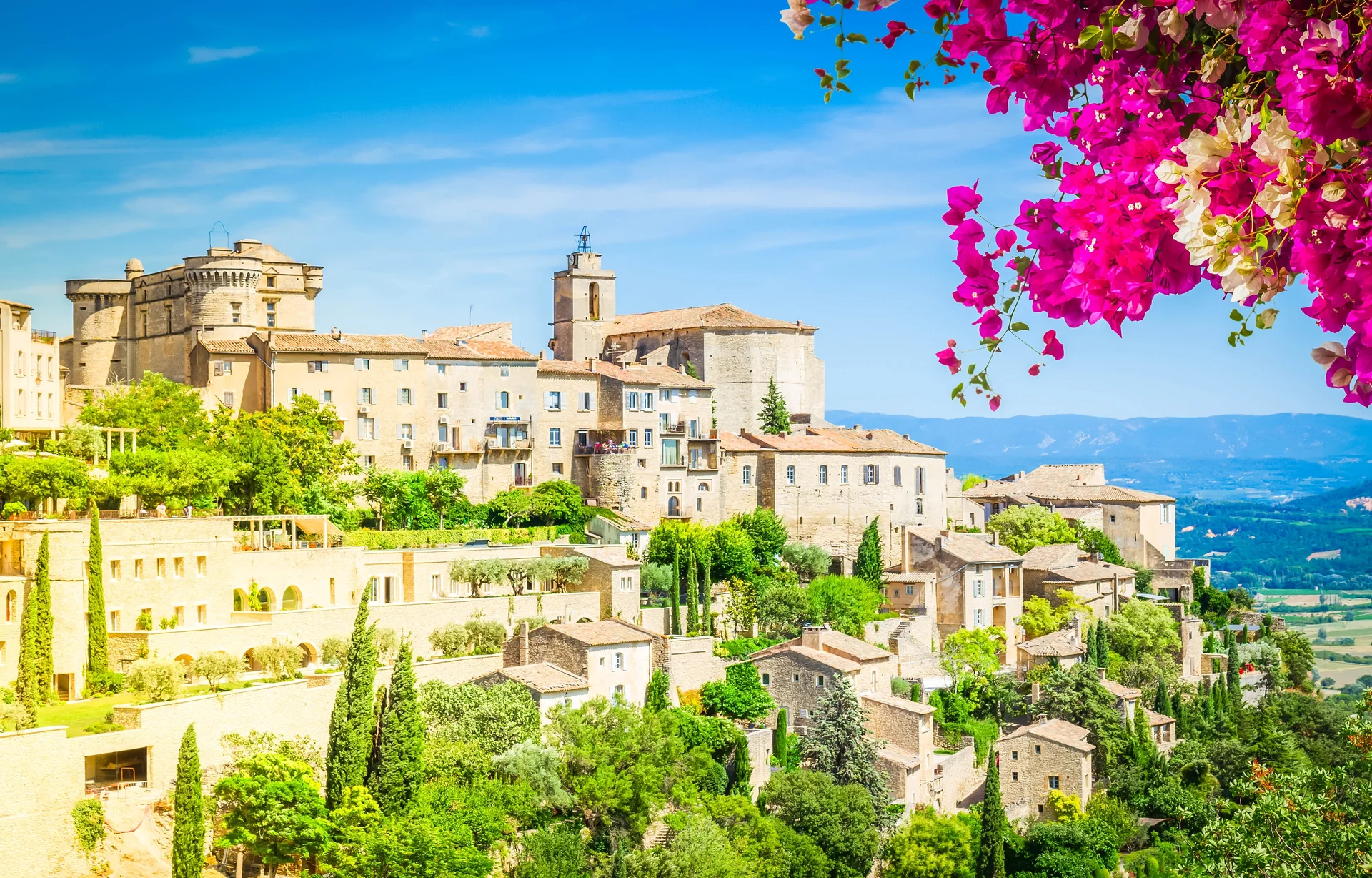
The thousand-year sentinel of the Luberon
The golden stones of the Château de Gordes have glowed under the Provençal sun for nearly a millennium. Perched at the summit of a village ranked among the Most Beautiful Villages of France, this massive structure with its round, machicolated towers looms over the Apt valley in a stance that is both defensive and majestic. The north facade presents high, austere walls, while the south side features Renaissance mullioned windows that invite light into the space with true Mediterranean elegance.
Why is this castle so captivating?
Mentioned as early as 1031 by Guillaume d'Agoult, one of the most powerful feudal lords in Provence, the castle quickly became a nobile castrum, the only one designated as such among all the surrounding fortresses. Reinforced in the 14th century to withstand the pillaging of Raymond de Turenne and the Great Companies, it even survived the turbulence of the Wars of Religion.
Between 1525 and 1541, Bertrand Rambaud de Simiane transformed the medieval fortress into a Renaissance residence without shedding its military past. This dual identity gives the site its charm, a fortified castle that opened itself to art and light.
The staircase and the fireplace: two sculpted masterworks
Upon entering the inner courtyard, the monumental spiral staircase demands attention. Each step was carved from a single stone sourced from the quarries of Ménerbes, Oppède, and Saint-Pantaléon. Sculptors chiseled details of surprising finesse into the stone, including elegant swans, coats of arms, corbels, stylized thistles, chubby cherubs, and delicate shells that punctuate the ascent.
On the first floor, the grand hall, 23 meters long, houses a treasure designated as a Monument Historique (Historic Monument) since 1902: a colossal fireplace measuring 7.20 meters long and 4.50 meters high. Bearing the date 1541, it marks the completion of the Simiane renovations. Its twelve niches once held statues of the apostles with Christ in the center, all destroyed during the French Revolution, which also defaced the family crest. Stylized acanthus leaves, carved thistles, and coffered panels with rosettes compete for delicacy in the ocher stone.
A sweeping panorama and a local secret
From the terraces, the view takes in the Comtat Venaissin and the entire valley stretching toward the Alpilles. The vineyards, olive groves, and lavender fields create a mosaic that shifts with the seasons, from tender green in spring to gold and purple in summer, and red and ocher in autumn.
Friendly tip: to understand the architectural evolution of the castle at a glance, head to the entrance of the garden of the Hotel Simiane, facing the north facade. From left to right, you will see the 12th-century Saracen tower with its medieval crenellations, the 14th-century tower that lost its crown and is now capped with tiles, and the 16th-century Renaissance towers commissioned by Bertrand de Simiane. It is the best photo spot and a free history lesson.
A vessel for contemporary art
Purchased for a symbolic franc by Victor Vasarely in the late 1960s, the castle was reborn following its restoration. From 1970 to 1996, the artist's geometric works engaged in a striking dialogue with the medieval vaults. Today, the castle continues its cultural mission with exhibitions that change every year. In 2025, the photographs of Hans Silvester filled the vaulted rooms.
A dedicated gallery traces the history of Gordes and pays tribute to the artists who made the village their home, including Marc Chagall, André Lhote, and Jean Deyrolle. The castle is no longer just a fortress frozen in the past, but a living space where heritage and creation feed into one another.
Opening hours
- June to September: 10:00 AM to 1:00 PM and 2:00 PM to 6:00 PM
- October to May: 10:00 AM to 1:00 PM and 1:30 PM to 5:30 PM

The Château de Gordes is mostly worth it for the panorama and its impressive architecture. For the rest, it is mainly a collection of exhibition rooms. The castle itself is quite plain and, I thought, a bit empty. You can just look at it from the outside, especially since the price of parking in Gordes is very high.