
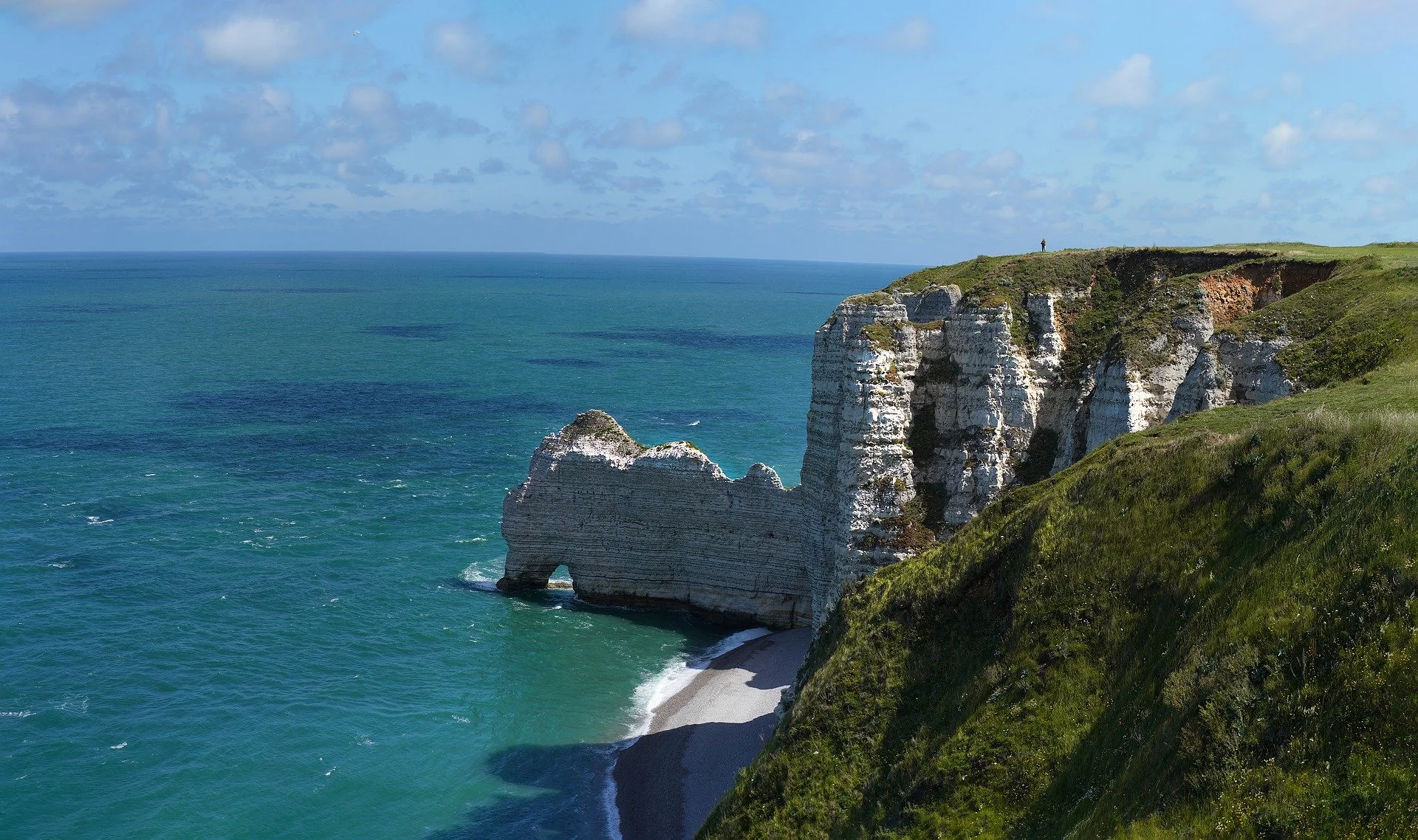
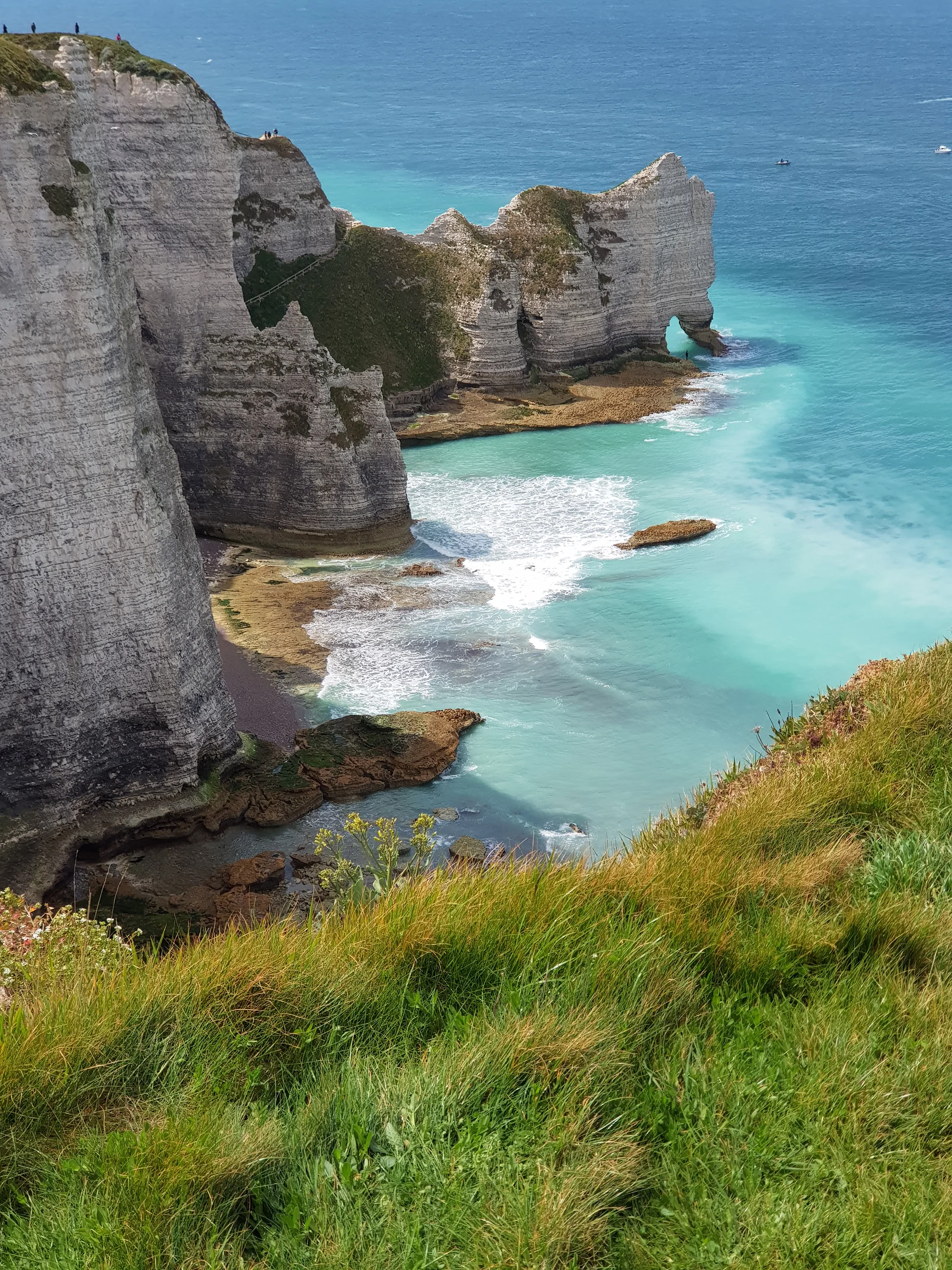
Amont Cliff in Etretat: The chalk lookout facing the English Channel
The wind whistles across the grassy plateau, heavy with salt spray. Rising 280 feet above the waves, the white chalk slices through the horizon like a blade. It was across the bay, on Aval Cliff, that Guy de Maupassant imagined an elephant dipping its trunk into the sea. The image is so precise that it still haunts anyone gazing at the arch from the pebble beach below.
Why climb Amont Cliff?
Long nicknamed the Blanc-Trait Cliff by sailors who used its brilliant white chalk as a landmark, this wall forms the longest cape in the Pays de Caux region. It extends nearly 400 feet into the English Channel, acting as a natural balcony over the entire bay of Etretat. Unlike its famous neighbor, the Aval Cliff, which is packed with visitors, this northern side remains quieter.
Birdwatchers come here to spot colonies of European shags and peregrine falcons nesting in the crevices. In the spring, rock samphire and wild cabbage carpet the rocky ledges, hardy plants that have defied the sea spray for millennia.
The summit: Between memory and contemplation
Notre-Dame-de-la-Garde Chapel
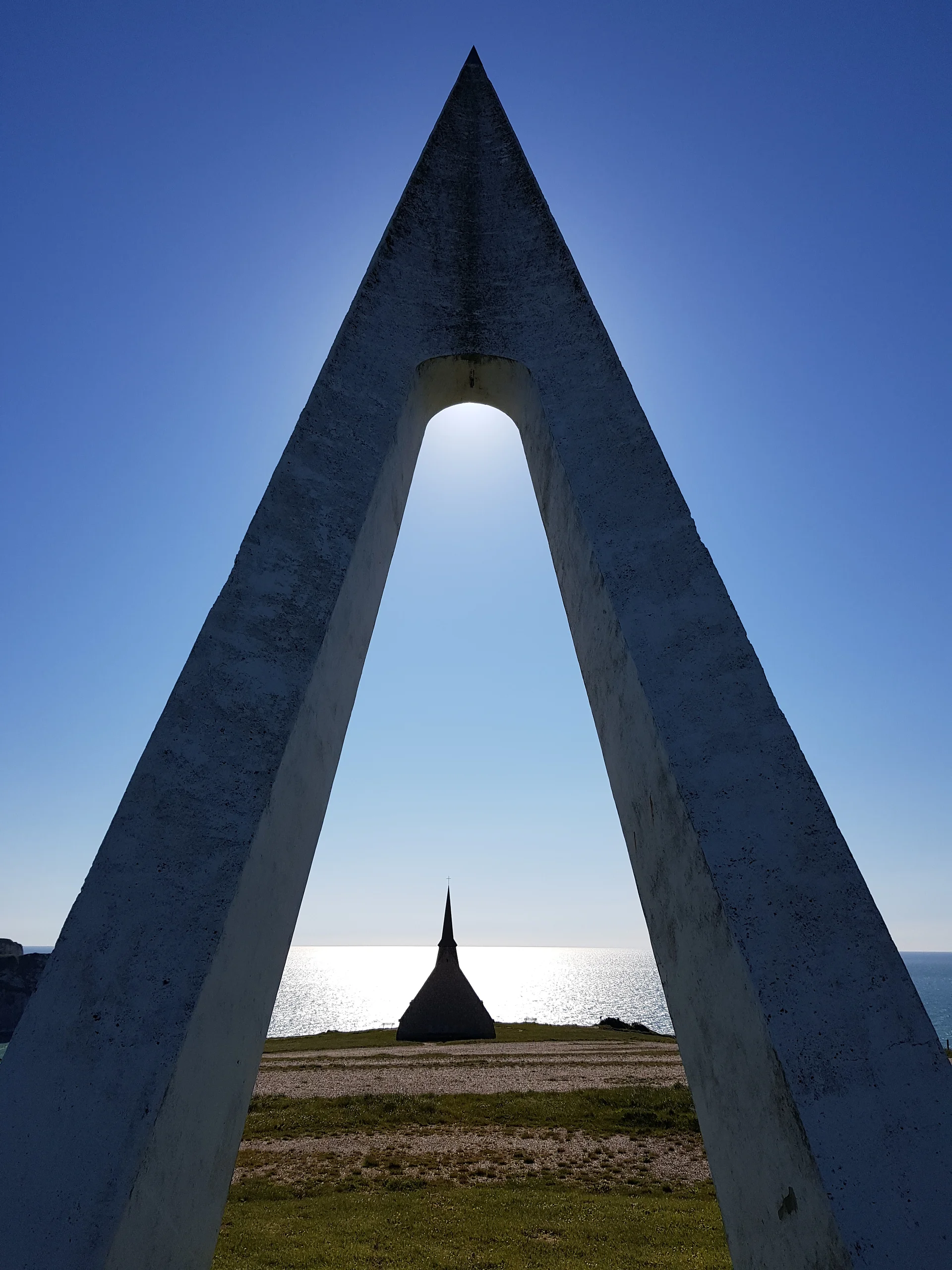
This small neo-Gothic church has watched over sailors since the 19th century. The original structure did not survive the bombings of World War II. Its reconstruction in 1950 preserved the spirit of the site, featuring a simple silhouette oriented toward the Porte d'Aval and the Aiguille Creuse (Hollow Needle). The interior is not open to the public, but the square outside offers one of the most photographed views in Normandy.
The Nungesser and Coli Monument
A white concrete arrow rises 80 feet, tilted at a 60 degree angle toward the sky. It marks the exact spot where Charles Nungesser and Francois Coli were last seen on May 8, 1927, at the controls of their biplane, L'Oiseau Blanc (The White Bird). Their attempt to cross from Paris to New York ended mysteriously in the Atlantic, two weeks before Lindbergh's triumph. On the ground, the outline of their plane is traced in stone. A small museum next door recounts their journey.
Etretat Gardens: The artistic side of the cliff
On the plateau, just steps from the chapel, lie 75,000 square feet of plant sculptures designed by landscape architect Alexandre Grivko. Since 2017, these topiary gardens have blended contemporary art with shapes inspired by Norman waves and seashells. The site existed in the early 20th century, when Madame Thebault, a Parisian actress and friend of Claude Monet, planted the first tree there in 1903. The garden holds the Remarkable Garden label and two stars in the Michelin Guide.
Look for these in the gardens:
- The Impressions Garden and its panoramic view of the Aiguille
- The human emotion sculptures by Samuel Salcedo
- The plant replica of the Porte d'Aval in the Aval Garden
Beyond the arch: The forgotten sentinels
Continuing to the northeast, the coastal path follows lesser-known rock formations. The Aiguille de Belval defies the laws of balance, its base eroded by the tides and thinning year after year. Further on, the Roc Vaudieu emerges from the waves like a section of a ruined wall. Guillemots have established their headquarters there, indifferent to the photographers armed with telephoto lenses.
Friendly tip: Take the stairs up from the beach at dawn. The low angle of the rising sun sets the chalk ablaze with a golden hue, and you will have the plateau almost to yourself. In peak season, the downtown parking lots are full by 10 AM.

If you come to Etretat, I recommend taking the time to climb both cliffs. Each one has its own charm and offers a magnificent view of the other. The path up is very well laid out and is not too difficult to handle. Once you are at the top, the view is truly incredible.