
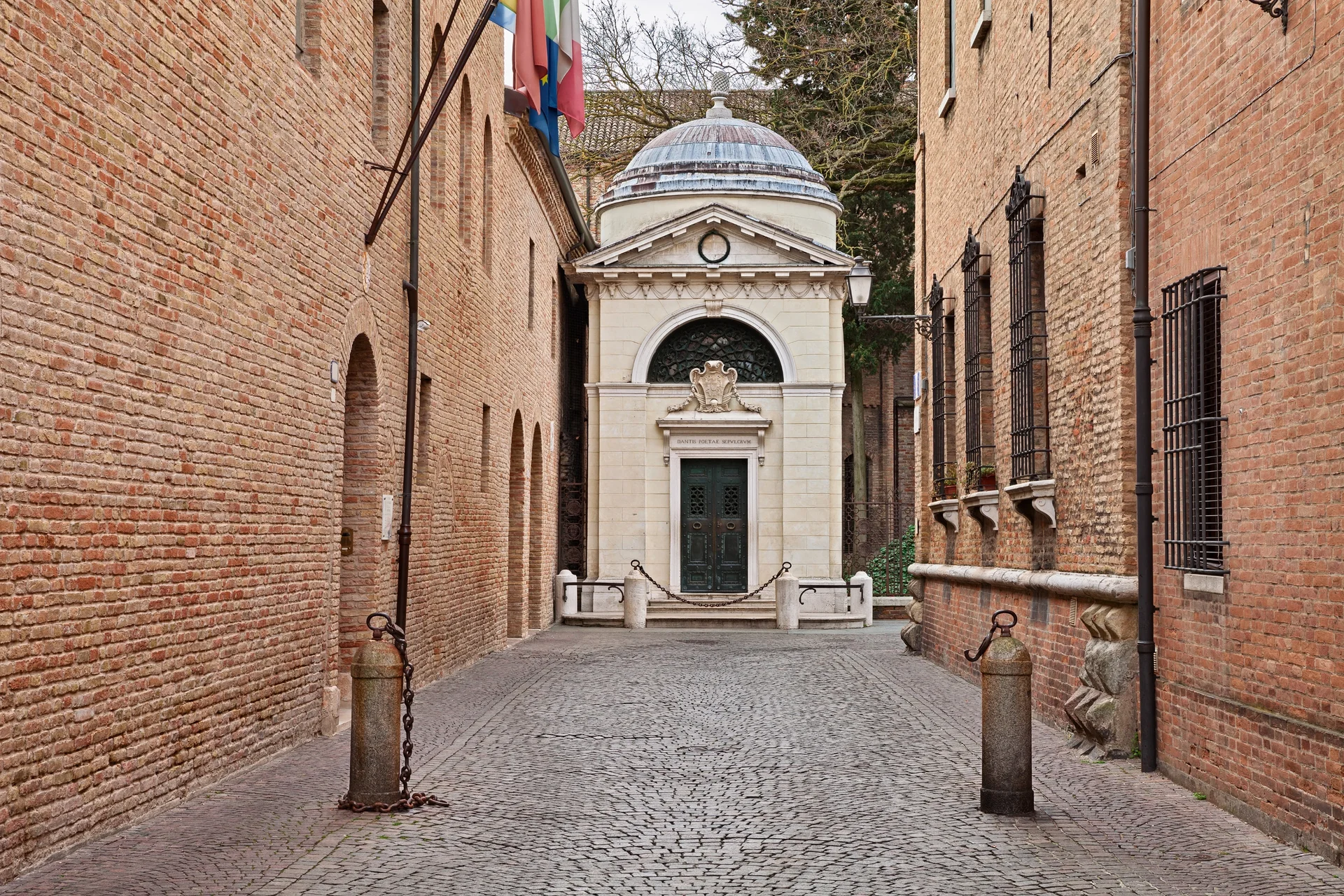
Visiting Dante's Tomb: The silence of the final exile
In Ravenna, away from the golden glare of the mosaics, a small street leads to a silence that feels almost physical. You are in the quiet of a zone of silence, where the Supreme Poet, Dante Alighieri, rests. His tomb lacks the heavy, opulent grandeur of the nearby basilicas. Instead, it is a modest neoclassical temple of soothing white that seems to whisper the story of an exile and an enduring legacy.
Why this place carries so much weight
Banished from his native Florence, Dante found refuge in Ravenna, where he spent the final years of his life and finished his monumental work, the Divine Comedy. He died here in 1321. Visiting his tomb means paying respects not just to the father of the Italian language, but also to the city that took him in. This site serves as a profound symbol of a nation recognizing its greatest poet.
A post-mortem feud: The poet's bones
The history of Dante's remains is as tumultuous as his life. Shortly after his death, Florence, the city that cast him out, demanded his remains back. To protect them from being taken, the Franciscan friars of the neighboring convent hid the poet's bones. They concealed them so effectively that they were only rediscovered by accident during construction in 1865.
This history explains why the tomb of Dante inside the Santa Croce basilica in Florence is empty. It is merely a cenotaph, or a commemorative monument. The true tomb, the place of his eternal rest, is right here in Ravenna, guarded by the loyalty of his hosts.
The Zone of Silence: A sanctuary in the city center
The tomb is the anchor of a larger area designed for reflection. This space, known as the Zona del Silenzio (Zone of Silence), invites respect and contemplation.
A sacred and secular space
The small temple houses the sarcophagus, which bears a Latin epitaph written by the humanist Bernardo Canaccio. Above it, an 18th-century lamp burns continuously. Its oil is an annual gift from the city of Florence, a gesture of reconciliation and perpetual tribute. Right next to the tomb stands the Quadrarco di Braccioforte (Braccioforte Arch), an old oratory attached to the San Francesco basilica that adds to the timeless atmosphere of the site.
Friendly tip: Visit early in the morning or late in the day when the light is soft and the crowds have cleared. This is when the zone of silence truly resonates. Take a moment to sit on one of the benches and soak in the atmosphere, thinking of the man who, banished from his homeland, created a work that unified the language of an entire nation.
The Dante Museum: Going deeper
For those who want to dig further into the poet's life, the adjacent Dante Museum offers a look at his work and history. Set in the former Franciscan cloister, it displays documents, rare editions, and artifacts that help explain the context of Dante's exile and his massive literary and cultural footprint.
Opening hours
| Monday | 10:00-19:00 |
|---|---|
| Tuesday | 10:00-19:00 |
| Wednesday | 10:00-19:00 |
| Thursday | 10:00-19:00 |
| Friday | 10:00-19:00 |
| Saturday | 10:00-19:00 |
| Sunday | 10:00-19:00 |

I wanted to visit Dante's Tomb to pay my respects to an author I really admire. He rests in a very pretty mausoleum, in a quiet and silent area. The monument is very well maintained and the place is truly peaceful. Avoid coming with young children, as it is recommended to keep quiet in the area.