
Basilica di Santa Maria Maggiore: sixteen centuries of art under a ceiling of American gold
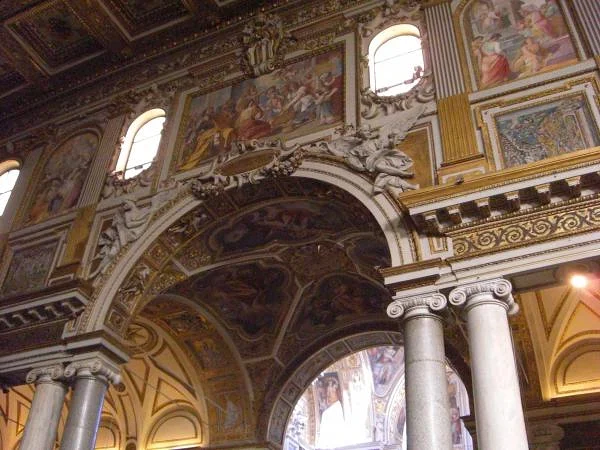
Look up. That coffered ceiling shimmering above the nave is coated in gold brought from the Americas by Christopher Columbus, a gift from the Catholic Monarchs of Spain to Pope Alexander VI at the end of the 15th century.
This single detail captures the ambition of the Basilica di Santa Maria Maggiore. Since its founding in 432, every era has sought to leave its mark here without erasing what came before.
Why visit the Basilica di Santa Maria Maggiore?
Rome is home to over 900 churches. Among them, only four hold the title of major papal basilica. The Basilica di Santa Maria Maggiore is the largest of the 80 Roman churches dedicated to the Virgin Mary, and it is the only one of the four major basilicas to have preserved its original early Christian structure. Its 5th-century mosaics, still in place along the nave, are among the oldest examples of Christian art in Rome.
Since April 2025, the basilica has gained a new layer of significance. Pope Francis now rests here in a tomb of Ligurian marble bearing the simple inscription "Franciscus," located between the Pauline Chapel and the Sforza Chapel. This personal choice by the pontiff, who visited to pray here before and after every apostolic journey, has turned the site into a major pilgrimage destination.
Fifteen centuries of architectural layers
The nave and its ancient columns
The central nave stretches 282 feet, lined with 40 Ionic columns, some of which were salvaged from ancient Roman temples. The Cosmatesque marble floor, with its 12th-century geometric patterns, creaks beneath your feet. The air stays cool even in the heat of summer, carrying a faint scent of beeswax. Above, 5th-century mosaics depict Old Testament scenes with a vividness that defies time.
The two rival chapels
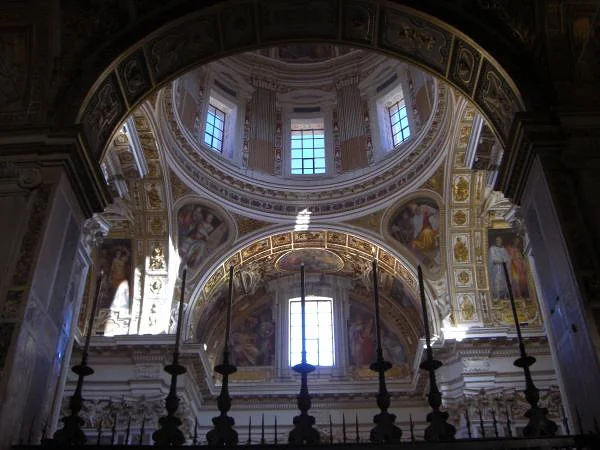
On either side of the papal altar, two monumental chapels face each other. The Sistine Chapel (not to be confused with the one at the Vatican) was built by Pope Sixtus V between 1585 and 1590. Across from it, the Pauline Chapel, commissioned by Paul V in 1611, houses the Salus Populi Romani icon. This image of the Virgin is at least a thousand years old and is traditionally attributed to Saint Luke. Its gilding and polychrome marbles rival the opulence of its neighbor.
The facade and the bell tower
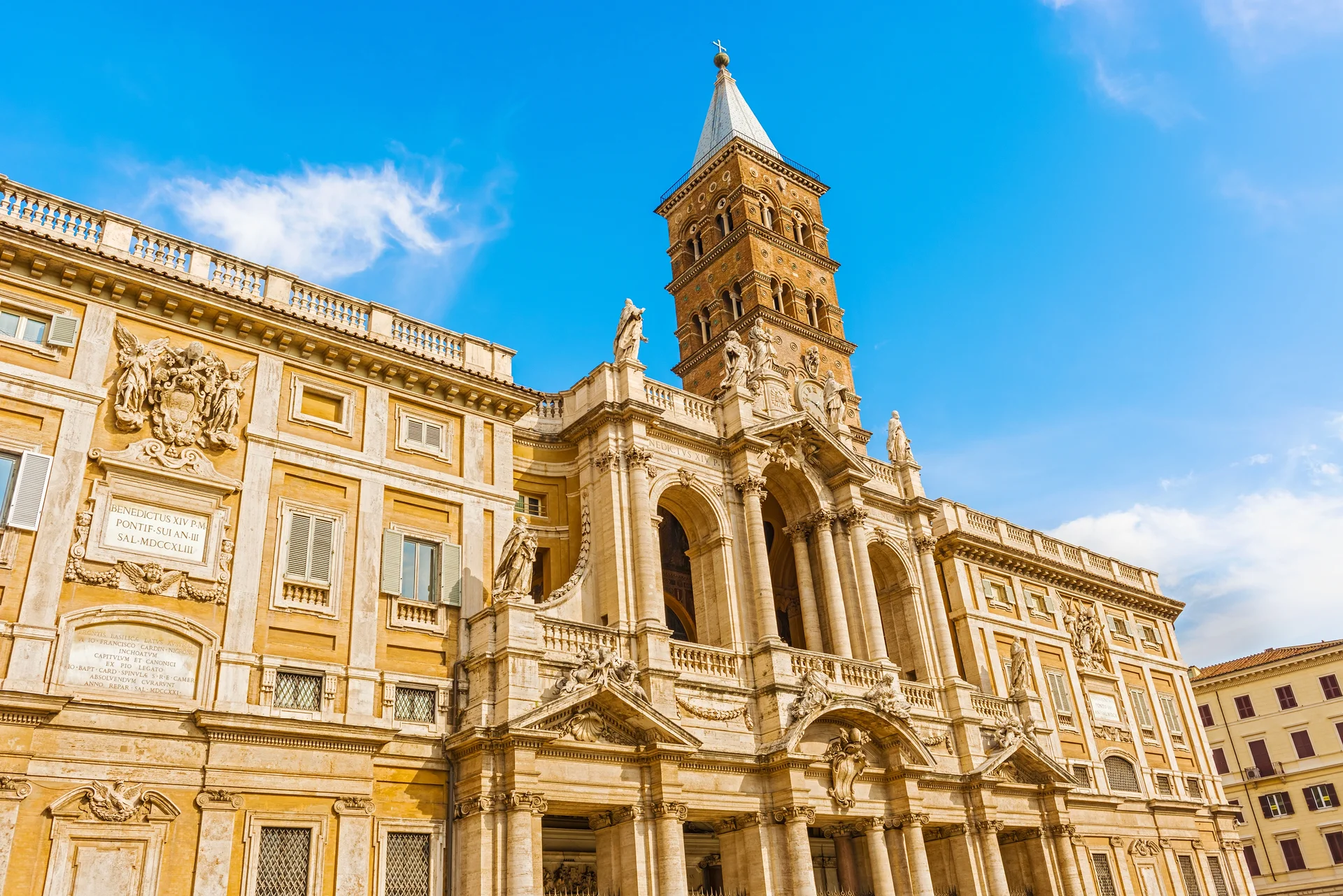
The current Baroque exterior dates to the 1750 Jubilee, designed by Ferdinando Fuga. Behind its Loggia of Blessings, it hides medieval mosaics by Filippo Rusuti. The brick bell tower, built in the 14th century, rises to 246 feet. It is the tallest bell tower in Rome and is visible from many vantage points across the city.
Treasures you cannot miss
Look for these items during your visit:
- The gilded coffered ceiling by Giuliano da Sangallo, covered in gold from the New World
- The apse mosaics signed by Jacopo Torriti (1295), depicting the Coronation of the Virgin
- The Sacra Culla, a rock crystal reliquary containing five pieces of sycamore wood, believed to be fragments of the manger from Bethlehem
- The tomb of Bernini, surprisingly modest for the genius of Roman Baroque, located in the right side aisle
- The first sculpted nativity scene in history, a 13th-century work by Arnolfo di Cambio
Friendly tip: The basilica opens at 7:00 AM. At this hour, the morning light streams through the nave, giving the mosaics a golden glow that the midday crowds will not allow you to appreciate. It is also the best time to see the ceiling without being jostled. For paid areas (the Loggia, the Hall of the Popes, Bernini's staircase, and the underground archaeological zone), book online, especially during a Jubilee year.
The miracle of the snow and the August 5th festival
The founding legend claims that in 352, the Virgin Mary appeared in a dream to Pope Liberius and a Roman patrician, asking them to build a church where snow would fall the next day. On August 5th, in the middle of a summer heatwave, the Esquiline Hill was reportedly covered in white.
Each year, the basilica commemorates this episode with a shower of white rose petals released from the ceiling during the liturgy. The ceremony draws a massive crowd, so arrive very early if you want to attend.
Opening hours
Polo Museale (Museum, Loggia of the Blessings, Hall of the Popes, Bernini Staircase): Monday to Saturday from 9:30 AM to 6:00 PM (last entry at 5:30 PM).
Certain areas may be closed during Masses and papal ceremonies.
*Information subject to change

Rome has so many religious monuments, but this basilica is an absolute must-see. It is truly magnificent both on the outside and the inside. It is richly decorated with gilding everywhere, and the ceilings are superb. I really recommend you visit it.