
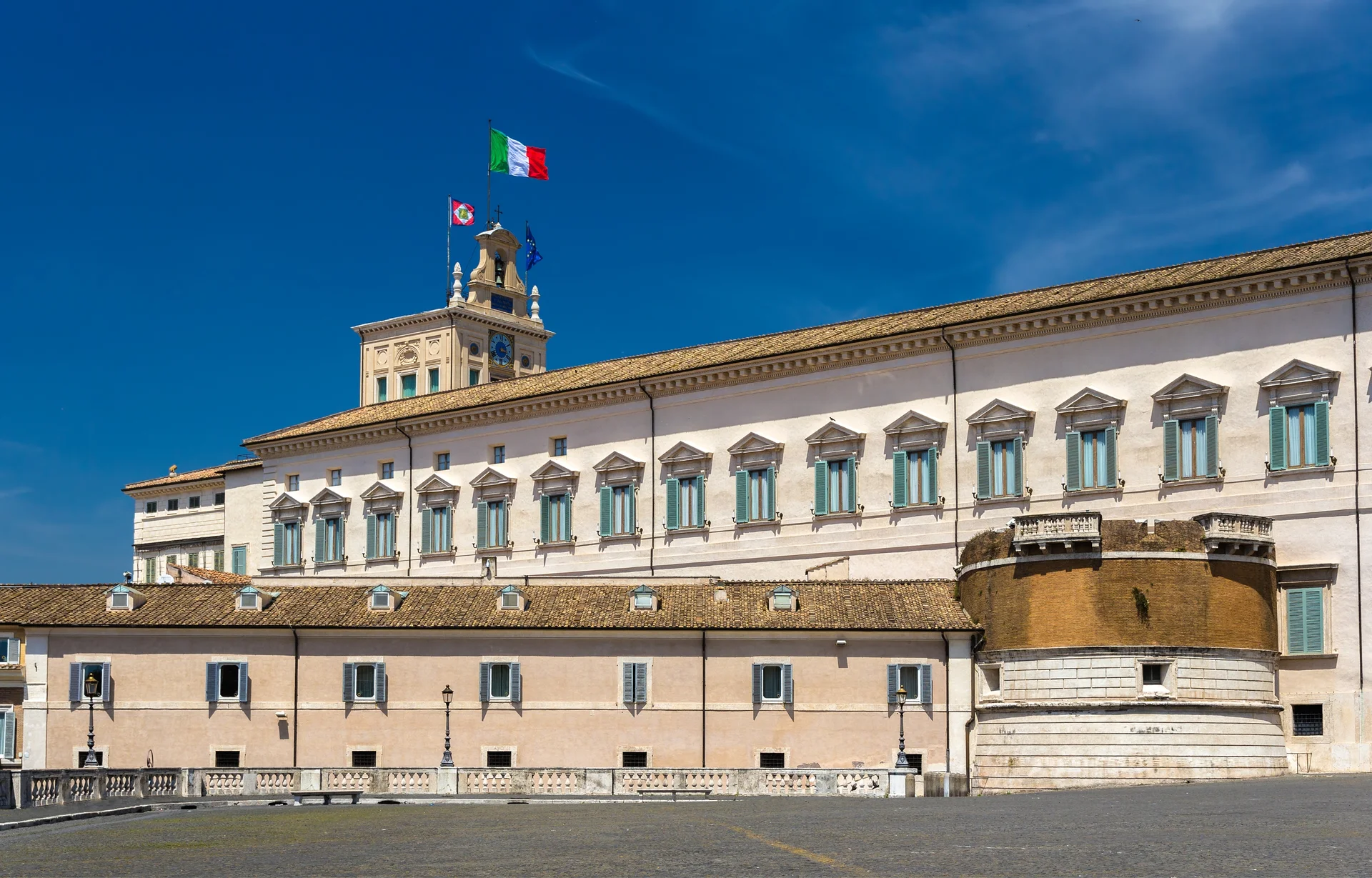
Quirinal Palace, three centuries of power on the highest hill in Rome
Perched on the highest of the seven hills of Rome, in a neighborhood known as Monte Cavallo, this monumental palace has loomed over the Italian capital since the 16th century. Spanning 110,500 square meters, it is the eleventh largest palace in the world. Ocher facades stretch across the square, the Dioscuri statues have guarded the entrance since antiquity, and every Sunday at 3 p.m., the presidential guard relief performs its ceremony to the sound of a brass band.
From papal retreat to the presidency of the Republic
Built in 1583 by Pope Gregory XIII as a summer residence, far from the humidity and foul odors of the Tiber, the Palazzo del Quirinale quickly became a symbol of power. Thirty popes established their quarters here, from Gregory XIII to Pius IX, commissioning the greatest Italian artists to enrich the space. Pietro da Cortona, Domenico Fontana, Ferdinando Fuga, and Carlo Maderno each contributed majestic interventions.
In 1870, after the annexation of the Papal States to the Kingdom of Italy, the palace became a royal residence until 1946. Napoleon himself had selected it as his future imperial palace, though he never stayed there. Since January 1, 1948, the Quirinal Palace has served as the official residence of the President of the Italian Republic.
The state rooms, a journey through the history of power
The tour begins with the Scalone d'Onore (Staircase of Honor), the monumental staircase leading to the apartments. On the landing, the Redeemer in Glory fresco by Melozzo da Forli, created around 1480, was strategically placed to remind departing visitors that they had received the papal blessing. It served as an artistic farewell rather than a simple goodbye.
The Salone dei Corazzieri
Built by Carlo Maderno during the pontificate of Paul V, the Salon of the Corazzieri impresses with its majestic dimensions and retains its early 17th century wooden coffered ceiling. This is where the most significant official ceremonies take place, including the swearing in of new governments.
The Hall of Mirrors and the Napoleonic apartments
The Hall of Mirrors was created during the Napoleonic occupation of Italy. The salons follow one another, showcasing precious tapestries, vibrant frescoes, and period furniture. The Quirinal Contemporary collection enriches the heritage with 36 paintings and sculptures by 20th century Italian artists such as Giorgio De Chirico, Lucio Fontana, and Arnaldo Pomodoro.
The secret gardens, an island suspended above Rome
The Quirinal Gardens stretch over 4 hectares, forming a green oasis that seems to float above the capital. Geometric flowerbeds alternate with a rich collection of trees, majestic hedges, and a grove with wide paths. A trapdoor in the gardens provides access to archaeological excavations that have revealed the remains of the ancient temple dedicated to the god Quirinus and residential blocks from the imperial era.
Pro tip: The view over Rome and the dome of Saint Peter's Basilica from the Piazza del Quirinale is superb. Arrive in the late afternoon to catch the golden light hitting the baroque facades of the neighborhood, then stay to watch the guard relief at 3 p.m., a spectacle worth seeing.
The three tour routes
- Route 1 (artistic and institutional) covers the main floor and the ground floor in 1 hour and 20 minutes. You will explore the state rooms, the presidential apartments, and the history of the palace through the three regimes that occupied it.
- Route 2 (artistic, institutional, and thematic) adds a visit to the Vasella where 18th century crystal and silverware are kept, the gardens, and the Carriage Museum, for a total duration of 2 hours and 30 minutes.
- Route 3 focuses on contemporary art.

The equivalent of the Elysée in Rome! This aspect will undoubtedly interest some, even if it is not the first place I would recommend visiting. It is, however, a place steeped in history with a monumental square. Another one of its perks is the view of the rest of the city! You can also visit inside (by reservation) if you are curious.