
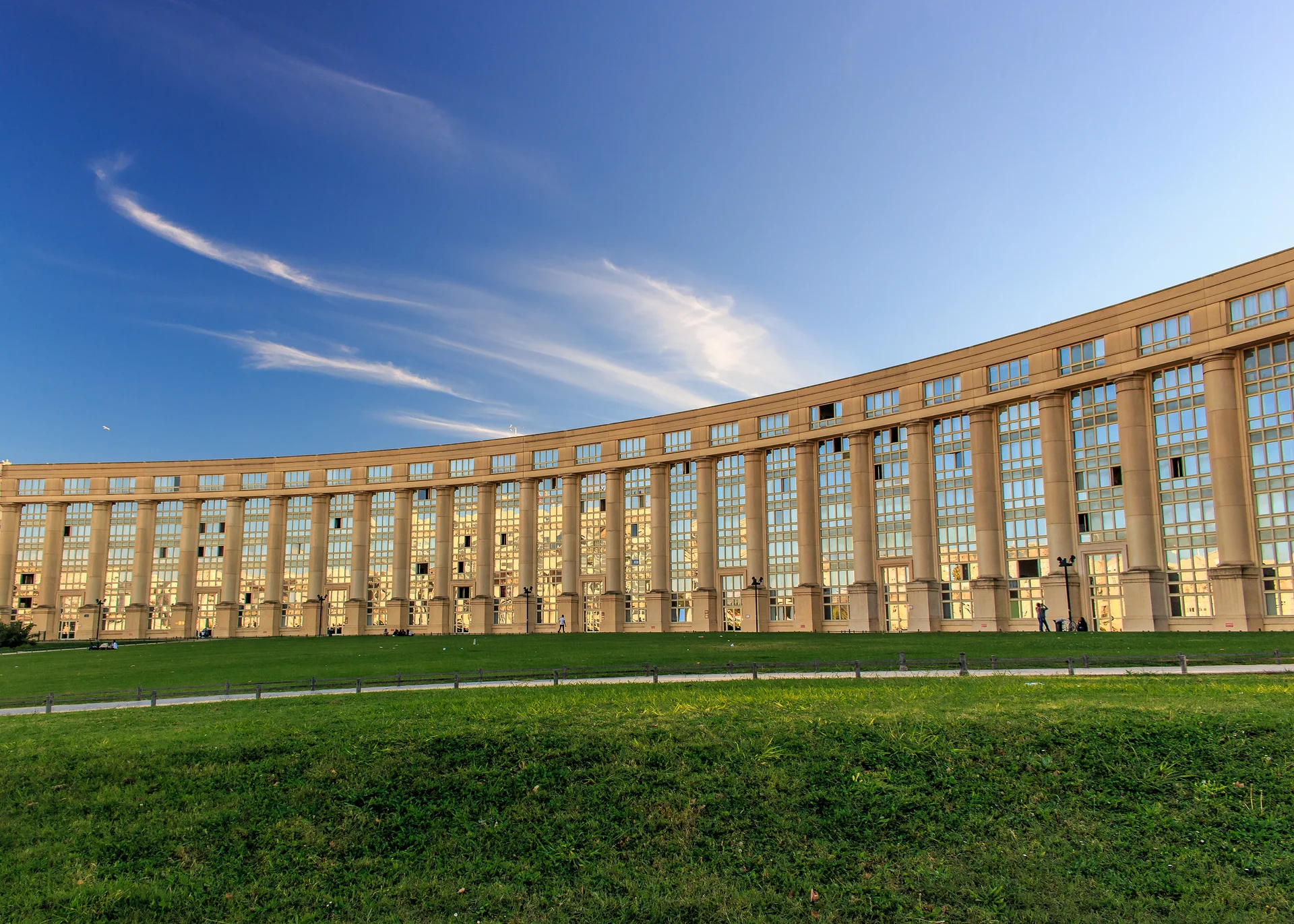
Esplanade of Europe: Montpellier through a lens of ancient Greece, right on the Lez river
A massive beige concrete colonnade, lawns that slope gently toward a river, and, in the distance, the glass facade of the regional government building catching the Mediterranean sun. This is the first impression of the Esplanade of Europe, the centerpiece of the Antigone district and the culmination of a pedestrian axis stretching nearly a kilometer through one of the most daring architectural projects of the 20th century in France.
Why visit the Esplanade of Europe?
Everything began with a radical political decision. In the late 1970s, Mayor Georges Frêche commissioned Catalan architect Ricardo Bofill to build a new district on former military land, effectively opening Montpellier to the east and the Lez river. The aesthetic choice was intentionally provocative, featuring pure neoclassicism, fluted columns, proportions inspired by the golden ratio, and streets named after the gods of Olympus. At the time, Antigone was as divisive as it was fascinating.
Today, the district has been designated as Architecture contemporaine remarquable (Outstanding Contemporary Architecture) since 2018. The Esplanade of Europe is its focal point, where curved buildings form a half-amphitheater opening onto the river. From the air, the entire district forms the shape of a key.
The curved architecture and details to spot
Facing the Esplanade, the buildings adopt a slow, symmetrical curve that directs the eye toward the Lez. The beige concrete, tinted to mimic stone, is punctuated by monumental columns, friezes, and entablatures that make no attempt to hide their material. It is unapologetic, exposed concrete. In the evening, low-angle lighting reveals textures that the harsh midday sun tends to flatten completely.
As you walk toward the Esplanade from the Place du Nombre d'Or (Square of the Golden Ratio), you will pass several reproductions of famous sculptures, including the Winged Victory of Samothrace, the Venus of Arles, and Diana the Huntress. These replicas are not accidental. Bofill and Frêche wanted to anchor the district in a shared Mediterranean culture that is visible and accessible to everyone.
Friendly tip: Visit at night at least once. The street lighting transforms the facades, giving the Esplanade an almost theatrical atmosphere that is entirely different from the daytime experience. Admission is free at all hours.
A living space, not an open-air museum
The Esplanade of Europe is not frozen in a heritage-focused state. The lawns are used by local families, joggers, and students. Every year since 2007, the FISE (International Festival of Extreme Sports) takes over the banks of the Lez and the Esplanade, drawing over 600,000 visitors over several days. The vibe during this time is completely transformed.
On weekdays, the quiet returns. This is where you can truly gauge the ambition of the project, as it is a large-scale public space designed to be lived in, not just admired. We at Avygeo believe this is exactly what makes the Esplanade of Europe different from other large French architectural ensembles. You can lounge on the grass, drink a coffee on a terrace, or watch children play. The urban utopia has taken root.
The regional government building and the banks of the Lez
Across the river from the Esplanade stands the Hôtel de Région Occitanie (Occitanie Regional Council Building), also designed by Bofill with Claude Joubert and completed in 1989. It closes the perspective with a monumental glass facade. Its panoramic terrace is occasionally open to the public during events. The restaurants located along the riverbanks offer a direct view of this ensemble.
The path along the Lez, whether by bike or on foot, serves as a natural extension of your visit toward the Port Marianne district, another showcase of contemporary architecture in Montpellier.
The highlights
- A cohesive urban project that is unique in France and carries the Outstanding Contemporary Architecture label
- Free access, well-maintained lawns, and cafes with terraces integrated into the base of the buildings
- Regular events throughout the year, such as the FISE, the Antigone des Associations, and local markets
- Direct access to the tramway and a bike path running along the Lez
Things to keep in mind
- The neoclassical concrete aesthetic can be polarizing or leave some visitors feeling indifferent
- During the FISE, the Esplanade is extremely crowded and loud
- There is little shade on the Esplanade itself during the height of summer, so plan your visit for the early morning or evening

I was pretty surprised when I discovered this neighborhood, which has really unique architecture inspired by Antiquity. I felt like I was completely transported somewhere else. Even though it is not a style I like very much, it is worth seeing.