
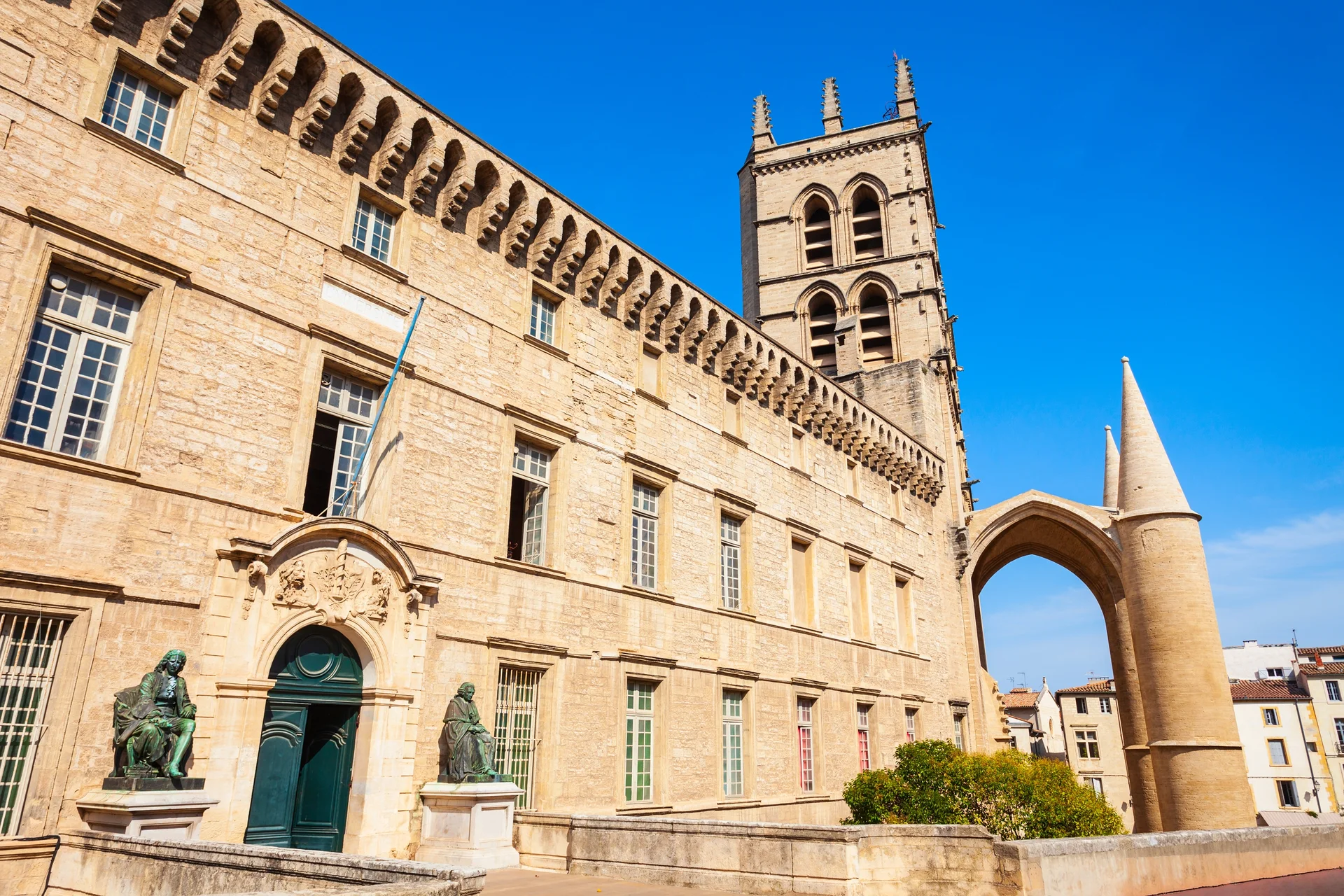
Visiting Montpellier Cathedral
Towering over the historic district, Montpellier Cathedral is one of the few medieval remnants still visible in the city. With its massive architecture and turbulent history, it is as striking for its appearance as for its role in the development of Montpellier.
A Gothic fortress in the heart of the city
Constructed in the 14th century at the urging of Pope Urban V, the cathedral surprises visitors with its military aesthetic. Its monumental portal is framed by two cylindrical pillars more than 4 meters in diameter, giving it the look of a fortress. Originally the church of the monastère Saint-Benoît (Saint-Benoît monastery), it became a cathedral in 1536 when Montpellier was designated an episcopal seat. Inside, the height of the nave and the Gothic vaults emphasize the sense of scale.
A witness to religious conflict
Like many religious structures in southern France, the cathedral suffered during the French Wars of Religion. In 1567, Protestant forces attacked the building and damaged a large portion of the structure. It was not until the 17th century that restoration work gave it its current appearance. Even today, certain parts of the building bear the scars of these clashes.
A historical and academic setting
Located near the Faculté de médecine (Faculty of Medicine), the oldest still-active medical school in Europe, the cathedral sits at the heart of the university district. A walk through the adjacent narrow streets reveals a rich architectural heritage, including the former cloister and the historic university buildings. The site is often included in guided tours of the historic center, which provide context on its significance within the history of Montpellier.
Opening hours
| Monday | 10:00-12:00, 14:00-18:00 |
|---|---|
| Tuesday | 10:00-12:00, 14:00-18:00 |
| Wednesday | 10:00-12:00, 14:00-18:00 |
| Thursday | 10:00-12:00, 14:00-18:00 |
| Friday | 10:00-12:00, 14:00-18:00 |
| Saturday | 10:00-12:00, 14:00-18:00 |
| Sunday | Closed |
Sunday hours are limited to religious services only, and the site is closed annually on December 25 and January 1.

This cathedral is truly stunning. Its facade is perfectly maintained and very bright. It is an impressive building. You can freely visit the interior, which is also very pretty. Although it is quite simple, there is a very serene atmosphere.