
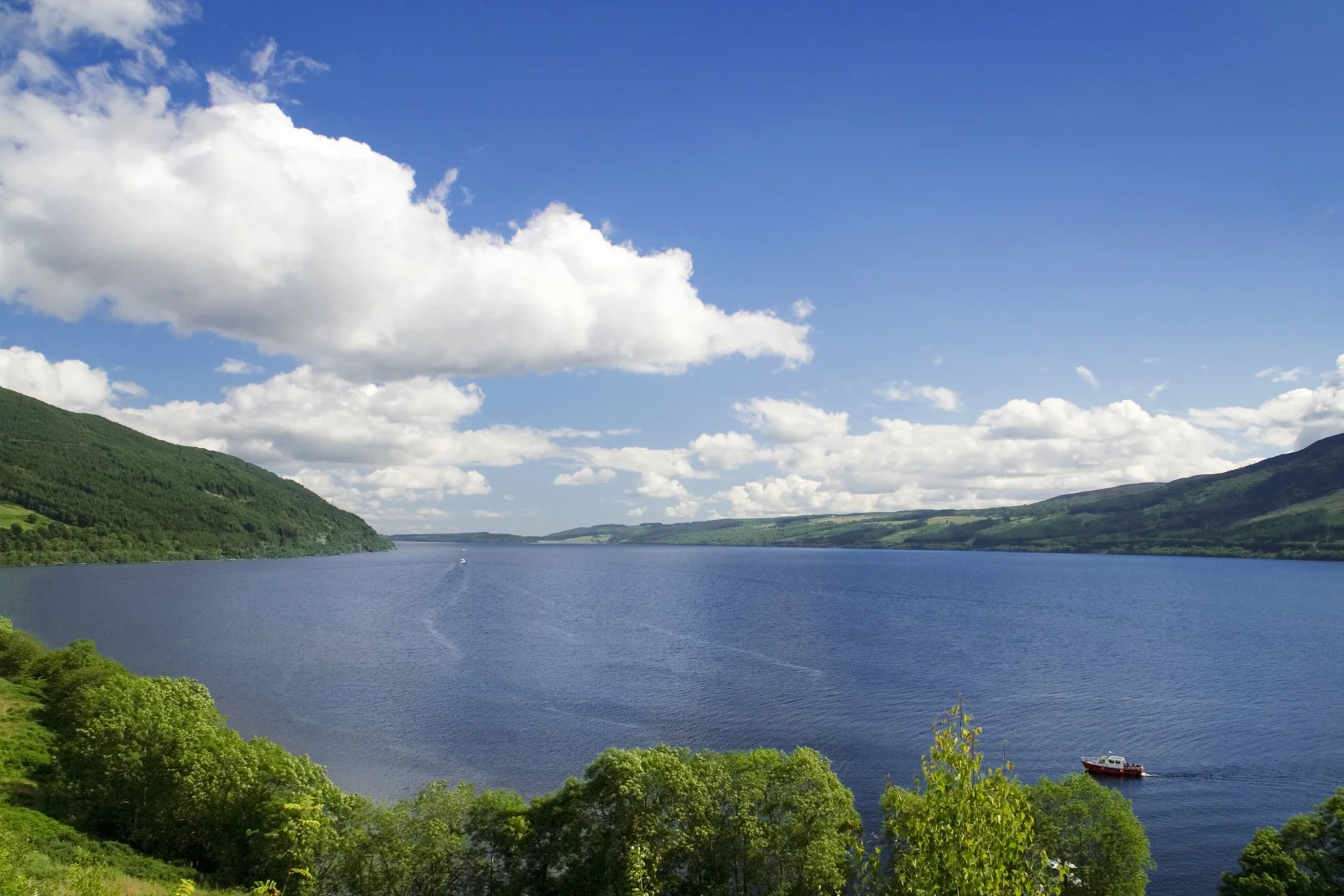
Into the depths of Scotland's largest lake
The dark waters of Loch Ness stretch for 37 kilometers through the Great Glen geological fault, carving a liquid path that splits the Highlands in two. With a maximum depth of 230 meters and a volume of 7.5 km³, this massive body of water contains more fresh water than all the lakes in England and Wales combined.
Black peat suspended in the water gives it a mysterious tint that, under the Scottish mist, has fueled one of the world's most persistent legends.
Why does Loch Ness hold such fascination?
Beyond the myth of Nessie, the sheer geological power of the site is striking. Formed by glacial erosion during the last ice age, the loch occupies a tectonic fault line visible even from space. Steep cliffs plunge more than 200 meters below the surface in certain areas, creating an aquatic abyss where light never reaches.
The legend dates back to the 6th century, when Saint Columba reportedly saved a man from a creature in the River Ness. However, it was the 1934 photograph taken by surgeon Robert Kenneth Wilson and published in the Daily Mail that propelled the monster to global fame. Even though this image was revealed to be a hoax 60 years later, the obsession remains.
More than 1,000 sightings have been recorded, and scientists continue to debate the phenomenon, with some pointing to a giant eel following a 2019 DNA study.
Exploring the loch: on water and land
Boat tours are the best way to grasp the scale of the loch. Departing from Inverness, Fort Augustus, or Drumnadrochit, boats equipped with high-tech sonar scan the dark depths for 1 to 2 hours. Screens display real-time depth readings and any shapes detected in the abyss. On board, guides share the geological history and the saga of Nessie.
For those seeking a faster pace, speedboats cut through the waves at over 25 knots, offering a dynamic view of Urquhart Castle and its medieval ruins perched on a rocky promontory. This 13th-century castle was once a site of clan warfare and offers a vertiginous panorama of the loch from its Grant Tower.
The Loch Ness 360° Trail
Dedicated cyclists take on the Loch Ness 360° Trail, an epic 129-kilometer route that circles the entire lake over six days. Starting and ending in Inverness, this circuit reveals the two faces of the loch: the tourist-heavy west bank with its wide road (A82) and the wild east bank (B852), which is narrow, winding, and offers solitary spots along the water. Day-trippers can opt for shorter segments.
Hidden gems around the loch
Fort Augustus, at the southern tip, is worth a stop for its spectacular Caledonian Canal. The five staircase locks, built in the 19th century, link the loch to Scotland's two seas. Watching boats navigate these hydraulic chambers is a highlight for visitors of all ages.
On the south side, the Falls of Foyers offer a different spectacle: a 30-meter waterfall crashing down a gorge with a deafening roar. The poet Robert Burns immortalized these falls during his 1787 visit, and excerpts from his poem still mark the trail that leads down to the loch.
In Drumnadrochit, the Loch Ness Centre & Exhibition untangles science and fiction regarding the monster through multimedia presentations narrated by David Tennant. It is kitschy, self-aware, and surprisingly educational regarding the geology of the loch.
Friendly tip: Visit in May-June or September-October to skip the summer crowds while enjoying mild weather. At daybreak, morning mists create an atmosphere worthy of Scottish legends, and the banks are completely deserted.
Glen Affric: a nearby natural jewel
A few kilometers to the west, Glen Affric is considered one of the most beautiful valleys in Scotland. Its ancient Caledonian pine and oak forests, crystal-clear lochs, and purple heather-covered mountains form a hiker's paradise. Marked trails lead to the Dog Falls or circle Loch Affric over 18 kilometers. Pine martens, red squirrels, red deer, and golden eagles inhabit these enchanting woods.
Opening hours
*Information subject to change

It is hard to miss Loch Ness if you are passing through the Highlands! Beyond the legends and extraordinary stories, it is truly a magnificent and peaceful place. There are plenty of walks nearby, and I recommend a little cruise on the loch to top it all off! Since we were there in April, we had beautiful, sunny weather.