
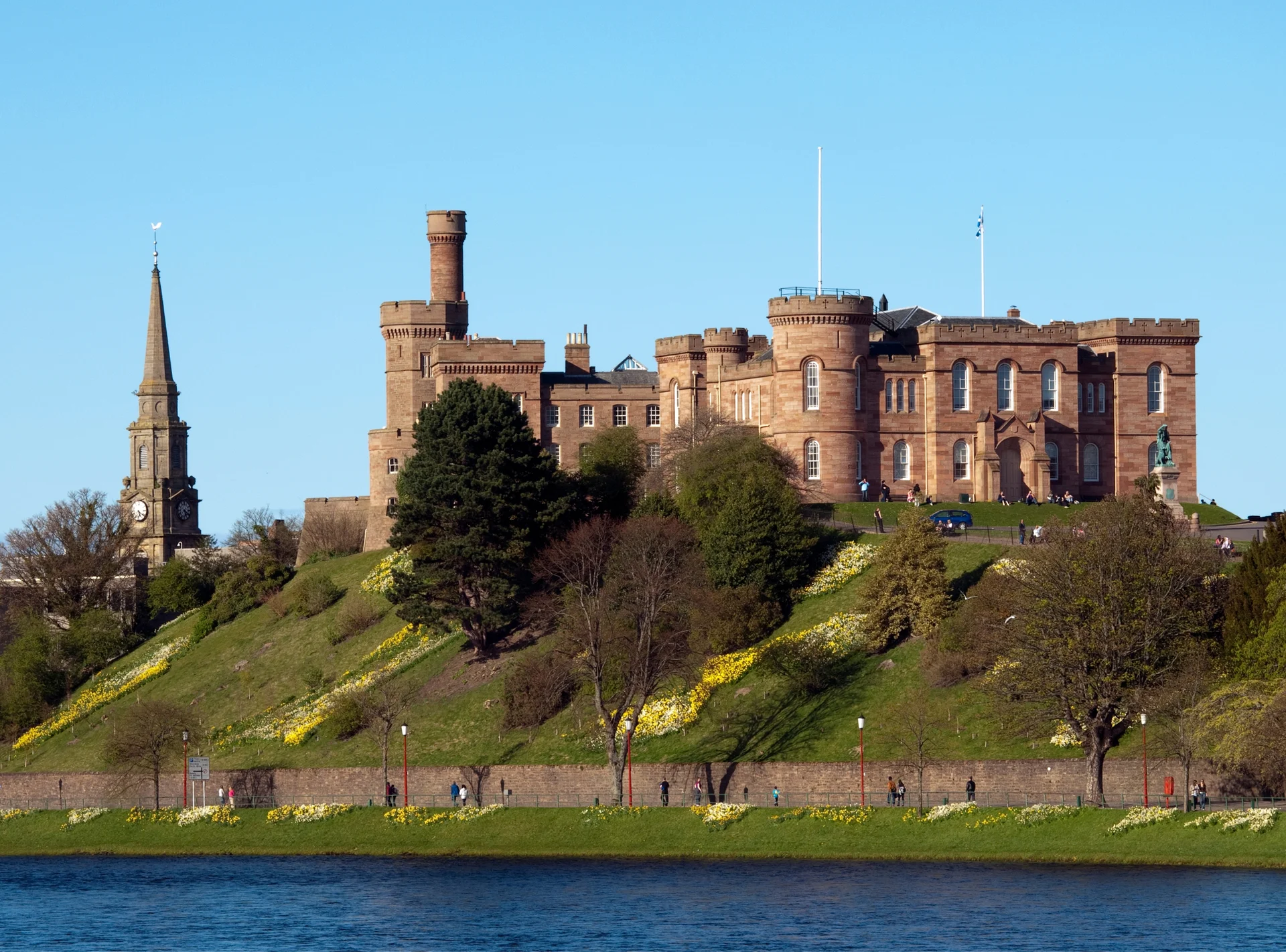
Inverness Castle, the gateway to the Highlands
Perched on a pink sandstone cliff overlooking the River Ness, Inverness Castle has stood guard over the capital of the Scottish Highlands for nearly a millennium. This Victorian silhouette with its crenelated turrets masks a thousand turbulent stories, from bloody sieges and royal betrayals to Jacobite rebellions. The site has been occupied without interruption since 1057, serving as a front-row witness to the power struggles that shaped Scotland.
Why venture up to Castle Hill?
The history begins in 1057 when Malcolm III built the first fortress on this strategic promontory, following the destruction of Macbeth's rival castle at Crown Hill. The location quickly became the stage for very real Shakespearean drama. In 1428, King James I set a trap here by inviting fifty clan chiefs under the guise of negotiations, only to arrest them and execute several on the spot.
The current castle dates to 1836, designed by architect William Burn in a romantic neo-Gothic style that celebrates the turbulent Highland past. This pink-sandstone structure replaced a medieval fortress demolished in 1746 on the orders of Bonnie Prince Charlie, just before the Battle of Culloden, to prevent government troops from seizing it. That decision ended a long succession of destructions and reconstructions that defined the site for seven centuries.
A succession of fortresses on the same hill
The initial earth-and-timber castle, complete with ditches and ramparts, evolved into an imposing stone structure by the 15th century. The Earl of Mar initiated this transformation in 1412, creating a stronghold capable of resisting attacks from the powerful Lords of the Isles. By 1548, the Earl of Huntly finished a massive five-story tower featuring a great hall and a chapel.
The most dramatic episode occurred in September 1562, when Mary, Queen of Scots, was denied entry to her own castle by the governor, Gordon, who was loyal to the Earl of Huntly. A furious queen mobilized the Fraser and Munro clans, who besieged the castle for three days. It was a royal victory, and Gordon was hanged for treason on the Queen's orders.
The Victorian fortress and its new luster
The current building, constructed between 1833 and 1848, originally functioned as a courthouse and prison. Burn drew inspiration from the Scottish Romanticism popularized by Walter Scott, creating theatrical architecture with octagonal towers, battlements, and machicolations. The local pink sandstone, quarried nearby, gives the castle its distinctive color that glows during sunset.
The Rose Window, a magnificent 1867 stained-glass piece from a former city church, now sits inside following a meticulous restoration. The statue of Flora MacDonald, the Highland heroine who helped Bonnie Prince Charlie escape after Culloden, has watched over the esplanade since 1896, her gaze fixed toward the west.
Friendly tip: to fully appreciate the castle, approach it first from the Ness Bridge on the opposite side of the river. The front-facing view of the pink sandstone cliff looming over the dark waters is the most spectacular, especially in the late afternoon when the sun sets the stone ablaze. Once inside, head straight to the panoramic terrace before exploring the exhibits. Understanding the geography of the Highlands from the heights significantly enriches the visit.
At the heart of Inverness, gateway to the Highlands
The castle is a fifteen-minute walk from the train station in Inverness, the final stop on the rail line from Edinburgh. The historic city center unfolds its charms in the immediate vicinity, including the Inverness Museum and Art Gallery, the medieval Old High Church, and the peaceful Ness Islands accessible by Victorian footbridges suspended over the river.

I found the visit to Inverness Castle very interesting. The route is well laid out and lets you discover the whole history of the Highlands. It really lets you dive into the region's past. Even though the castle is not from the original period, it is still a beautiful building that fits perfectly into the surrounding landscape.