
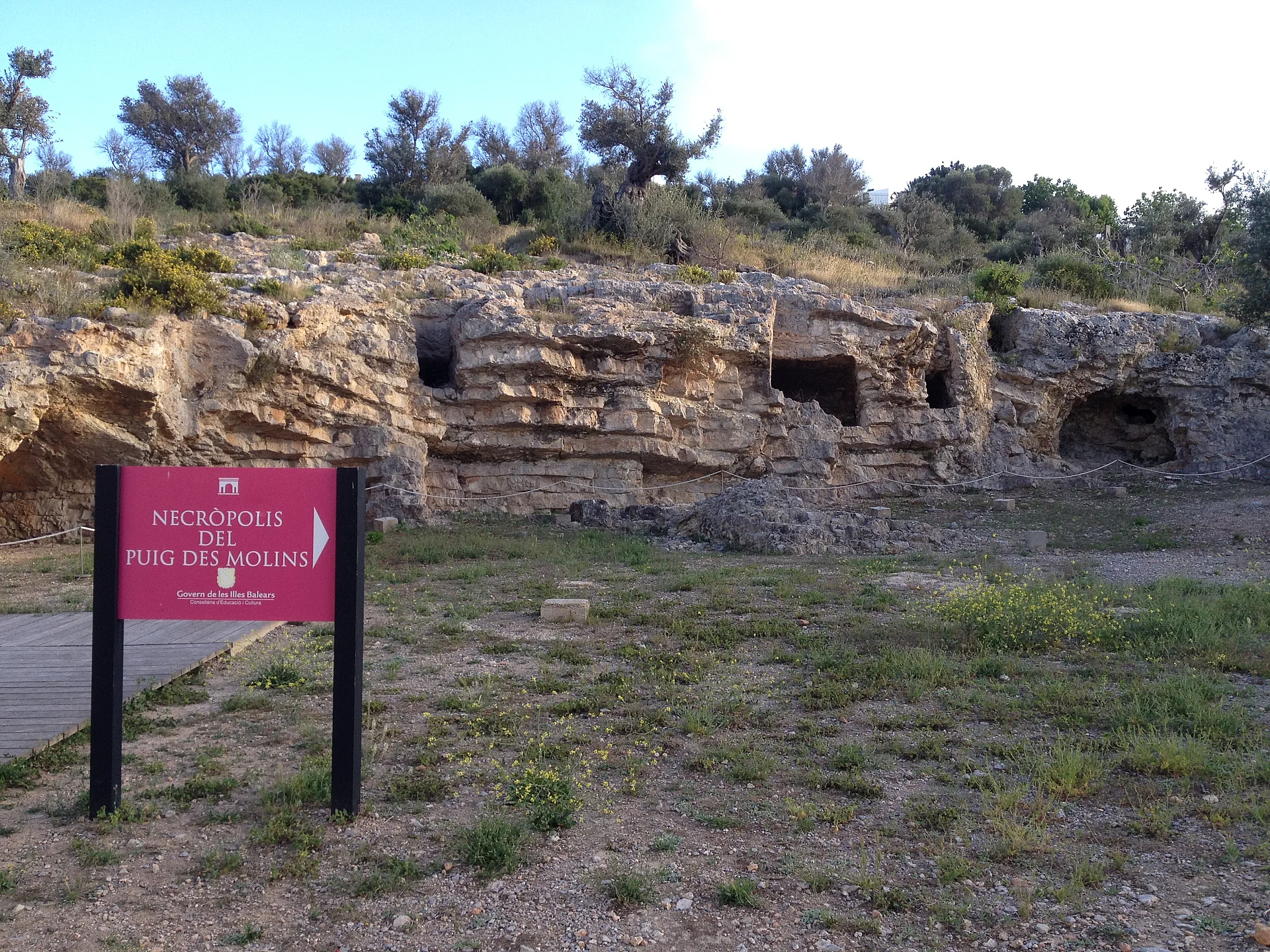
The Largest Punic Necropolis in the Mediterranean
Beneath the hill of Puig des Molins, just a short walk from the old town of Ibiza, lie more than three thousand tombs carved directly into the rock. For nearly a millennium, Phoenicians and later Carthaginians buried their dead here with precise rites, leaving behind one of the best-preserved Punic burial sites in the world.
Why visit the Puig des Molins Punic Necropolis?
The site occupies a strategic position, situated directly across from the ancient Phoenician settlement of Sa Caleta and the fortified city of Dalt Vila. The earliest burials date back to the 7th century BC, when the Phoenicians first settled on the island, and the site remained in use under Carthaginian rule until the arrival of the Romans.
Archaeologists are particularly drawn to the wealth of funerary objects recovered here, including jewelry, amulets, ceramics, and numerous clay statuettes representing the goddess Tanit, a protective deity highly venerated in Ibiza. Many of these artifacts are now displayed in the archaeological museum located right next to the site.
Funerary wells and their architecture
The visit allows you to descend to the level of the hypogea, these deep funerary chambers accessible by vertical shafts that were sometimes cut several meters into the earth. This technique, typical of Punic necropolises, protected the tombs from looting and erosion.
Some chambers still feature niches designed to hold multiple bodies or cremation urns, illustrating the evolution of burial practices from initial inhumation to cremation starting in the 4th century BC.
A World Heritage site
The necropolis is part of the property inscribed by UNESCO under the title Ibiza, biodiversity and culture, alongside Dalt Vila and Sa Caleta. This recognition highlights the site's importance in understanding trade routes and cultural exchanges in the western Mediterranean during Antiquity.
Friendly tip: combine your visit with the nearby archaeological museum, which houses the pieces recovered during excavations. Without this stop, much of the site's context remains hidden, as the empty tombs, however well-preserved, tell only half the story without their funerary offerings.
Pros
- One of the few Punic sites this well-preserved in the Mediterranean
- Immediate proximity to Dalt Vila
- Complementary archaeological museum on site
Cons
- Static archaeological site, not particularly engaging for young children
- Best experienced with a guided tour or a visit to the museum
Opening hours
Tue to Sat: 9:00 AM to 2:00 PM.
Sun: 10:00 AM to 2:00 PM.
Closed Mondays and on official public holidays.
Friendly tip: Hours may be reduced or shifted during the summer months or for special events. It is highly recommended to check the official website of the Museu Arqueològic d'Eivissa i Formentera (Archaeological Museum of Ibiza and Formentera) before your visit to confirm access to the hypogea.
How long for this activity
Plan on about 1 to 1.5 hours to explore the archaeological site and see the accessible hypogea, plus an extra 30 minutes to visit the adjacent museum.


Visiting this necropolis is very interesting. It is split into two parts, with an outdoor path first and then ruins to discover inside. It is an original visit that teaches you a lot about the island's history. Ibiza has a rich history that people tend to forget these days. Plus, the visit is free.