Visiting Rhodes
The Colossus is gone: the bronze statue that guarded the harbour, one of the seven wonders of the ancient world, came down in an earthquake more than two thousand years ago. What is left is something else, and rarer: you sleep inside the largest inhabited medieval town in Europe.
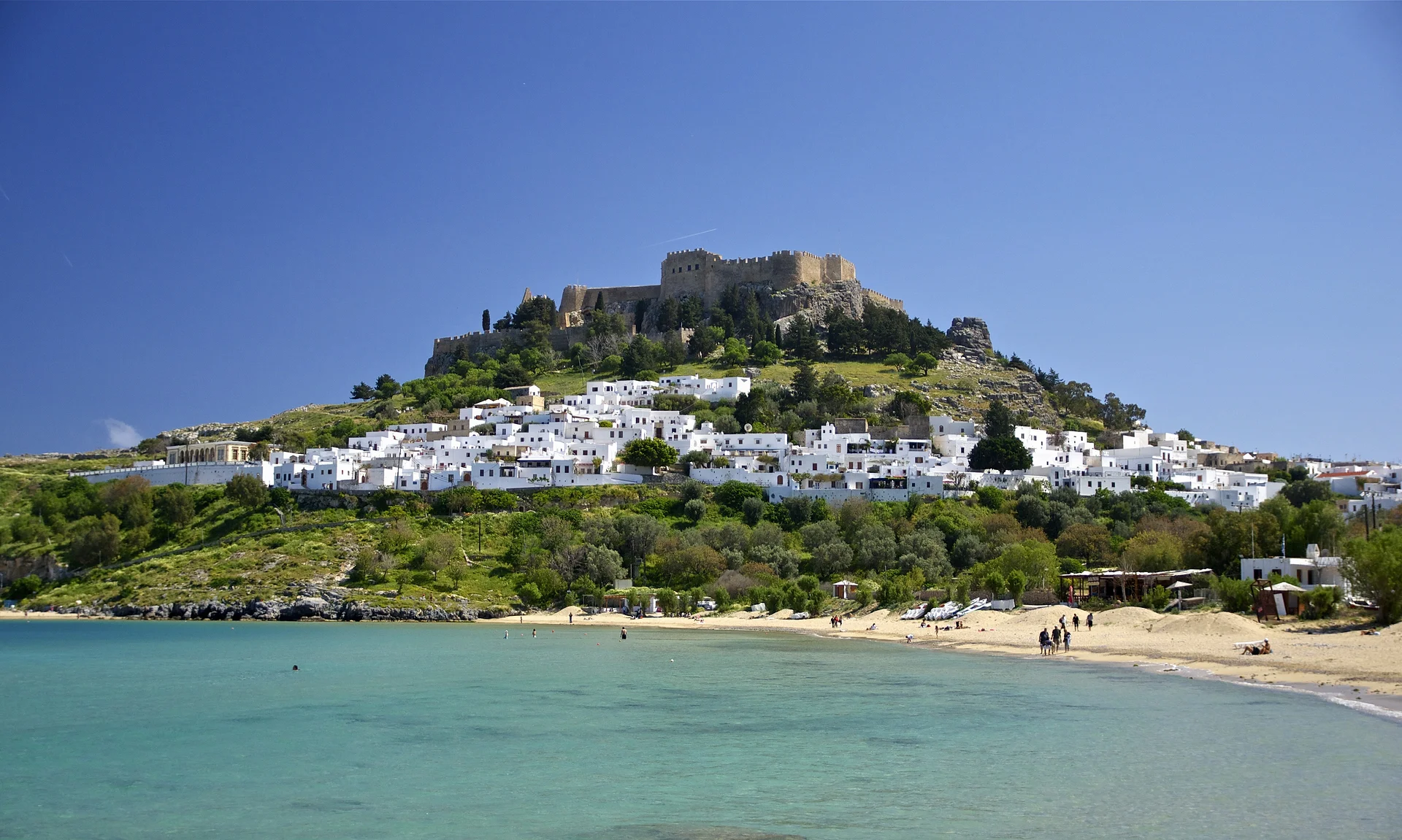
The Knights of Saint John held Rhodes from 1309 to 1522 and built an entire stronghold here. Fifty kilometres south, Lindos answers that military stone with a Greek acropolis and a turquoise bay.
You will love it if
- You want to sleep in a medieval town, not tour one
- Three hundred days of sunshine a year suit you
- You come in May, June or September, when the sea is warm and the stone bearable
Look elsewhere if
- You steer clear of mass tourism: this coast has been built up for fifty years
- You come in July or August: 35 °C on the ramparts, with no shade
- You are after a secret island: this is the most visited in the Dodecanese
The must-sees
-
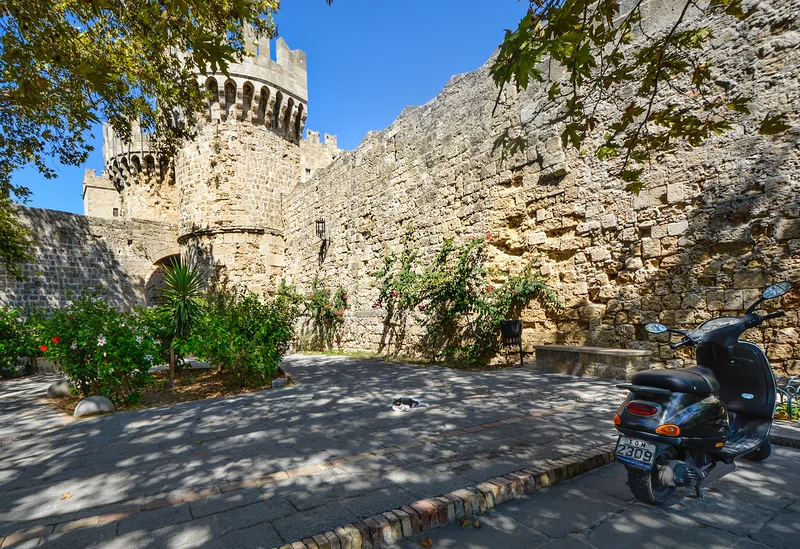
1 The Palace of the Grand Master +8 recs
In 1856 an accidental explosion in the cellars, where the Ottomans stored ammunition, reduced the palace to rubble. What you walk through is the Italian reconstruction of the nineteen thirties, openly presented as such, and the Roman mosaics it shipped in from the neighbouring islands.
-
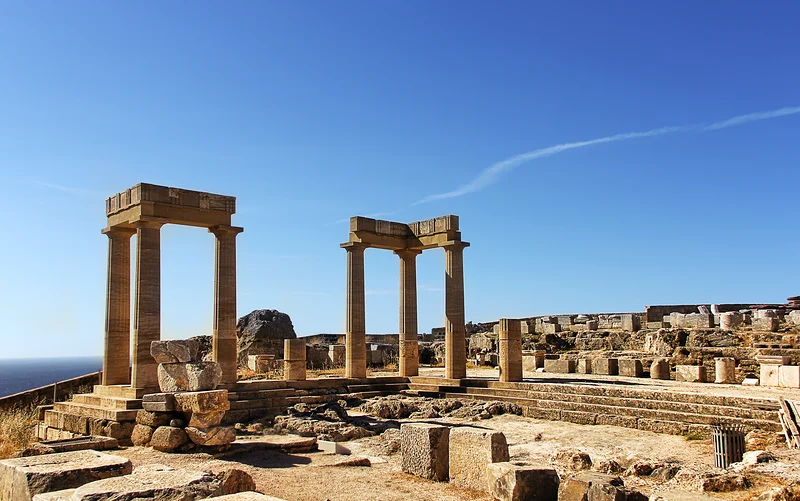
2 The temple of Athena Lindia +8 recs
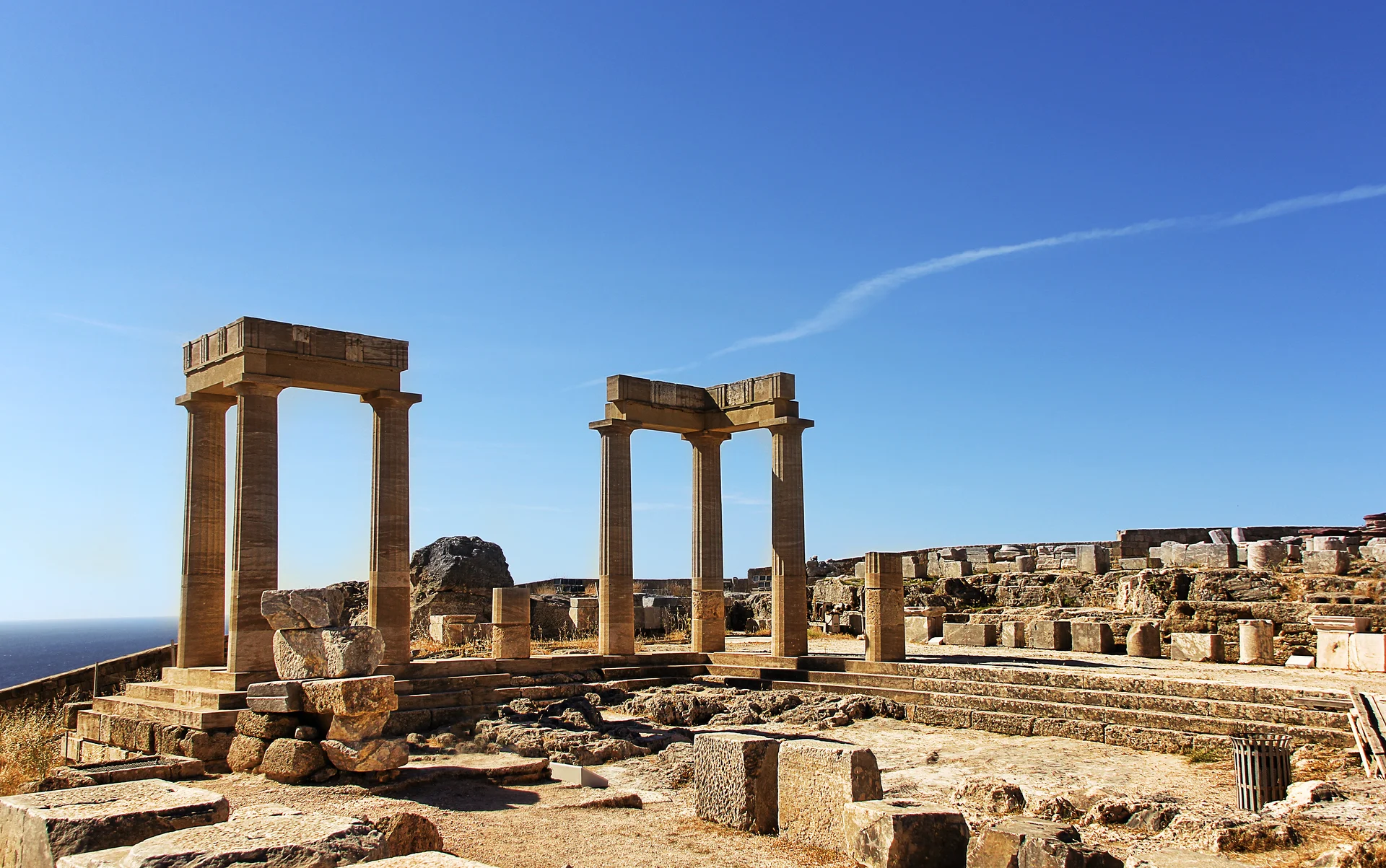
Doric columns on a sheer rock, and the sea a hundred and sixteen metres below. The sanctuary predates the knights by a thousand years, and it was they who shut it inside a fortress: the two ages sit on the same summit.
-
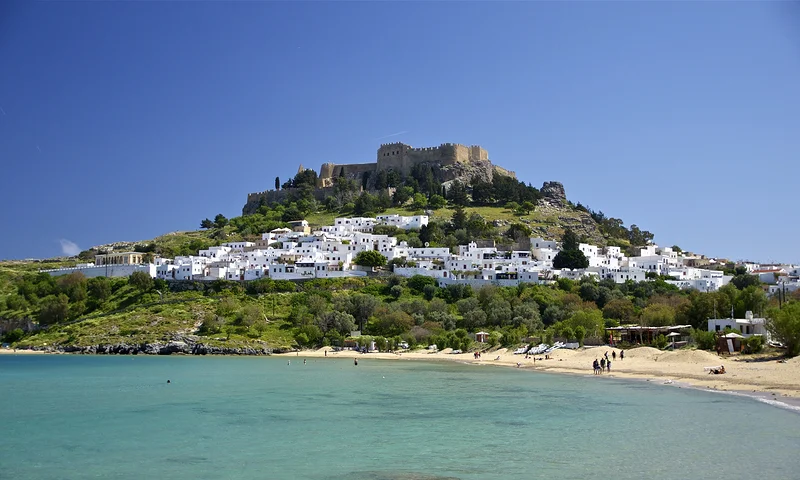
3 Lindos beach +8 recs
A crescent of golden sand at the foot of the acropolis, sheltered from the wind by the headland. It is the only bay on the island where you swim with an ancient site above your head, and it is packed by ten in the morning in summer.
-
4 The Street of the Knights +40 recs
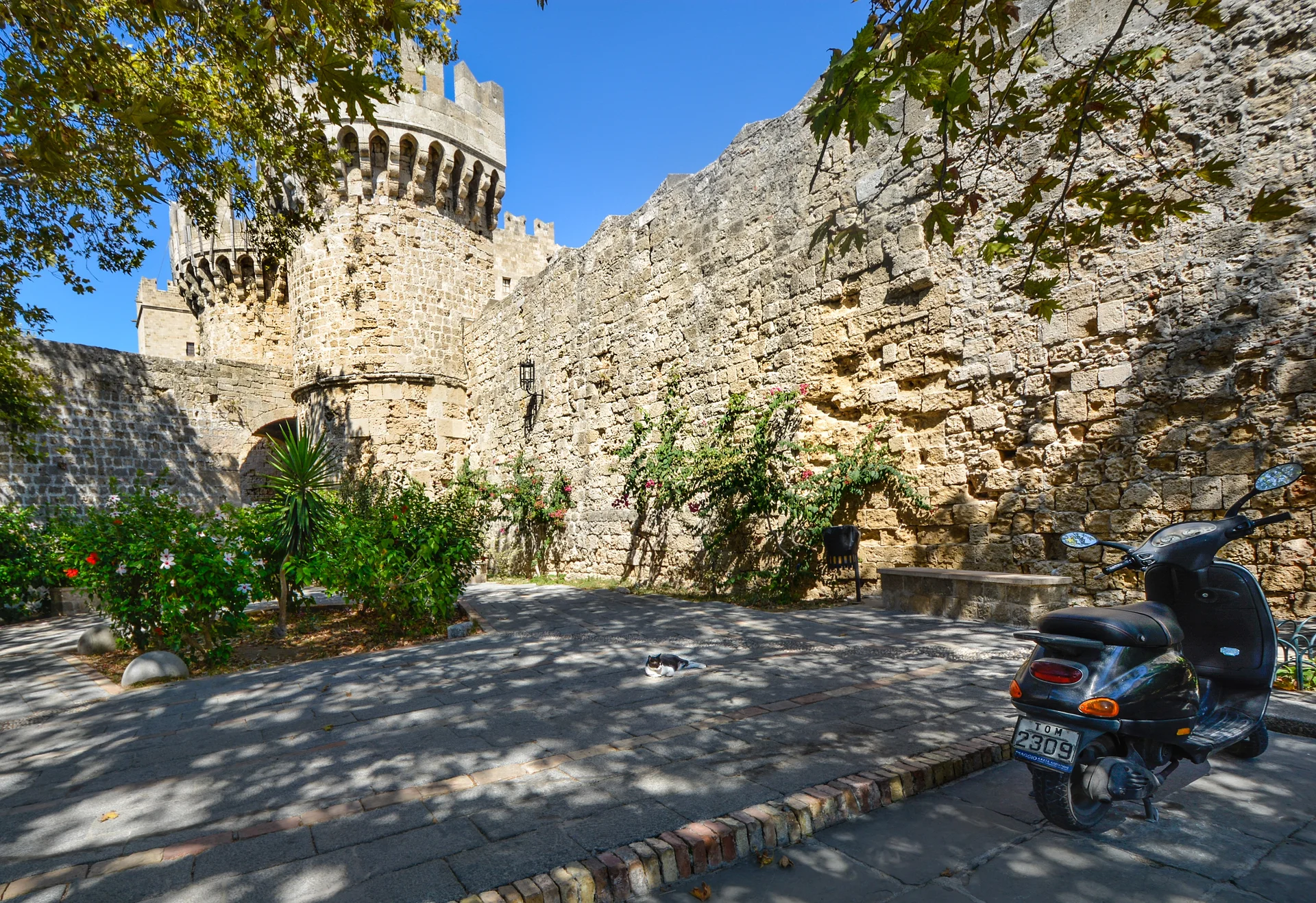
Two hundred metres of sloping cobbles between the inns of the order's seven tongues: France, Italy, Spain, Provence, Auvergne, England and Germany. The coat of arms above each door says which nation lodged there, and the street has not changed since 1500.
-
5 The old town +40 recs
Four kilometres of ramparts, eleven gates, and six thousand people living there all year round: that last figure is what separates it from an archaeological site. The World Heritage listing covers the whole town, not one monument.
The classic mistake
Do not visit Lindos in the middle of the day. The village is pedestrian, white and shadeless, the acropolis is earned by three hundred steps, and the cruise coaches pull in around eleven. Come at eight in the morning or after five in the afternoon: you will find a different place.
Our itineraries in Rhodes
| Length | Itinerary | What you see |
|---|---|---|
| 2 days | The old town of Rhodes | Palace, Street of the Knights, ramparts |
| 4 days | Rhodes plus Lindos | The knights, the acropolis, the bay |
| 1 week | Both of those plus the west coast | The ancient sites and the windward beaches |
The island runs eighty kilometres from north to south, and the east coast road reaches Lindos in an hour. Public buses cover it every hour in season, which spares you hiring a car for that trip.
The west coast, open to the meltemi, belongs to windsurfers and to pebble beaches that stay almost empty: twenty minutes from the old town, and nobody goes.
When to visit Rhodes
| Rating | Season | Weather | Crowds and prices |
|---|---|---|---|
| May, June and September | 24 to 29 °C, sea at 23 | Moderate, the stone stays walkable | |
| April and October | 19 to 24 °C, clear skies | Light, cool sea in April | |
| July and August | 30 to 36 °C, meltemi in the west | Saturated, cruise ships every day | |
| November to March | 15 to 19 °C, showers | Deserted, half the addresses close |
Getting to Rhodes
-
1 By plane The quickest
easyJet and Ryanair fly from London, Manchester and Dublin to Rhodes from May to October, in about four hours. Out of season you go through Athens, and the last leg takes fifty minutes.
-
2 By boat Between the islands
the ferries out of Piraeus take fifteen to seventeen hours, and the fast boats link Rhodes to the other Dodecanese islands in one to three hours. That is how you add Symi or Kos without flying again.
-
3 From Turkey The other door
Marmaris is an hour away by boat, with daily sailings in season. Plenty of travellers string the Turkish coast and Rhodes together, and it is the shortest crossing in this corner of the sea.
The airport sits fifteen kilometres south-west of the old town, half an hour on the public bus. Cars are hired on the spot, but the old town is entirely pedestrian: you will park nothing inside it.
Getting around Rhodes
The old town of Rhodes is walked, and only walked: the lanes are too narrow and the cobbles slippery. For Lindos and the coast the hourly bus is enough, and it costs a few euros.
Good to know
The Palace of the Grand Master closes on Mondays out of season, and the acropolis of Lindos at three o'clock on some winter days. Official hours change twice a year and it is the version posted at the gate that counts, not the one you will read online.
What to eat in Rhodes
- Pitaroudia: chickpea fritters with mint and onion, a speciality of this island and of nowhere else. Served warm, as a starter, with lemon.
- Melekouni: a sesame and honey bar handed out at weddings, dense and scented with orange. It keeps for weeks and travels home easily.
- Rhodes mussels: farmed on the east coast and served saganaki, with tomato and feta. The dish of the bay, and rarely on the tourist menus.
- The island wines: athiri in white and mandilaria in red, grown on the slopes of Mount Attavyros. The Embona estates can be visited, and their whites hold their own against the mainland.
- Souma: the grape spirit of the Dodecanese, distilled under an old licence and served ice cold. A cousin of Cretan raki, drier.
- The local goat cheese: krasotyri, matured in wine, stronger than feta and not to be found beyond the neighbouring islands.
- Figs and thyme honey: the dried figs of August and the honey of the plateaux, sold at the market in the new town, not in the old one.
In the old town, the tavernas on the tourist lanes have menus in six languages and touts at the door: that is the signal to walk on. The good addresses are in the Ottoman quarter to the south, and in the new town where people who live here eat.
Where to stay in Rhodes
| Area | What it is for | Good to know |
|---|---|---|
| Old town of Rhodes | Palace, ramparts, lanes | Guesthouses in the stone, suitcases to carry |
| New town | Market, town beaches, prices | Nineteen sixties blocks, handy and plain |
| Lindos | Acropolis, bay, captains' houses | Pedestrian village, dear, glorious outside coach hours |
| Faliraki and the east coast | Resorts, families, sport | Built up, busy, without character |
| West coast | Wind, pebbles, quiet | Windsurfing, almost nobody, older hotels |
Sleeping in the old town carries a hidden price: most addresses have no car access at all, and bags are carried two to three hundred metres over cobbles. Many hosts offer a lift to the town gate: ask for it before you arrive.
In Lindos, the seventeenth-century captains' houses, with their floors of black and white pebble mosaic, have become guest rooms. It is the most singular place to sleep on the island, and it books months ahead.
How much does a trip in Rhodes cost?
| Style | Length | Budget per person |
|---|---|---|
| Tight (simple room, buses, tavernas) | 5 days | 250 to 400 € |
| Comfortable (guesthouse, restaurants, sites) | 5 days | 600 to 900 € |
| High (captain's house, boat, harbour tables) | 5 days | 1,600 to 2,500 € |
- The combined site ticket: the palace and the museums of the old town share one entry, valid three days, bought at the first desk.
- The bus to Lindos: a few euros each way against the price of a day's car hire, and it leaves every hour in season.
- May and September: the same room costs half what it does in August, for a sea at 23 °C.
- Eating in the new town: half the price of the old town, ten minutes away on foot, and that is where you will meet Rhodians.
- Public beaches: free and fitted with showers all along the east coast; paid sunbeds are a choice, not an obligation.
Traditions and way of life in Rhodes
The Knights of Saint John, driven out of the Holy Land, settled in Rhodes in 1309 and stayed two centuries, until Suleiman's siege in 1522. They left for Malta, where they did the same thing again: the two cities look alike because they had the same builders.
Italy occupied the Dodecanese from 1912 to 1943 and rebuilt much of what you visit, the palace included. The islands only joined Greece in 1947: this is the most recently Greek territory in Greece.
Two customs worth knowing. In Orthodox churches, cover your shoulders and knees, and do not turn your back on the iconostasis as you leave: worshippers step back a few paces before turning round.
And the stairway to the acropolis of Lindos is climbed on foot. The donkeys offered at the entrance carry loads beyond what their condition allows, and local associations ask visitors to refrain.