
Where to stay in Mandalay: the 4 neighborhoods to know in 2026
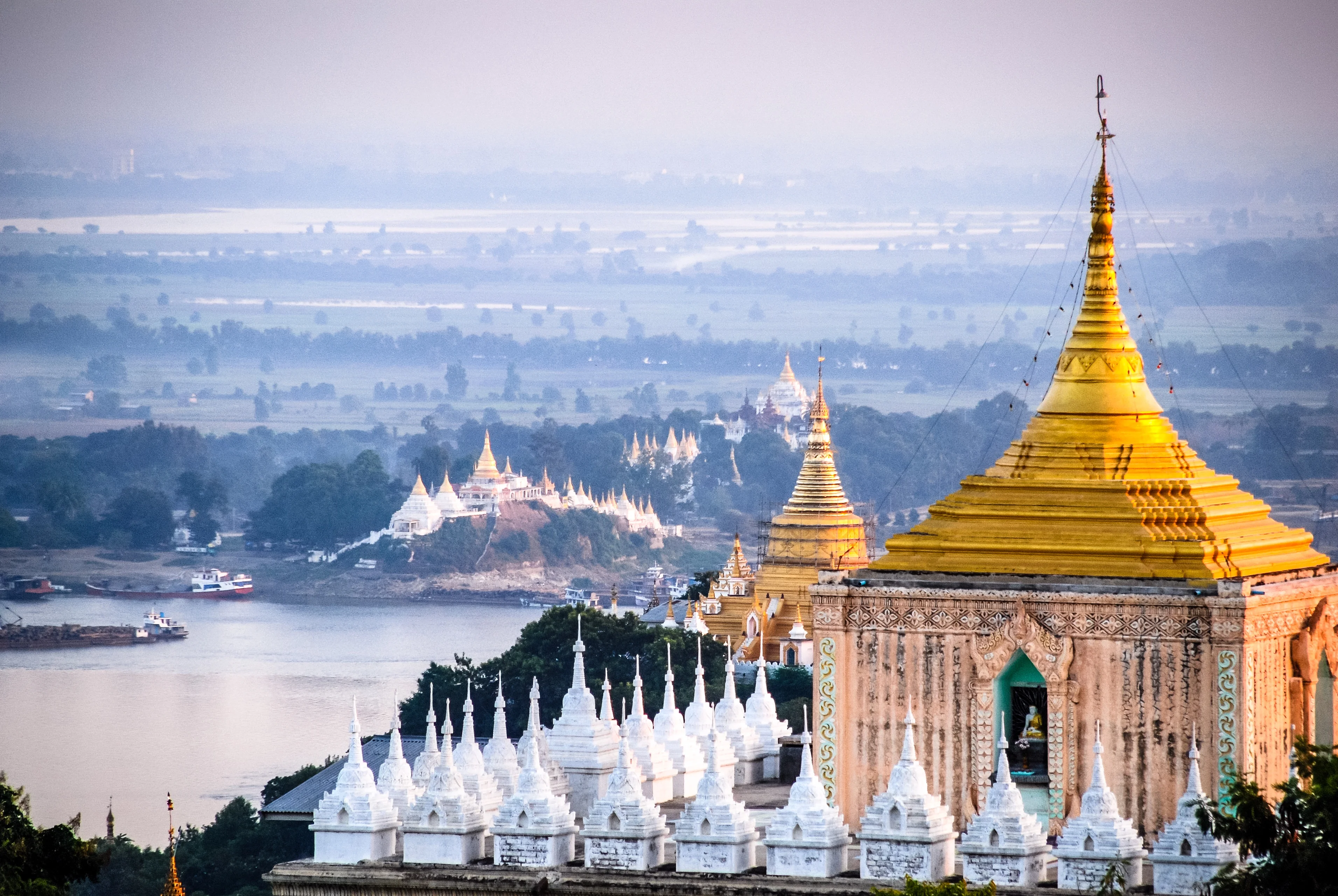
In Mandalay you do not pick a neighborhood for its charm, you pick it for the distance to the monasteries. The last royal capital of Burma is a grid of numbered streets laid flat between the Irrawaddy and a hill two hundred and forty metres high, and that grid has nothing picturesque about it: the city is crossed by motorbike taxi, not on foot. What you came to see is all around it. To the north, the square enclosure of the palace, the hill and its one thousand seven hundred and twenty-nine steps, and the royal monasteries including Kuthodaw, seven hundred and twenty-nine marble slabs engraved with the Buddhist canon. To the south, the Buddha of Mahamuni, which the faithful cover in gold leaf and which is washed every morning at four, the gold-beaters' workshops, and the teak bridge of U Bein, twelve hundred metres across a lake. Opposite, on the far bank, the former capitals: Mingun, Sagaing, Inwa.
Two things must be said before booking. The earthquake of 28 March 2025, magnitude 7.7, epicentre twenty kilometres from here, damaged buildings, monasteries and pagodas across the region: the state of any given site is checked the day before, not in a guide. And foreign bank cards no longer work in the country: you arrive with dollars in cash, new notes. Prices, for their part, go lower than anywhere else in these guides: a hostel or a simple hotel sits between $14 and $34*, a mid-range place with a pool between $40 and $68*, and the only recent large hotel asks $136 to $181*. The eight addresses that follow all fit inside a rectangle of eight streets, and a fourth neighborhood has none at all.
The city itself does not have the immediate charm of other destinations in Burma, but it is hiding some real treasures.
Compare hotel prices in Mandalay
In a hurry? Find the best accommodation deals in 3 clicks.
Compare live deals from Booking, Expedia, Agoda and other partners.
At a glance: our picks by traveller type
Pick the profile that suits you to head straight to the recommended neighborhood.
The neighborhood map in Mandalay
Get your bearings on the neighborhoods and must-see sights before choosing where to drop your bags. Click a name to jump to its description.
The north: the palace, the hill and the royal monasteries The walls and moat of Mandalay palace, Mandalay Hill and its covered stairway, Kuthodaw pagoda and its seven hundred and twenty-nine slabs, Atumashi monastery, Sandamuni pagoda, the quiet streets from 22nd to 27th
for the monasteries on foot or nearly, a first visit, daybreak
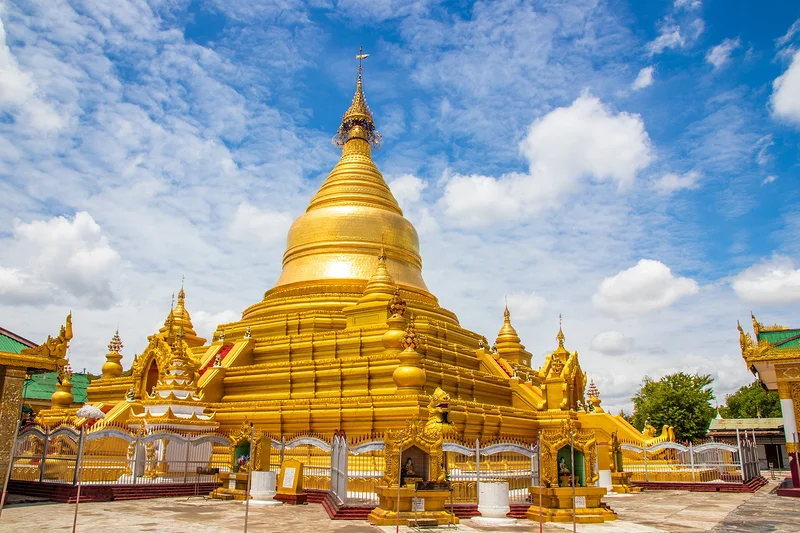
The north is the reason the city exists. The palace enclosure draws a square two kilometres on each side, ringed by moats and battlements: the inside is occupied, the 1990s reconstruction stands in for the buildings burned in 1945, and it is mostly the silhouette from the road that counts. Two kilometres further up, Mandalay Hill is climbed barefoot by a covered stairway, or by car from the back, and gives the city, the river and the plain in a single look. At its foot the royal monasteries line up: Kuthodaw and its slabs under their white stupas, Atumashi monastery and its golden doors, Sandamuni pagoda and its one thousand seven hundred and seventy-four tablets. You sleep here to start the day in the monasteries before the heat. The downside: few restaurants, and you have to go down into town for dinner.
The architecture, the carved details, and the peaceful atmosphere that reigns there make for an unforgettable visit.
What to see & do in the neighborhood
Where to stay in this neighborhood
Mingalar Mandalay Hotel Luxury
On 26th street, at the south-east corner of the palace: the only recent large hotel in the city, wide rooms, a pool, a gym, and a breakfast reviews name first. Scored 9.3, but on twenty-two reviews only: in Mandalay the volumes collapsed along with tourism. It is also the most expensive address in the guide, by far.
Ostello Bello Mandalay Mid-range
Five hundred metres from the palace: an Italian hostel with private rooms and dorms, a roof terrace where people gather in the evening, a bar and a restaurant, and a team reviews describe as available at any hour. Scored 8.7 on more than one hundred and fifty reviews, the largest volume in the north. This is where you find the other travellers, when there are any.
Ease Hotel Budget
Between the palace and the hill, a simple recent address: clean rooms, breakfast included, staff reviews thank by name. Scored 8.6, but on fourteen reviews: the score states the intention, not the consistency. Take it for the price and for the position.
Pros
- The royal monasteries and the hill without crossing the city
- The quietest neighborhood, and the only one where you willingly walk
Cons
- Few tables in the evening: you go back down towards the centre to eat
- The three addresses here are each scored on fewer than thirty reviews
The west: the station, Zegyo market and the lower streets The central station and its night trains, Zegyo market and the shopping streets from 84th to 88th, Shwe Kyi Myin pagoda, the restaurants of 27th street, the Irrawaddy jetty and the boats to Mingun
for the trains, the market, the restaurants, small budgets
West of the palace the city turns useful: Zegyo market and the shopping streets around it, the workshops and eating houses of 27th street, Shwe Kyi Myin pagoda in among the apartment blocks, and the central station, from which the slow trains leave for Hsipaw and Yangon. It is the densest, noisiest neighborhood, and the one where you eat best for three euros; it is also from the jetty, at the end of the lower streets, that the Mingun boat leaves every morning. The hotels here are the most numerous and the cheapest in the guide, including the only one that counts its reviews in thousands. You sleep here for the price and for the street life. The downside: the traffic, the horns, and power cuts that hotel generators cover more or less.
Where to stay in this neighborhood
Hotel Aurora Mid-range
87th street, between 26th and 27th, a seven-minute walk from Eindawya pagoda: a well-kept address, free bikes, a concierge, allergy-free rooms. It is the only one in the city whose score rests on real volume, 8.9 on more than one thousand four hundred reviews, which makes it the surest bet in this guide.
79 Living Hotel Budget
Directly opposite the station: free bikes, parking, a shared lounge, a terrace from which you see the Sagaing hills at sunset. Scored 8.0 on more than one hundred and twenty reviews, which praise the management and the bus tickets it secures. The right choice for a night train, and one of the cheapest in the guide.
Royal Pearl Hotel Budget
In the lower streets, ten minutes from the market: no pretension, well-equipped rooms kept clean, wifi that works, staff reviews find helpful. Scored 8.0 on twenty-nine reviews. It is the kind of address that makes this city's average: decent, modest, and thinly documented.
Pros
- The market, the eating houses and the Mingun jetty on foot
- The lowest prices, and the city's only address scored on thousands of reviews
Cons
- Noise, traffic and power cuts more noticeable than elsewhere
- Nothing monumental in the neighborhood itself
The east and south: Mahamuni, the gold workshops and Amarapura Maha Myat Muni pagoda and its gilded Buddha, the gold-beaters' workshops of 36th street, the marble carvers on the Sagaing road, Maha Gandhayon monastery at Amarapura and its ten o'clock meal, U Bein bridge and its lake, the wide quiet streets of 65th
for the Mahamuni Buddha, the workshops, the bridge at sunset
South of the grid the city turns artisanal and religious. Maha Myat Muni pagoda shelters a four-metre Buddha whose body the faithful have been covering in gold leaf for two centuries, and whose face is washed every morning at four in front of a crowd; around it, the gold-beaters work with hammers in workshops open to the street, and the marble carvers turn out Buddhas in series on the Sagaing road. Ten kilometres further down, Amarapura keeps Maha Gandhayon monastery, where a thousand monks take their meal at ten, and U Bein bridge, twelve hundred metres of teak on stilts that everyone crosses at sunset. To the east, 65th street is the city's residential quarter, wide and planted. You sleep here for the quiet and to set off south early. The downside: everything is done by car.
Where to stay in this neighborhood
E-outfitting Golden Country Hotel Mid-range
65th street, between 31st and 32nd: outdoor pool, gym, garden, restaurant and bar, in a residential quarter. Location scored 9.0 and staff 9.3, for an 8.3 on around fifty reviews. It is the best compromise between quiet, a pool and price in this city.
Rupar Mandalar Resort Luxury
At the corner of 53rd and 30th street, Mandalay's boutique resort: teak pavilions in a garden, two pools, a spa, an airport shuttle. The reviews are too few for a score to mean anything, so this guide gives none: what is certain is that it is the only address in the city built like a Burmese house and not like an apartment block.
Pros
- Mahamuni, the gold workshops and the Amarapura road on the same axis
- The quietest streets and the only two addresses with a pool in the guide
Cons
- Neither market nor station on foot: the neighborhood is lived by motorbike taxi
- U Bein bridge is ten kilometres away, and packed at sunset
The far bank: Mingun, Sagaing and Inwa Mingun Paya, Bodawpaya's unfinished stupa, the Mingun bell and its ninety tonnes, the white pagoda of Myatheindan, Settawa Paya, Maha Aungmye Bonzan monastery at Inwa, the leaning watchtower of Nanmyin, the pagoda hills of Sagaing
half of what you came to see, and no hotel: you go for the day
This neighborhood appears in this guide even though you do not sleep in it: no address on the far bank can be booked online, and yet half of what you came to see in Mandalay is there. Mingun, eleven kilometres upstream and reached by the morning boat, lines up three things that exist nowhere else: the base of a stupa Bodawpaya meant to be the largest in the world and which stopped at fifty metres, split by an earthquake; a bell of ninety tonnes that you strike with your fist; and the white pagoda of Myatheindan, whose terraces ripple like waves. To the south-west, Inwa keeps its yellow brick monastery and its leaning watchtower among the paddy fields, and Sagaing covers its hills with pagodas and monasteries. It is also the zone the earthquake of 28 March 2025 struck: the state of the sites is checked before setting off.
Pros
- Mingun by the morning boat, an hour on the river from the jetty
- Inwa by horse cart and Sagaing in half a day, twenty kilometres out
Cons
- No bookable hotel: you sleep in town and come for the day
- The neighborhood worst hit by the March 2025 earthquake, to be checked before going
Our tips for booking the right place
- The earthquake of 28 March 2025, and what the reader must check alone: An earthquake of magnitude 7.7 struck the region on 28 March 2025, epicentre near Sagaing, twenty kilometres from Mandalay. Buildings collapsed in the city, monasteries and pagodas were damaged on both sides of the river, and the old Ava bridge broke. A guide cannot say what has reopened today, site by site: the only reliable method is to have the hotel confirm the day before what you want to go and see. Add the fact that most governments have advised against travel to Myanmar since 2021, on grounds of security and conscription: this guide describes the city, it does not tell you to go.
- Dollars in cash, new notes, and no bank card: This is the first practical trap and there is no way round it: foreign bank cards have barely worked in the country since 2021, the cash machines do not serve international cards, and almost no hotel takes online payment. You arrive with dollars in cash, in recent notes, unfolded, unwritten on, untorn: a marked note is refused at the exchange desk. Changing is done in town or at the hotel, into kyats, and you need to plan for the whole stay. Same for electricity: the cuts last several hours a day, hotels run on generators, and a torch earns its place every evening.
- Getting around: motorbike taxi, a driver for the day, and the morning boat: Mandalay is flat and wide, there is neither metro nor useful bus, and distances are counted in numbered streets. The motorbike taxi is the normal way, $0.57 to $2.30* a trip across town, and a taxi $3.40 to $6.80*. To see the south, the right formula is a driver for the day, $29 to $46* depending on the car, who strings together Mahamuni, the workshops, Amarapura, U Bein bridge and sometimes Inwa. For Mingun, it is the boat: leaving the jetty late in the morning, an hour on the river, back in the early afternoon, a few euros. The airport is thirty-five kilometres south, forty-five minutes, and the shuttle costs less than the taxi.
- The Burmese table, the tea and monastic hours: You eat early and cheaply: mohinga, the rice noodle and fish soup that is the national breakfast, fermented tea leaf salad, Burmese curry served with a whole table of small dishes, Shan noodles in the eating houses of the centre. The tea house is the local institution: you walk in at six, you drink a sweet milk tea for a few cents, and you read the news. Count $2.30 to $5.70* for a full meal in the centre, double that in the two or three restaurants aimed at foreigners. And remember the opening hours of the sites, set by monastic life: the washing of the Mahamuni Buddha at four in the morning, the monks' meal at Amarapura at ten, the pagodas closing at dusk.
- A hotel chosen on its score without looking at the number of reviews: in Mandalay, seven of the eight addresses in this guide are scored on fourteen to one hundred and fifty reviews, and a 9 built on twenty voices does not mean what it would mean elsewhere. The only solid score in the city rests on more than one thousand four hundred reviews, and it belongs to a mid-range hotel.
- The addresses that advertise a price with no published score at all, numerous in the lower streets below $17*: they exist, they may well be fine, but nothing lets you know and there is no recourse on the spot.
- The far bank as a place to sleep: Mingun, Sagaing and Inwa have no bookable address, and settling there means giving up money changing, restaurants and transport. You go for the day, from the city.
- The airport district: thirty-five kilometres south, no interest at all, and the shuttle reaches the centre in forty-five minutes. Even for an early flight, you sleep in town.
FAQ: where to stay in Mandalay
Which neighborhood should you sleep in in Mandalay for a first visit?
Where can you sleep cheaply in Mandalay?
How many nights should you plan in Mandalay?
Is Mandalay safe for a traveller?
How do you get to the centre from Mandalay airport?
What does a night in Mandalay cost?
 Keep exploring
Things to do in Mandalay
Keep exploring
Things to do in Mandalay
Comments (0)
No comments yet. Be the first!