
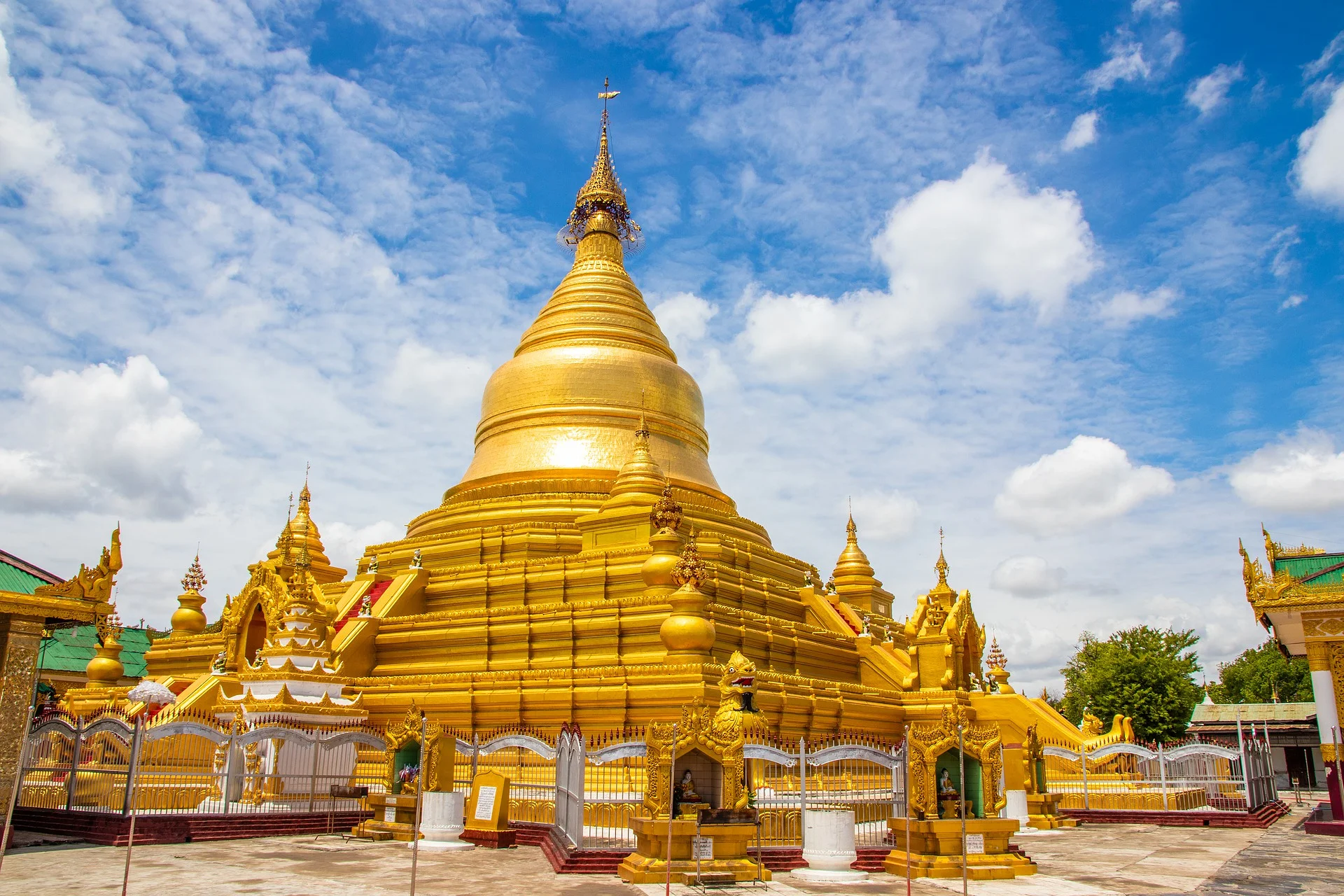
The world's largest book carved in marble
At the foot of Mandalay Hill stands a unique treasure. A collection of 729 white marble slabs, each sheltered under its own small stupa, forms what is known as the largest book in the world. Sunlight reflects off the gilded roofs of the shrines, creating a shimmering sea of white and gold.
A royal act of faith to preserve Buddhist knowledge
King Mindon Min began construction of the Kuthodaw Pagoda in 1857, during the founding of Mandalay as the new capital. His goal was ambitious. He sought to carve the entire Pali Canon, the Tipitaka, onto marble slabs to protect it for posterity. The marble was sourced from Sagyin Hill, 32 miles north of Mandalay, then transported by boat to the city. Engraving began in October 1860 and was completed in May 1868.
At the center of the complex sits a golden stupa 57 meters (187 feet) tall, built on the model of the Shwezigon Pagoda near Bagan. Each slab measures approximately 1.52 meters (5 feet) long and 1.06 meters (3.5 feet) wide, engraved with 80 to 100 lines on each side in Burmese script.
A walk among the stone books
The site spans over five hectares (12 acres), organized in symmetrical rows of white stupas. Between the shrines, hkayei (Mimusops elengi) and meze (Madhuca longifolia) trees were planted, creating a fragrant and pleasant shade. The visit typically begins at the south entrance, with its massive doors adorned with floral carvings.
Visitors stroll along the shaded paths, discovering the slabs housed in their kyauksa gu (stone inscription caves). Originally, the letters were filled with gold leaf. After the British looting in 1885, they were repainted with black ink, which paradoxically made the texts easier to read.
The remains of a tumultuous history
When the British annexed Mandalay in 1885, their troops were stationed within the complex. They stripped the pagoda of its riches, including gold, jewels, and any movable valuables. It was a dark moment for this heritage site.
A man named U Aung Ban had the idea to appeal directly to Queen Victoria, who had promised to respect all religions. In 1890, she ordered the withdrawal of troops from all religious sites. Restoration began thanks to donations from across Myanmar (Burma), bringing the complex back to life.
Friendly tip: Burmese newlyweds often come to have their photos taken among the rows of stupas, creating a lively atmosphere toward the end of the day. Plan your visit for the late afternoon to enjoy the sublime golden light and a more tranquil environment.
World-recognized heritage
The Kuthodaw Pagoda has been inscribed on the UNESCO Memory of the World Register, an international recognition of its exceptional importance to humanity. It stands as a living testament to a king's determination to preserve his spiritual legacy for future generations.
Opening hours
| Monday | 08:00-20:00 |
|---|---|
| Tuesday | 08:00-20:00 |
| Wednesday | 08:00-20:00 |
| Thursday | 08:00-20:00 |
| Friday | 08:00-20:00 |
| Saturday | 08:00-20:00 |
| Sunday | 08:00-20:00 |

The Golden Palace Monastery in Myanmar is an exceptional place that is truly worth the trip. It is a testament to remarkable craftsmanship. The architecture, the carved details, and the peaceful atmosphere that reigns there make for an unforgettable visit.
I really enjoyed discovering this unique place, which is filled with tradition and authenticity. An essential stop during a trip to Myanmar.