
Where to stay in Gwalior: the 4 neighborhoods to know in 2026
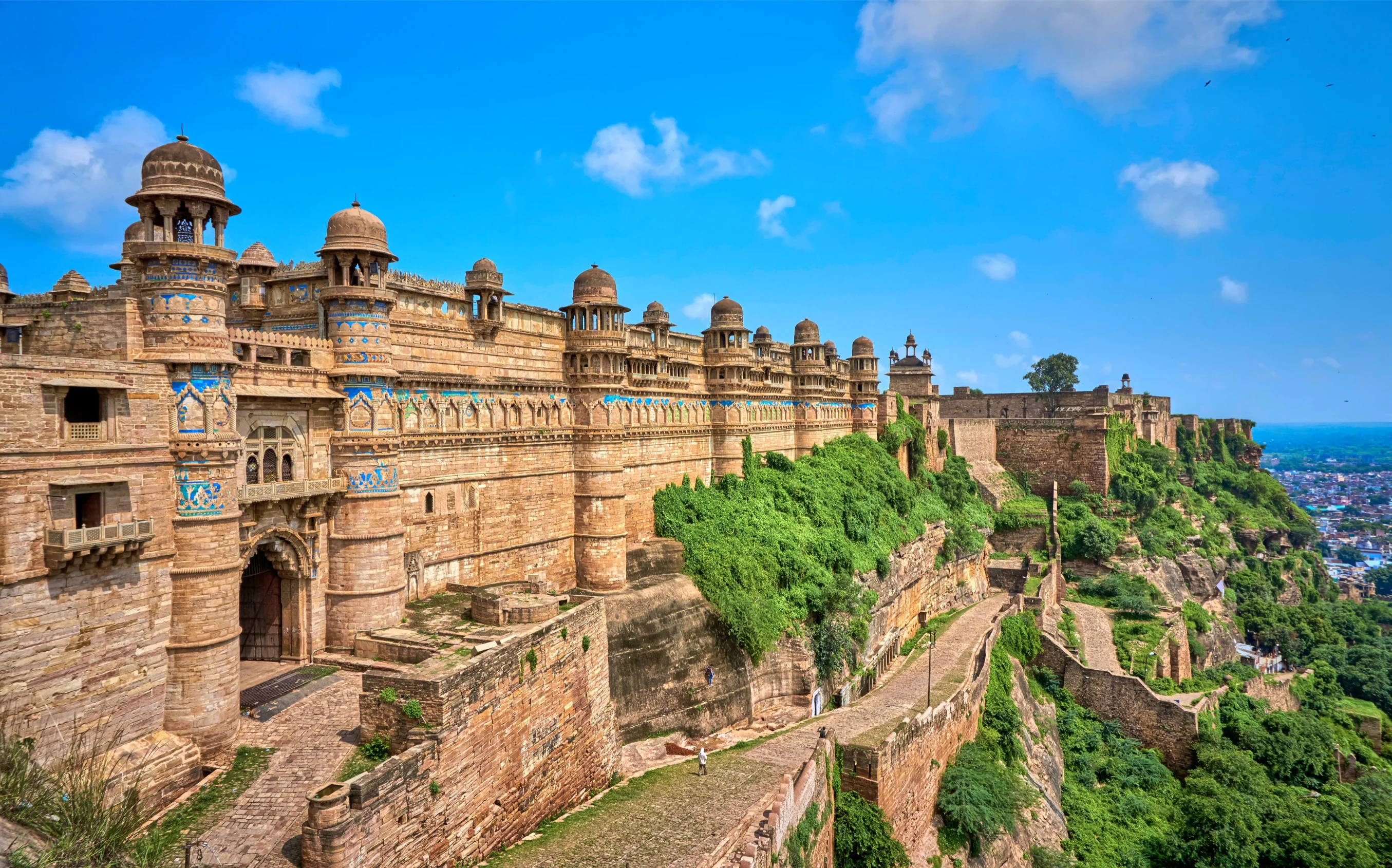
Let us say it straight away, because it decides the whole trip: you come to Gwalior for a rock. The fort occupies a sandstone plateau almost three kilometres long, standing a hundred metres above the rooftops, and it fills a whole day on its own: palaces, eleventh-century temples, and Jain statues cut straight into the cliff face, one of them seventeen metres tall. Down below, the city is a nineteenth-century princely capital that has become a provincial town of a million people: the Jai Vilas palace, the bazaars of Lashkar, and around them avenues that are not for sightseeing.
So the question in Gwalior is not what a neighbourhood feels like; what counts is how far it sits from the fort, and when the next train leaves. Four neighbourhoods are enough to answer it, and two of them have nothing to see: what they have is rooms. An entry-level room costs $17*, a three-star $34*, a four-star $62*, and the finest night in town is spent in a garden on the edge of the city, for that last price.
Between the impressive fortresses, the temples, and especially the statues carved directly into the cliffs, it was a full day.
Compare hotel prices in Gwalior
In a hurry? Find the best accommodation deals in 3 clicks.
Compare live deals from Booking, Expedia, Agoda and other partners.
At a glance: our picks by traveller type
Pick the profile that suits you to head straight to the recommended neighborhood.
The neighborhood map in Gwalior
Get your bearings on the neighborhoods and must-see sights before choosing where to drop your bags. Click a name to jump to its description.
The fort and Hazira, the old town Gwalior fort and its access ramp, the Man Mandir palace and its tiled facade, the 23-metre Teli ka Mandir, the Sas Bahu temples of 1092, the Jain statues of the Siddhachal caves, the tomb of Ghaus Mohammed and that of Tansen in the same enclosure, the lanes of the old town at the foot of the rock
for the visit, not for the night
The whole trip is here, and once you are up it is done on foot. The plateau holds palaces, eleven Jain temples, the Teli ka Mandir that oil merchants paid for in the eighth century and the two Sas Bahu temples of 1092. On the flank, the Siddhachal statues are carved into the cliff: the largest, Adinath, stands seventeen metres eighty. Coming down the eastern side, Hazira keeps in a single enclosure the sixteenth-century tomb of Ghaus Mohammed and that of Tansen, the musician of Akbar's court, around whom the city sings every December. One word about sleeping: there is no hotel here, and this guide lists none.
The statues are diverse and huge, and we were able to get very close to them.
Pros
- A full day of sightseeing on a single plateau
- The statues in the cliff, which you can walk right up to
Cons
- No hotel at the foot of the rock: this guide lists none
- The climb is done by car or rickshaw, not on foot
Lashkar and the Maharaj Bada The Jai Vilas palace and the Jivajirao Scindia museum, Maharaj Bada square and its mix of architectural styles, the Sarafa and Jayendraganj bazaars, the Phool Bagh garden, the Captain Roop Singh stadium and its 18,000 seats
for the princely city, for the bazaars, for the most elegant night
This is the Gwalior of the Scindias, laid out in the nineteenth century around a military camp whose name it still carries. At its centre, Maharaj Bada square lines up seven buildings in seven different architectural styles, and the bazaars begin at its corners. Ten minutes away, the Jai Vilas palace, built in 1874, shows what a princely state could do when it wanted to impress London: two chandeliers twelve and a half metres tall weighing three and a half tonnes each, hung only after eight elephants had been walked across the roof to test the ceiling, and a little silver train that carried the drinks along the dinner table. Forty of the four hundred rooms can be visited.
Where to stay in this neighborhood
Taj Usha Kiran Palace Luxury
The former guest house of the Scindias, next to the palace: 8.7 from a little over a hundred reviews, with 9.0 for location, 9.0 for staff and 9.0 for comfort. A courtyard, a pool, high-ceilinged rooms in a nineteenth-century building. It is the highest rating in Lashkar and the most expensive night in this guide; the wifi, at 7.3, is the low point of its listing.
Pros
- The palace, the square and the bazaars in the same area
- The only address with character in the city
Cons
- Heavy traffic and busy pavements: you walk slowly
- The fort is twenty minutes away by car, not on foot
Around the station: Racecourse Road and the City Centre Gwalior station and its two large hotels, Racecourse Road, the avenues of the City Centre, the shopping malls and chain restaurants, the airport some ten kilometres away
for the room, for the train, for a business trip
This is the neighbourhood our member says left no mark, and that is fair: there is nothing to see. Wide avenues, shopping malls, office blocks, and the two most practical hotels in the city, two and two and a half kilometres from the station. People sleep here for three reasons: an early train, a meeting, or a reliable room at a known price. For a first visit it is a defensible and unsurprising choice, since everything happens by taxi anyway.
As for the rest of the city, nothing else really stood out to us.
Where to stay in this neighborhood
Park Inn by Radisson Gwalior Mid-range
On Racecourse Road, two kilometres from the station: 8.0 from 311 reviews, with 8.6 for location, 8.4 for both cleanliness and comfort and 8.3 for staff. It is the best rating-to-volume ratio in the city, around $62*.
Radisson Gwalior Mid-range
The largest review volume in this guide, and a lower rating: 7.7 from nearly four hundred reviews, with 8.4 for location, 8.3 for comfort and 8.2 for both staff and cleanliness. A large business hotel in the City Centre, two and a half kilometres from the station, with a pool and a restaurant; value for money, at 7.7, says you are paying for the brand as much as for the room.
Pros
- The most reliable rooms in the city, at a known price
- The station two kilometres away and the airport ten minutes further
Cons
- Nothing to see in the neighbourhood: it is a base, not a stop
- Every trip by taxi, in both directions
Bahodapur and the Agra road The Deo Bagh garden and its Maratha temples, the main Agra to Mumbai road that crosses the city, the western suburbs, the station five kilometres away
for the finest night in this guide, for the quiet, for a peacock at breakfast
On the edge of the city, the main road from Agra to Mumbai runs through suburbs with no charm, and it is precisely there, behind a wall, that the best address in Gwalior is to be found: a Maratha garden of several hectares, its seventeenth-century temples still standing, its peacocks, and some fifteen rooms in the original buildings. Nothing to visit in the neighbourhood, nothing to do on foot, and a night you remember longer than the rest of the trip. The fort is a quarter of an hour away by car, the station five kilometres.
Where to stay in this neighborhood
Neemrana's Deo Bagh Luxury
The highest rating in this guide: 9.1 from 240 reviews, and above all 9.7 for staff, the highest figure in the whole city. 9.3 for comfort, 9.1 for cleanliness, 8.7 for location and 8.7 for value for money. A former Maratha estate with its temples in the grounds, rooms in the original buildings, a table the reviews mention as often as the garden. Budget $62*.
Pros
- The highest rating in this guide, in a garden of several hectares
- Complete quiet, a quarter of an hour from the fort
Cons
- Nothing to do on foot: everything is taken by car
- The suburbs around have nothing to show
Our tips for booking the right place
- One day, two nights: the right arithmetic: Our member spent one day in Gwalior and considers it well spent. That is the right measure, and it calls for two nights: you arrive the evening before, go up to the fort at opening time to avoid the heat and the hard light, have lunch down below, visit Jai Vilas in the afternoon, and leave the next morning. With a single night you have to give up either the palace or the Jain statues, and both are worth the trip. With three nights you add Orchha, an hour further by train, and that is the best use of the third day.
- The fort is a climb, and it needs planning: The plateau is almost three kilometres long and a hundred metres high: there are two ways up, a drivable ramp on the west and a path on the east, and nobody walks up under the midday sun. Take a taxi or a rickshaw, ask it to wait, and count three to four hours up there. There is almost nothing to eat or drink on the plateau: bring water. The evening sound and light show is held at the Man Mandir palace, and you have to check the day's time locally, because it changes with the season.
- Getting in and out: Gwalior is a stop on a line: The city sits on the main line from Delhi to Bhopal, and that is what makes it an easy stop: 118 kilometres from Agra, 97 from Jhansi, which is the station for Orchha, and 403 from Delhi, which the fastest trains cover in three and a half hours. The airport is some ten kilometres from the City Centre. The practical consequence: if you are chaining Agra, Gwalior, Orchha and Khajuraho, the train does all the work, and you are better off sleeping near the station than at the foot of the fort, which has no hotel anyway.
- When to come, and what the season changes: Gwalior lies in the north of Madhya Pradesh, in a dry continental climate: the good stretch runs from October to March, with cool mornings and a washed sky. April to June climb above forty degrees, and a plateau with no shade becomes an ordeal; the monsoon, from July to September, makes the rock slippery but the countryside green. One date is worth noting: the music festival around Tansen's tomb at Hazira is held in December, and the hotels of Lashkar fill up that week.
- Looking for a room in the old town, at the foot of the fort: there is no hotel worth recommending on that side, and this guide lists none. The entire stock is in Lashkar, in the City Centre and along the Agra road.
- Going up to the fort in the middle of the day between April and June: the plateau has almost no shade, no refreshment stand, and three hours there are long above forty degrees.
- Judging the city by its avenues: the City Centre has nothing to see and does not pretend otherwise. It is a one-night base, to be taken for what it is.
- Planning only one night: you then have to give up either the Jai Vilas palace or the Jain statues, and those are the two things people remember about Gwalior.
FAQ: where to stay in Gwalior
Which neighbourhood should you stay in in Gwalior?
How much does a night cost in Gwalior?
How long does it take to visit Gwalior fort?
Is Gwalior worth the detour?
How do you get from the station to the fort?
What is there to see in Gwalior apart from the fort?
 Keep exploring
Things to do in Gwalior
Keep exploring
Things to do in Gwalior
Comments (0)
No comments yet. Be the first!