
Where to stay in Varanasi: the 5 neighborhoods to know in 2026
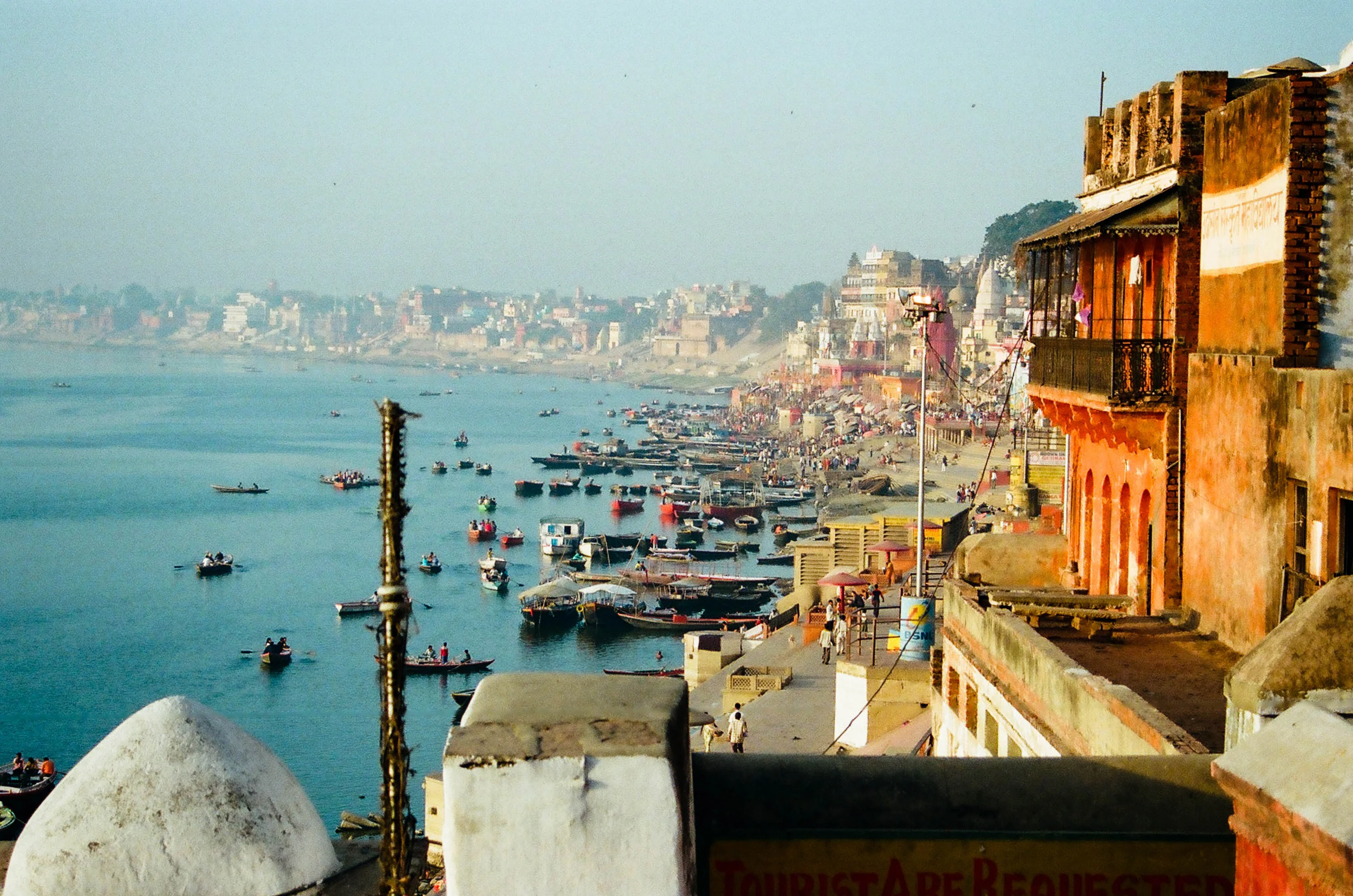
In Varanasi the question is neither charm nor comfort: it is the distance to the river, and the hour at which you agree to be woken. The eighty-four ghats run along six and a half kilometres of bank, the Ganges here flows north, and the steps therefore face the sunrise. At four in the morning the first pilgrims go down to bathe; at five the temple bells start; at dawn the rowing boats leave Assi to pull upstream. Sleeping on a ghat means all of that under your window, and two hundred metres of lanes no car enters: the rickshaw stops at the Godowlia crossing, and the suitcase finishes by hand. Sleeping in the Cantonment, the British military quarter where the station and the big hotels are, means a lawn, a car park, a swimming pool, and twenty minutes of travel to get back to the river.
This guide follows that line and cuts the city into five. Assi and the southern ghats open the bank: calmer, wider, this is where the cheapest rooms and the morning aarti are. The old city, from Dashashwamedh to Manikarnika, holds the golden temple, the great evening aarti and the pyre that burns without pause. The Cantonment holds the station, the airport and the hotels with lifts. The university south, around the BHU campus and Ramnagar fort, has no address worth recommending and appears all the same, because you spend half a day there. And Sarnath, ten kilometres north, where the Buddha gave his first sermon, is a village of stupas and monasteries where you sleep for the silence. Prices: the dorm bed opens at $6.80* and rarely passes $14*; a guesthouse room on a ghat goes from $15 to $34*; in town or at Sarnath a decent hotel occupies the $34 to $102* band; and on the water, the first haveli opens at $152* while the most expensive palace asks $310*.
A holy city if there ever was one, the many pilgrimages in the Ganges and the cremations cannot leave you indifferent.
Compare hotel prices in Varanasi
In a hurry? Find the best accommodation deals in 3 clicks.
Compare live deals from Booking, Expedia, Agoda and other partners.
At a glance: our picks by traveller type
Pick the profile that suits you to head straight to the recommended neighborhood.
The neighborhood map in Varanasi
Get your bearings on the neighborhoods and must-see sights before choosing where to drop your bags. Click a name to jump to its description.
Assi and the southern ghats Assi Ghat and its morning aarti, Tulsi Ghat, Hanuman Ghat, the Harishchandra cremation ghat, the Durga temple and its tank, the Tulsi Manas temple, the rowing boats at dawn, the cafés and music schools of Assi street
for dawn on the river, small budgets, a first stay
This is the gentle way into Varanasi. Assi ghat is wide, paved, open: you can sit there without being jostled, the morning yoga and aarti begin before sunrise, and the rowing boats leave from here. Behind it, a straight street lines up cafés, instrument shops, music schools and agencies, and the lanes climbing towards the Durga temple and the Tulsi Manas stay wide enough for a scooter. To the north, the bank links Tulsi, Hanuman and then Harishchandra, the second cremation ghat, smaller and more discreet than Manikarnika. You sleep here to watch the river wake up without living in the maze. The downside: the great evening aarti and the golden temple are three kilometres north.
Where to stay in this neighborhood
Amritara Suryauday Haveli Luxury
On Shivala ghat, between Assi and the old city, with its own steps down to the water: an 1890 Nepalese haveli, high rooms, live music in the evening, a boat included for the aarti. Rated 8.4 on more than two hundred reviews, with 9.2 for the staff and 9.1 for location. At $152* a night, it is the address for those who want the river under the window without climbing into the maze.
Hotel Temple On Ganges Mid-range
Just behind Assi ghat: air-conditioned rooms with a balcony, a rooftop restaurant facing the river, yoga and meditation classes included. Rated 7.3 on more than four hundred and fifty reviews, including 8.8 for location: the overall score says small and dated rooms, the location says the bank. At $28*, the trade-off is clear.
Sahi River View Guest house Budget
A family house on Assi, a terrace straight onto the river, rooms with balcony and bathroom, and a cook the reviews name by her first name. Rated 8.4 on one hundred and nine reviews, with 9.6 for location, the best location score in this guide, and 9.3 for the welcome. At $16* a room, it is the best deal in this city.
goSTOPS Lite Varanasi Budget
A kilometre from Assi, in the streets of Nagwa: dorms, private rooms, a roof terrace and a shared kitchen, from $6.80* a bed. Rated 7.6 on more than three hundred reviews, with 8.6 for the staff and 8.0 for value for money. It is not on the river and the score says so: this is the address for solo travellers staying a week.
Pros
- The morning aarti and the dawn boats at the foot of the hotel
- The cheapest rooms in this guide, and the best rated on location
Cons
- The golden temple and the great evening aarti are three kilometres away
- The addresses here count one hundred to three hundred reviews, no more
The old city: from Dashashwamedh to Manikarnika Dashashwamedh ghat and its evening aarti, the Manikarnika cremation ghat, the golden temple of Kashi Vishwanath and its corridor opened onto the river, the Vishwanath temple, the Godowlia crossing, the lanes of Bengali Tola and the silk shops
for the evening aarti, the golden temple, the maze, and on condition you walk
This is the heart, and it cannot be visited from a distance. In the evening, Dashashwamedh ghat fills for the great aarti: seven priests, tiered lamps, an hour of drums, and boats pressed against one another to watch from the water. Five hundred metres north, the pyre of Manikarnika burns day and night, and families accompany their dead there: you pass in silence, you do not photograph, and nobody needs an improvised guide to explain the scene. Between the two, the golden temple of Kashi Vishwanath, reopened onto the river by a corridor since 2021, with gates, lockers and an identity document to show. The lanes, for their part, are a metre and a half wide, they climb, they turn, and they take only pedestrians, motorbikes and cows. You sleep here to be inside. The downside: everything arrives on foot.
Not to be missed: the Aarti ceremony, which takes place in the evening at sunset on the ghats.
Where to stay in this neighborhood
BrijRama Palace, Varanasi - By the Ganges Luxury
An 1812 palace on Darbhanga ghat, bought back and restored piece by piece: you arrive by boat or by a lift cut into the cliff, and the terrace looks over the whole curve of the river. Rated 9.4 on more than four hundred and eighty reviews, the best score in this guide, with 9.8 for location and 9.7 for the staff. It is also the most expensive, $310* a night, and the reviews say so at the same time as they cite the service.
Guleria Kothi at Ganges Luxury
A patrician house at the water's edge, a stone's throw from Manikarnika: a dozen rooms, a roof terrace where dinner is served, and sunrise over the Ganges from the breakfast table. Rated 8.1 on one hundred and fifteen reviews, with 9.2 for location and 9.3 for the staff, but 7.4 for value for money: the rooms are small for the price, and the reviews do not hide it.
Ganpati Guest House Mid-range
On Meer ghat, ten metres from the water and ten minutes from Dashashwamedh: the big guesthouse of the old city, with the largest review count in town, 8.4 on more than seven hundred, and 9.4 for location. Rooftop restaurant with a view of the river, thali and chai at neighbourhood prices. Between $37 and $65* depending on the room, and the price is paid for the bank.
Pros
- The evening aarti and the golden temple five minutes' walk away
- The two finest addresses in the city, both on the water
Cons
- No cars: the rickshaw stops at Godowlia and the suitcase is carried
- Crowds, touts and constant solicitation around the two great ghats
The Cantonment, the station and the airport road Varanasi Junction station, the Bharat Mata temple and its marble map of India, the avenues and lawns of the old military quarter, the big hotels with pools, the road to Babatpur airport
for a train, a flight, a pool and a lift
The British laid this quarter out away from the old city, and it has stayed what it was: wide avenues, trees, boundary walls, lawns. Here you find Varanasi Junction station, from which the trains for Delhi, Calcutta and Gaya leave, the road to the airport twenty-six kilometres away, and the Bharat Mata temple, which holds no deity but a marble map of India to scale. The two hotels here are the only ones in this guide with a pool, a lift and a car park. You sleep here for logistical reasons, and they are good ones: a night train, an early flight, children, a May heat of forty-five degrees. The downside is a whole one: the river is twenty minutes away by rickshaw, and this quarter is not Varanasi.
Where to stay in this neighborhood
Taj Ganges Varanasi Luxury
Forty acres of garden inside the Nadesar grounds: outdoor pool, spa, two restaurants, twenty-four-hour room service. Rated 8.6 on more than nine hundred reviews, with 9.1 for comfort and 9.0 for the staff, but 7.8 for value for money. At around $141*, it is the only truly comfortable large hotel in the city, and the reviews praise the quiet first.
Radisson Hotel Varanasi Mid-range
In the middle of the Cantonment, ten minutes from the station: outdoor pool, gym, three restaurants, a bar. Rated 7.1 on more than four hundred reviews, and the recent comments all say the same thing, a tired building, old bathrooms, temperamental air conditioning, for $96* a night. You take it for the position and for the pool, not for the room.
Pros
- The station, the airport and the taxis without crossing the old city
- The only pools, the only lifts and the only car parks in this guide
Cons
- Twenty minutes by rickshaw to reach the first ghat
- Nothing to see on the spot apart from Bharat Mata
The university south: BHU, Lanka and Ramnagar The campus of Banaras Hindu University and its avenues, the new Vishwanath temple built by the Birlas in the middle of the campus, the student market of Lanka, Ramnagar fort on the other bank and its museum of carriages
half a day to see, and no address to recommend
This quarter appears in this guide even though no address here is recommendable: hotels are rare, thinly reviewed, and none stands comparison with the ghats. You come all the same, for half a day. The BHU campus, founded in 1916, is a city within the city, with its planted avenues, its hospital, its museum and its new Vishwanath temple, a slender replica of the golden temple built by the Birlas, open to all and without crowds. South of the campus, the Lanka market feeds the students for next to nothing. And on the other side of the bridge, Ramnagar fort, residence of the maharaja of Benares, lines up its carriages and its clocks in the disorder of a provincial museum.
Pros
- The campus, its temple and its museum are walked without crowds
- Ramnagar fort and the Lanka market in the same half day
Cons
- No recommendable address: you come by day and sleep elsewhere
- Five kilometres from the old city, and the Ramnagar bridge jams
Sarnath, ten kilometres north The Dharmarajika stupa and the foundations of the deer park, the Mulagandha Kuti Vihara monastery and its Japanese frescoes, the archaeological museum and its lion capital, the Thai, Tibetan and Burmese monasteries, the tea shops of the village
for the silence, for Buddhism, and for a night without horns
Ten kilometres north of the din, Sarnath is where the Buddha gave his first sermon, and it is today a village of lawns and monasteries. The Dharmarajika stupa and the foundations of the deer park are covered in an hour; the Mulagandha Kuti Vihara monastery, built in 1931, keeps frescoes painted by a Japanese artist; and the archaeological museum holds Ashoka's lion capital, the one that serves as India's emblem. Around them, the Thai, Tibetan and Burmese monasteries receive pilgrims from their countries. You sleep here for a silent night, or because you have come from the airport, fifteen kilometres away. The downside: in the evening nothing happens, and the ghats are forty minutes away by road.
Where to stay in this neighborhood
Hotel Buddha Park near Sarnath, Varanasi Mid-range
At the entrance to the village, large rooms, a garden, a restaurant: the good surprise of the north. Rated 8.6 on one hundred and twenty-six reviews, and the comments insist on the size of the rooms and the price, $33* a night. It is the best score in this guide outside the two river palaces.
The Fern Residency Sarnath Mid-range
On the Sarnath road, ten minutes' walk from the site: a four-star chain hotel, air-conditioned rooms, a restaurant, twenty-four-hour reception. Rated 7.5 on one hundred and eighty-one reviews, with 8.1 for comfort and 7.9 for the staff, but 6.9 for value for money at $98*. Take it for the comfort, not for the bargain.
Pros
- The silence, the lawns and no solicitation at all
- Fifteen kilometres from the airport, against thirty from the ghats
Cons
- Forty minutes of road for the evening aarti
- Two decent addresses, and nothing open after nine in the evening
Our tips for booking the right place
- The last kilometre is done on foot, and nobody says so beforehand: In the old city the lanes are a metre and a half wide: no taxi, no auto-rickshaw enters them. The ride stops at the Godowlia crossing or at the end of a lane, and the rest is done on foot, suitcase in hand, in a tangle where the phone goes round in circles. Two reflexes avoid all of it: ask the hotel for the name of the nearest ghat rather than an address, and ask whether it sends someone to the crossing, which almost every house on the ghats does. At Assi, in the Cantonment and at Sarnath the question does not arise: the car goes to the door.
- Cremations: what is watched, what is not photographed: At Manikarnika and at Harishchandra the pyres burn without pause and families accompany their dead three metres from the path. You may watch, from a distance, in silence and without sitting down; you do not photograph, and no exception holds. Two practices to know about: strangers offer to "show you the ghat" and then ask for a wood donation in rupees per maund, sometimes considerable sums, and others take you up onto a terrace for the same reason. A polite refusal is enough. KassandraR, whose review this guide quotes, advises taking an official guide to understand the rites: that is the right advice, and it is arranged through the hotel, not on the ghat.
- The dawn boat, the evening aarti and their hours: The city's two appointments are a matter of one hour. The rowing boat leaves forty minutes before sunrise, from Assi or Dashashwamedh, and pulls up the curve of the river for an hour: it is the only moment when you see all eighty-four ghats. Count three to eight hundred rupees depending on the boat and the bargaining, half that if you share. The great aarti at Dashashwamedh starts at nightfall, around half past six in winter and seven in summer: settle on the steps half an hour before, or pay for a boat to watch it from the water. At Assi a shorter aarti takes place in the morning, and almost nobody watches it.
- The season, the monsoon and what the water covers: Between October and March, Varanasi is at its best: twenty to thirty degrees, dry sky, cool mornings. December and January bring a thick fog that delays trains and flights by several hours, sometimes by half a day: do not plan a flight for the morning of departure. In May and June the city passes forty degrees and the lanes become an oven in the afternoon. And during the monsoon, from July to September, the Ganges rises by several metres: the lower steps disappear, the walk from one ghat to the next becomes impossible, the cremations move up into the lanes and some houses on the ghats close their ground floor. It is also the cheapest season, and the one where you bargain.
- The Cantonment hotels chosen for their chain name: one of them shows 6.4 on more than five hundred and ninety reviews, with repeated comments on tired rooms and the kitchen, at a price close to the $96* of the neighbour rated 7.1. A known name says nothing here, the number of reviews does.
- Guesthouses advertised as "near the ghats" without naming a ghat: one of the most visible is four kilometres from Assi and rated 7.2 on twenty-seven reviews. A hotel on the river always names its ghat, and it can be checked on a map before paying.
- Windowless rooms in the maze, numerous below $15*: they exist, some are clean, but in Varanasi you pay for a terrace and a river, and a blind room on the third floor of a lane has neither.
- Paying a wood donation at Manikarnika because a stranger took you up onto a terrace: it is not a custom, it is a trade. The sums asked for climb very fast, and refusing offends nobody.
FAQ: where to stay in Varanasi
Which part of Varanasi should you sleep in for a first visit?
Should you sleep on a ghat or in the modern town?
Where do you sleep cheaply in Varanasi?
How many nights should you plan in Varanasi?
How do you reach the ghats from the station or the airport in Varanasi?
What does a night in Varanasi cost?
 Keep exploring
Things to do in Varanasi
Keep exploring
Things to do in Varanasi
Comments (0)
No comments yet. Be the first!