
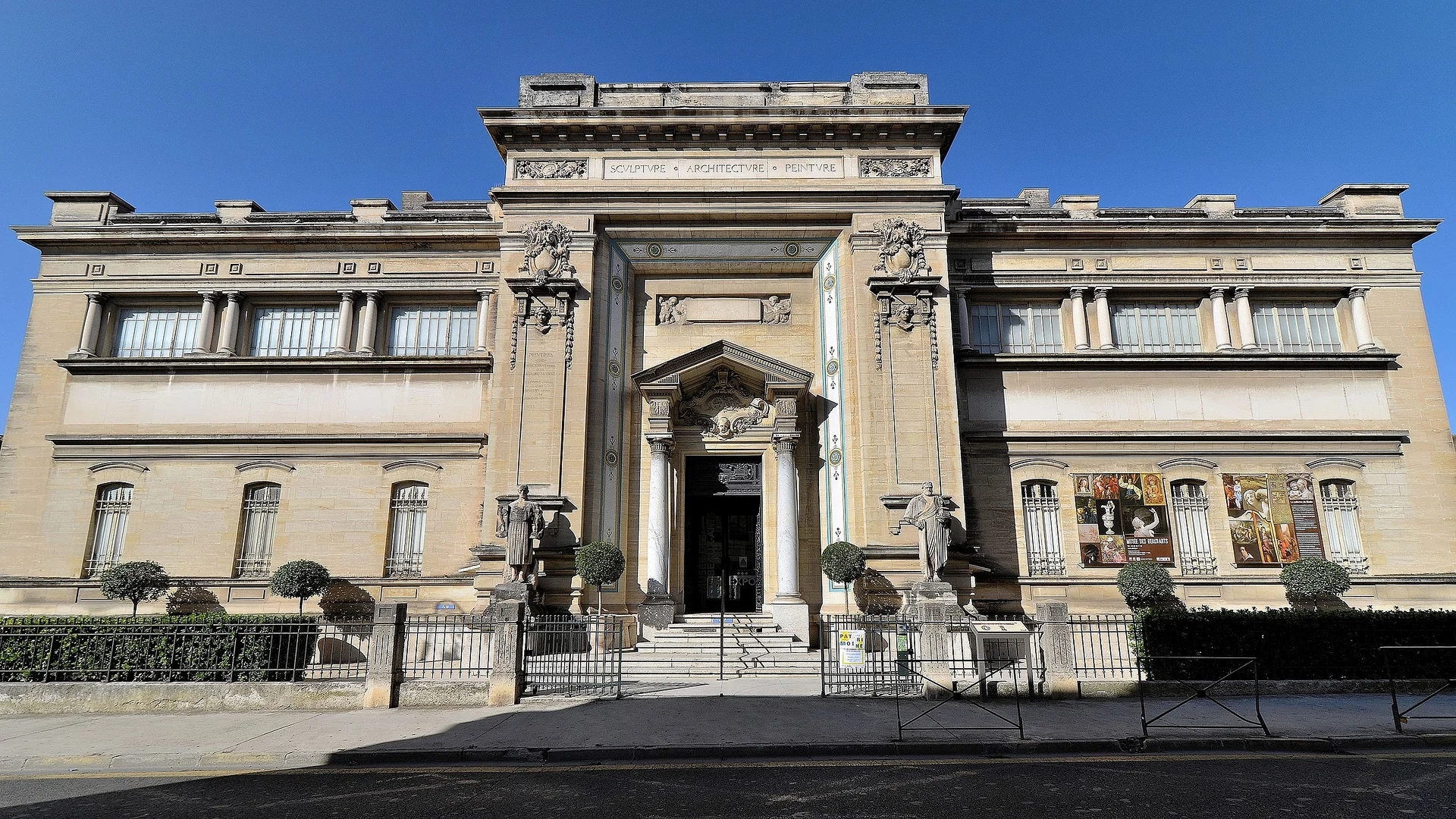
The Museum of Fine Arts of Nîmes, two centuries of art under glass
More than 50 square meters of multicolored tiles await you on the floor. From the moment you enter, this 2nd-century Roman mosaic demands silence. It depicts the wedding of Admetus, King of Pherae, and was unearthed beneath the city market halls in 1883. Buried nearly two meters underground for centuries, it has retained colors that look as fresh as if they were laid yesterday.
Why visit the Museum of Fine Arts of Nîmes?
This museum houses the second-largest collection in the Languedoc-Roussillon region. Founded in 1821 in the Maison Carrée, it initially focused on ancient artifacts before expanding to include French, Italian, Flemish, and Dutch paintings. As the space became too cramped, an architectural competition was launched in 1902. Nîmes architect Max Raphel won, and the current building opened its doors in 1907.
The collection now holds nearly 3,800 works covering five centuries of artistic creation. In 1987, Jean-Michel Wilmotte renovated the interiors while preserving the elegance of the space. The central atrium, covered by a large glass roof, bathes the galleries in overhead light that brings out the subtle tones of the canvases.
Works to look for
On the ground floor
Two monumental statues by Henri Bouchard frame the access staircase. The Roman mosaic of the Wedding of Admetus occupies the center of the atrium, surrounded by a cycle of paintings dedicated to Mark Antony and Cleopatra, signed by Charles-Joseph Natoire. This Nîmes-born painter executed these large canvases in the 18th century with a command of drapery and flesh tones that remains impressive.
In the upper galleries
The seven rooms upstairs follow a chronological path through European schools. You will encounter Rubens with a portrait of a Capuchin monk, François Boucher, Jean-François de Troy and his moving Sleeping Reaper. The Cromwell before the Coffin of Charles I by Paul Delaroche grabs your attention with its dramatic intensity. Also, do not miss the Madone Foulc, a glazed terracotta tondo by Andrea della Robbia that came from the Strozzi Palace in Florence.
Friendly tip: Admission is free on the first Sunday of every month. It is the perfect time to stroll through the galleries without keeping an eye on your watch.
A building between tradition and modernity
The museum architecture blends cut stone with metal structures. The steel trusses, reinforced concrete floors, and glass roofs are testaments to early 20th-century construction techniques. The 1987 renovation introduced clean-lined display walls and discreet lighting that highlights the paintings without overwhelming them.
The double gallery layout allows for free movement between floors. The quiet that reigns here contrasts with the energy of the Arenas, located just a few hundred meters away. Visitors appreciate this hushed atmosphere, which is conducive to contemplation. The staff, often praised for their warm welcome, can point you toward the masterpieces if you are short on time.
The link with the Roman heritage of Nîmes
The placement of the ancient mosaic at the heart of a fine arts museum was intentional from the building's design. The residents of Nîmes wanted to highlight the Roman origins of their city. This exceptional piece, composed of twenty squares featuring unique geometric patterns, engages in a dialogue with the surrounding paintings. The entire collection tells a continuous story, from the 2nd-century tiles to the brushstrokes of the 19th century.

I went in because I had a little bit of time to kill. This small museum has some pretty mosaics, though they are less impressive than the ones at the Musée de la Romanité, along with French, Flemish, and Italian paintings and works by a few local artists. It is a shame that the pieces on display are not always well presented, and even less well described. There is only a small pamphlet at the entrance. In my opinion, this museum is not a must see. Go if you have an hour to fill.