
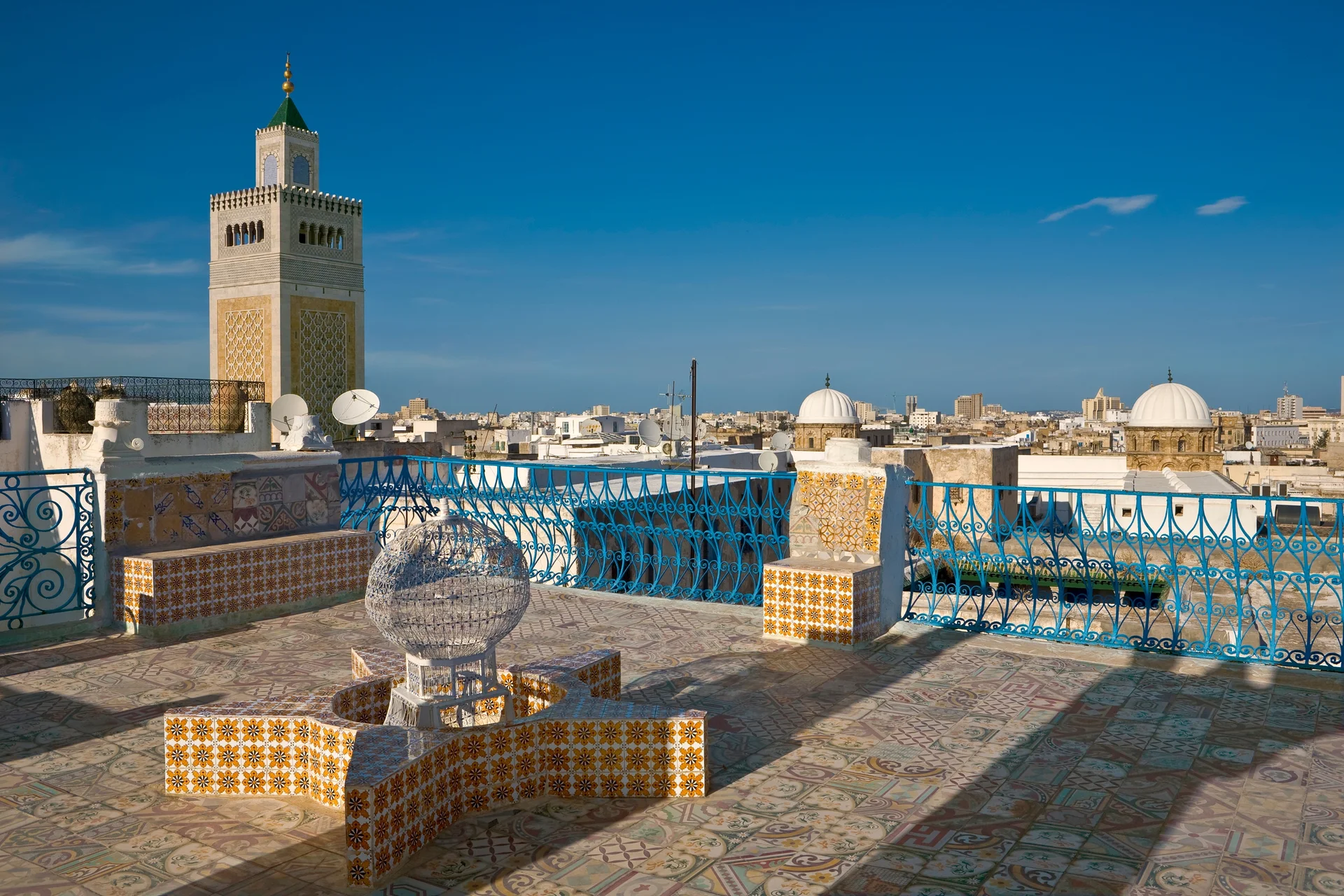
Medina of Tunis: 13 centuries of living history in the city center
In the ochre labyrinth of the Medina of Tunis, time feels like it has come to a standstill. Since 1979, UNESCO has protected this treasure where 700 monuments chronicle the epic story of a city that was, from the 12th to the 16th century, one of the most powerful centers in the Islamic world. Today, 110,000 residents carry on a millennial way of life within a maze of alleys where every stone whispers a story.
What makes the Medina of Tunis so captivating?
Founded in 698 around the Zitouna Mosque, this fortified city spans 280 hectares and remains one of the best-preserved examples of Arab-Muslim urban planning in North Africa. Under the Almohad and Hafsid dynasties, Tunis thrived as the intellectual and commercial capital of Ifriqiya.
Sumptuous palaces, prestigious madrasas, and caravanserais stand as evidence of this bygone grandeur. The architecture itself responds to the climate, with narrow alleys that offer shade from the sun in summer and trap warmth in winter, and patio houses that create cool, private havens. Think of the layout as a desert-adapted version of a historic Mediterranean village.
What makes the Medina exceptional is that it remains a living organism. Artisans work in their ancestral workshops, families live in centuries-old homes, and the souks buzz with commercial activity that has continued uninterrupted for generations.
The souks: a sensory journey through tradition and craftsmanship
Each trade guild has its own souk, arranged according to a precise hierarchy established in the medieval era. Near the Zitouna Mosque, you will find the noble trades, such as booksellers and perfumers at the Souk el-Attarine, where the scent of essential oils fills the air. Further on, the Souk des Chéchias offers a unique spectacle with its traditional red wool caps hanging by the hundreds in shops with intricate storefronts.
The Souk des Étoffes displays shimmering fabrics, while the Souk El Birka now houses jewelers and embroiderers in stalls that served as a slave market until 1841. Artisans work in the open air, with weavers, potters, coppersmiths, and leatherworkers practicing age-old techniques right before your eyes.
Friendly tip: Avoid Fridays and Sundays, as many shops close on these days. To escape the main tourist paths, wander into the alleys branching off the primary thoroughfares. You will find family workshops where artisans are often happy to explain their craft. Haggling is part of the cultural experience, but always keep it respectful.
Architectural treasures you cannot miss
Zitouna Mosque, the spiritual heart of the city
Built in 732 on the ruins of a church, the Mosque of the Olive Tree takes its name from the tree that once graced its courtyard. Rebuilt in the 9th century, it served for centuries as a prestigious Islamic university. Its square Almohad-style minaret dominates the skyline of the Medina. Non-Muslims can admire the courtyard and exterior architecture from Saturday to Thursday, 9:00 AM to 12:00 PM and 2:00 PM to 5:00 PM.
Exceptional palaces and residences
The Dar el-Bey, the government palace, harmoniously blends architectural styles from different eras on the suspected ruins of a Roman theater. Dar Hussein and Dar Lasram illustrate the lifestyle of the Tunis elite with their zellige-tiled patios, painted ceilings, and carved stucco. The Tourbet el Bey, built in the 18th century, is the largest mausoleum in Tunis, featuring rooms with walls covered in polychrome tiles and marble tombs.
The authentic Medina experience
Strolling through the Medina requires time and a willingness to get lost. Monumental gates like Bab el-Bhar (the Sea Gate) mark the entrance from the modern city. Inside, let the sounds guide you, from the calls to prayer and the rhythmic hammering of coppersmiths to animated conversations in traditional cafes where mint tea flows endlessly.
Panoramic terraces offer hidden perspectives. Climb to the Cafe M'Rabet, facing the Zitouna Mosque, to take in the sprawling maze of rooftop terraces punctuated by minarets. These rooftops are a vital part of daily life, as immortalized in the film Halfaouine by Férid Boughedir.
Customized recommendations:
- For craft lovers: Look for Arabic calligraphy workshops at the Centre des Arts Calligraphiques (Center for Calligraphic Arts) inside Dar El Monastiri.
- For foodies: Try the traditional pastries and the brik, a crispy fried pastry, in the family-run shops in residential areas.
- For photographers: The doors painted in saffron yellow, a color considered sacred in the Quran, featuring decorative apotropaic nails, make for striking subjects.