
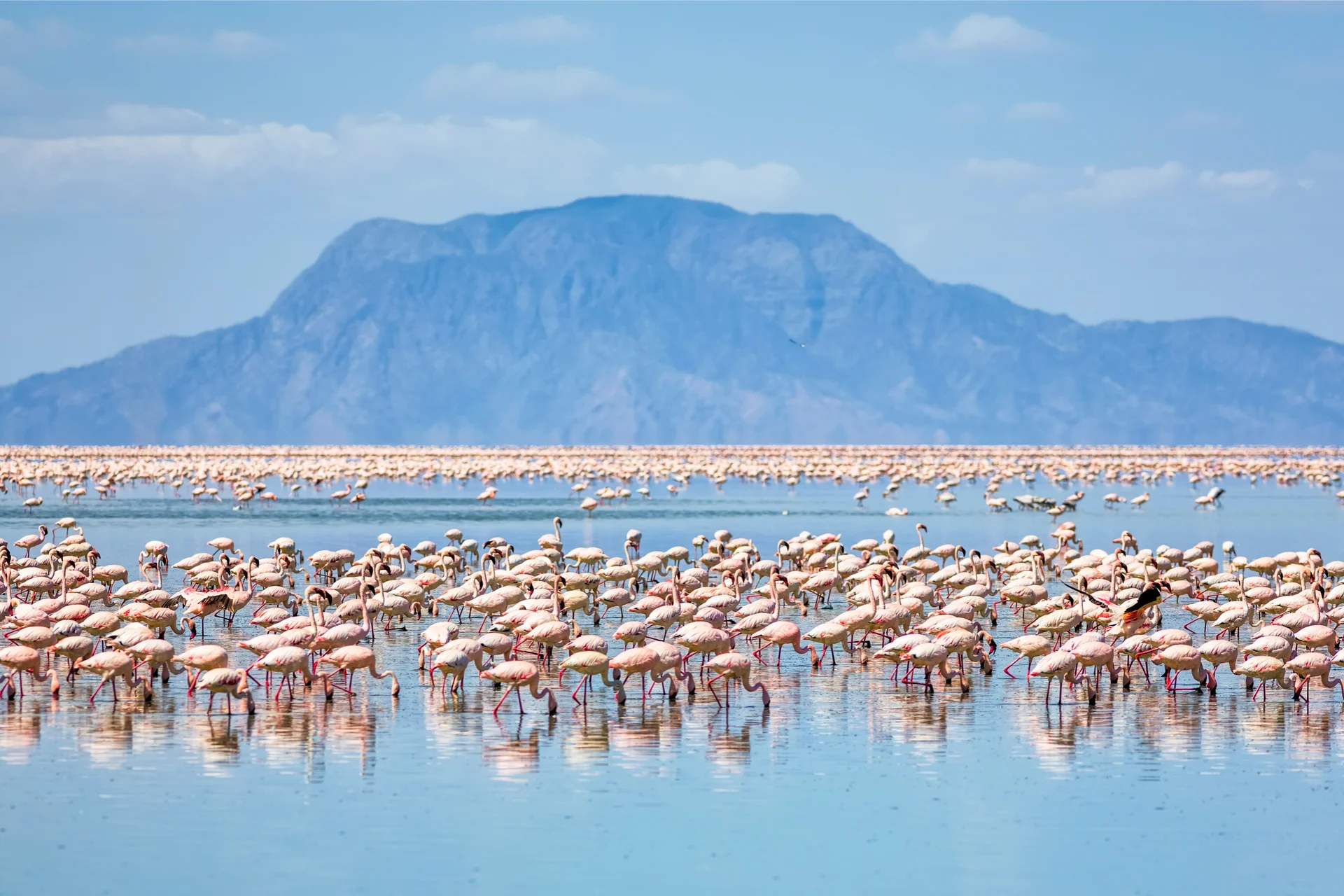
Natron Lake, a crimson mirror at the base of a sacred volcano
The water here takes on shades of brick and dried blood. The ground crunches underfoot, crusted with salt and soda. Welcome to Natron Lake in northern Tanzania, just a few miles from the Kenyan border. This is a landscape that feels more like another planet than a typical vacation destination.
Why visit Natron Lake?
This shallow alkaline lake is fed by mineral springs rich in natron (sodium carbonate). It reaches a pH near 10.5 and water temperatures that can exceed 104 degrees Fahrenheit (40 degrees Celsius). These conditions are hostile to almost all life, yet paradoxically, they make the site one of the most important breeding grounds on earth for lesser flamingos (Phoeniconaias minor). Hundreds of thousands of birds gather here, taking advantage of the inhospitable environment to nest far from predators.
The red-orange color of the lake, visible from the surrounding heights, is produced by halophilic cyanobacteria that thrive in the saturated waters. During the dry season, the visual effect is particularly striking.
Ol Doinyo Lengai, the dominating volcano
On the southern horizon stands Ol Doinyo Lengai, a 9,442-foot (2,878-meter) active volcano and a sacred site for the Maasai people, who call it the Mountain of God. It is the only volcano in the world to produce carbonatite lava. It is black when it exits the crater, but it turns white upon contact with moist air, giving the summit a permanent lunar appearance.
The climb is demanding, with steep slopes and significant elevation gain. It is usually done at night to reach the summit by sunrise and avoid the heat. A local guide is mandatory and is organized from the village of Engare Sero. In fact, it is advised to visit the entire region with a guide. If you book through a reputable agency, this service should be included in your safari in Tanzania.
Friendly tip: Plan your visits to the lakeshore for dawn or late afternoon. The glare off the salt in the middle of the day is exhausting, and the low-angle morning light reveals much richer colors on the water. Bring high-protection sunglasses and closed-toe shoes, as the salt crystals are sharp.
The gorges and waterfalls of Engare Sero
Less famous than the lake itself, the Engare Sero waterfall is worth the detour. A few miles from the shore, a cool river rushes through volcanic gorges before spilling into the lake. Swimming is possible here and provides an unexpected contrast to the surrounding aridity. The trail that runs along the gorges also offers clear views over the entire lake.
Right for you if...
- You are looking for a radically different landscape, far from standard tourist circuits
- You are passionate about birdwatching or nature photography
- You are prepared to accept difficult access and limited creature comforts
- You are drawn to volcanic climbs or hiking in wild terrain
Less suitable if...
- You are traveling without a 4x4, as the track from Arusha (a 6-hour drive) is otherwise impassable
- You have difficulty tolerating intense heat or unstable terrain
- You expect developed tourist infrastructure on-site
Opening hours
Open 24/7
Free access natural site. Access to certain areas requires a guide and the payment of an entrance fee.
How long for this activity
Plan for a full day at Natron Lake to explore the shoreline and watch the colonies of lesser flamingos. If you want to include the climb up the Ol Doinyo Lengai volcano, add two extra days to your trip.

Lake Natron in three words: dry, hot, almost hostile. Nothing moves, except for the flamingos. The smell is strong, the air is heavy. The kind of place where you don't stay long, but you remember it. It is not beautiful in the "classic" sense, but it hits you. I felt like I was seeing a forgotten corner of the world.