
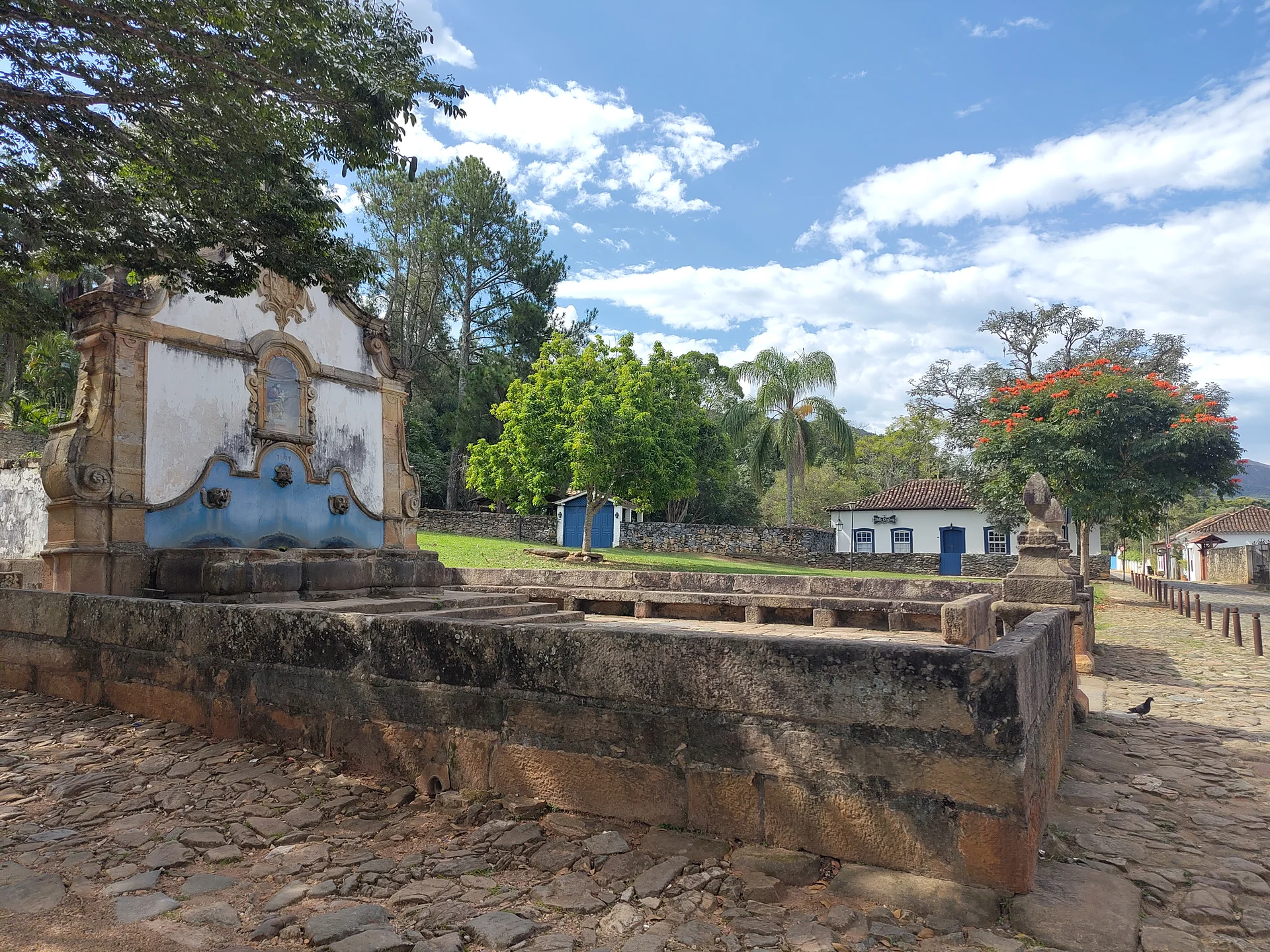
Chafariz de São José, a Baroque Jewel of Colonial Fountains
Three stone masks spout fresh water into a curved basin. Behind them, a rare 18th century terracotta image depicts São José de Botas, the patron saint of the bandeirantes (pioneers). The Chafariz de São José is more than just a colonial fountain. It is the hydraulic heart of a city that has weathered the centuries without losing its character.
Why does this fountain captivate visitors?
Built in 1749 by the Câmara Municipal (City Council) of São José Del Rei, this monument embodies the sophistication and contradictions of the colonial era. Widely considered the most beautiful fountain in Brazil, it stands out for its Baroque architecture carved from local quartzite blocks. Its facade resembles a church, complete with pilasters, a curvilinear pediment, and elegant scrolls.
Beyond its beauty, this fountain tells a brutal social history. It was designed with three distinct functions. The front provided water to the free population, the left side served as a washbasin for enslaved people, and the right side was for animals and enslaved people. Segregation was literally etched into the stone.
The secrets of a symbol-laden design
An incline that reveals local attitudes
Look at the monument from the side to spot a disturbing detail. The fountain features an incline of about 15 degrees. This was designed so that in the event of a collapse, the structure would fall backward onto the enslaved people and animals, sparing the masters sitting at the front. This cruel geometry serves as a testament to the rigid social hierarchy of colonial Brazil.
The only oratory in Minas Gerais
The Chafariz de São José is the only fountain in the state of Minas Gerais that houses an oratory with a saint's image. The statue of São José de Botas, protector of explorers, has watched over the site for nearly three centuries. Above it, a carved cross bears the royal coat of arms of Portugal, a reminder of the colonial administration.
The water that draws you back to Tiradentes
The three sculpted stone heads still spout crystalline water. This water flows from the Serra de São José via an ancient stone aqueduct running about one kilometer from the Bosque da Mãe D'água. Locals and travelers still come here to fill their bottles at the source.
A persistent legend circulates among visitors. Some believe you must drink from one of the three specific spouts to secure wealth, health, or love, though no one agrees on which mask offers which gift. Others simply claim that drinking this water guarantees your return to Tiradentes. It is up to you to test it.
Friendly tip: The calçamento (paving) in front of the fountain is one of the few places preserving the original pé-de-muleque stone paving. Take a moment to look at these irregular, rounded river stones worn down by three centuries of foot traffic. They have witnessed the entire history of Tiradentes.
A living witness to Brazilian heritage
Registered as a monument by the Belas Artes register of IPHAN (National Institute of Historic and Artistic Heritage) on December 3, 1949, the fountain is an essential stop on the city historical circuit. Any itinerary in Tiradentes inevitably passes by this site. The patio, surrounded by low walls with stone benches, invites a contemplative break, while the colorful colonial houses lining the square create a picture-perfect backdrop.
Note that the state of preservation can vary. While some visitors appreciate the site maintenance, others have recently noted upkeep issues. Check before your visit to ensure the fountains are running so you can enjoy the full experience.

A beautiful fountain that reflects serenity. Nice view of Tiradentes and the Santo Antônio church.