
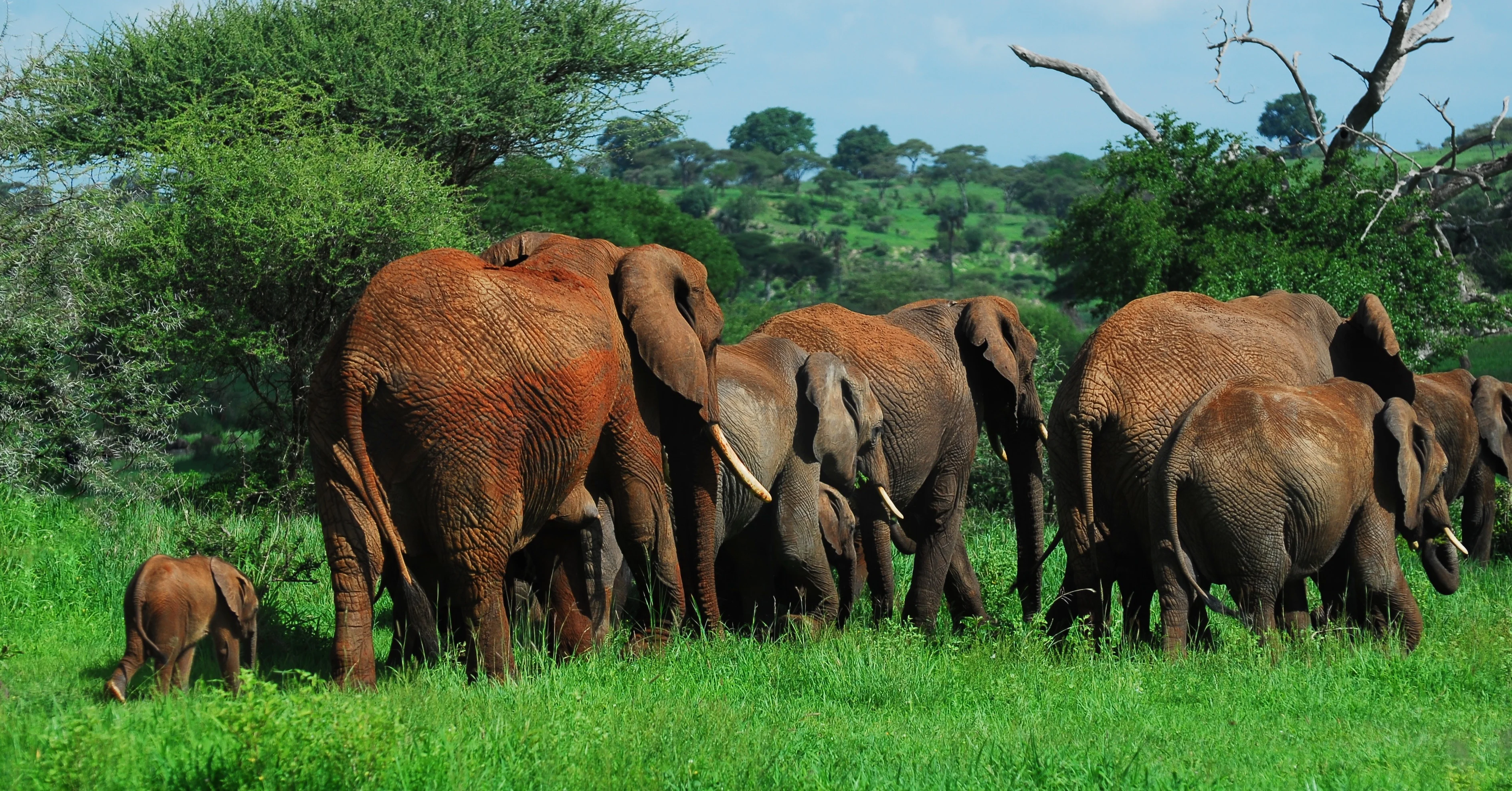
Where to stay near Tarangire National Park: the 4 areas to know in 2026
The park gates close at 6 pm, and that is where the whole question starts. The park authority itself points to late afternoon as its best moment, for the golden light over the baobab hills and the river valley, and that is what our member gabrielabhepal describes: « the giant baobabs, elephants everywhere, and that golden light at the end of the day ». Sleeping inside means keeping that hour, and the one at first light. Sleeping outside means having to drive back out before it arrives.
The second point contradicts a widespread idea: admission is no cheaper here. Our member Johanna came « because it is the cheapest in Tanzania », yet the park authority charges $70* per non-resident adult, the same amount as for the Serengeti and Lake Manyara. What costs less at Tarangire is the road: 109 kilometres from Arusha, 2 hours 30 to 3 hours on tarmac, where the parks further west take a full day.
Compare hotel prices near Tarangire National Park
In a hurry? Find the best accommodation deals in 3 clicks.
Compare live deals from Booking, Expedia, Agoda and other partners.
The two ways to stay near Tarangire National Park
Admission costs $70* per non-resident adult, $20* per child and 20,000 shillings for East African residents. The park authority warns that separate charges may apply for vehicles, camping and guiding, without giving the amounts: this rate is therefore not the full cost of a day.
| What changes | Inside the park | Before the gate |
|---|---|---|
| Late afternoon | You are there | You have to be out by 6 pm |
| First light | Without having driven | 16 to 51 minutes by road first |
| To the northern gate | 48 minutes of track | 16 minutes from Kwa Kuchinia |
| The number of addresses | Just one, book early | One at the gate, one at Makuyuni |
| Adding another park | You have to drive back out | Makuyuni is the fork |
| Arriving by air | Kuro airstrip, inside the park | Kilimanjaro or Arusha |
| In the rainy season | Park tracks, 4x4 recommended | Tarmac up to the gate |
| Who it suits | Anyone who comes for the animals | Anyone passing through, or counting nights |
How long to the entrance, area by area?
The kilometres and minutes below are CAR routes from the northern gate, calculated on the road network. The road from Arusha is tarmac; the last kilometres inside the park are tracks.
| From | Time | How |
|---|---|---|
| Inside the park, along the Tarangire River | 31.4 km | of track, 48 minutes Kuro airstrip, inside the park, is 38.9 kilometres and 59 minutes from the northern gate. |
| Kwa Kuchinia, the hamlet at the northern gate | 6.8 km | by car, 16 minutes This is the hamlet the tarmac road arrives through, the closest to the gate. |
| Makuyuni, where the Arusha road forks | 34.7 km | by car, 51 minutes The town itself is 32 kilometres and 40 minutes away: it is the fork towards the other parks. |
| Arusha, where the road and the flights start | 109.1 km | by car, 2 hours 30 to 3 hours The range is the park authority's own, for a tarmac road via Makuyuni. |
At a glance: our picks by traveller type
Pick the profile that fits you and go straight to the recommended area.
Map of the areas near Tarangire National Park
See how the areas sit relative to one another before choosing your base. Click a name to jump to its description.
Inside the park, along the Tarangire River 31 kilometres of track from the northern gate
Anyone who comes for late afternoon and first light
The Tarangire River gave the park its name, and it decides everything: in the two dry seasons, June to October and then January and February, animals from the surrounding plains converge on it, and the Silale swamp concentrates buffalo, elephants and birds. Sleeping here means one precise thing: still being inside the park at 6 pm, when the gate closes, and setting out again before daylight without having driven. The park authority recommends booking well ahead for the high dry season.
We drive slowly, we listen, we watch
Where to stay in this area
Tarangire Sopa Lodge city.oudormir_tier_haut
The only bookable address inside the park on this page: 31 kilometres of track from the northern gate, so 48 minutes, with an outdoor pool, a garden and a shared lounge. No air conditioning in the rooms.
Pros
- Still inside the park at closing time
- Out at first light without having driven
- The river and the Silale swamp within reach
Cons
- 48 minutes of track from the northern gate
- A single bookable address, to book early
Kwa Kuchinia, the hamlet at the northern gate 6.8 kilometres by road from the gate
Anyone who wants to enter at opening without sleeping inside
This is the hamlet you arrive through, at the end of the tarmac, and the gate is 6.8 kilometres away, so 16 minutes. Sleeping there means crossing the entrance as it opens and paying admission once for a full day, without the night inside. MarineBouras describes the arrival: « right at the entrance, I felt I was stepping into the set of The Lion King ».
right at the entrance, I felt I was stepping into the set of The Lion King
Where to stay in this area
Elephant lodge Mid-range
A few minutes' drive from the park entrance, with a restaurant, a bar, a garden, an outdoor pool and a terrace. The rooms look onto the lake, and a waterhole faces the dining area: elephants come to it in the evening.
Pros
- The gate 16 minutes away by road
- Entering at opening, for a full day
- At the end of the tarmac, no track to drive the night before
Cons
- You have to be back out before 6 pm
- The late-afternoon light happens outside the park
Makuyuni, where the Arusha road forks 35 kilometres by road, where the roads part
Anyone combining several parks in one trip
The park authority describes the approach on tarmac « via Makuyuni », and that is exactly what this small town is: the point where the road from Arusha divides, towards Tarangire on one side and the parks to the west on the other. The northern gate is 35 kilometres away, so 51 minutes. You do not sleep here for Tarangire alone: you sleep here when Tarangire is one stage, which ValNomad finds « ideal for starting a journey through Tanzania ».
ideal for starting a journey through Tanzania
Where to stay in this area
Maasai Eco Boma & Lodge Mid-range
Run by the Maasai of Makuyuni, who built it in 2020, 35 kilometres from the northern gate. You sleep in traditional huts, with a barbecue on site: this is the address that adds something to the trip beyond a night before the park.
Pros
- On the tarmac road, before the fork
- A night that adds something other than the safari
- Useful when Tarangire is not the only stage
Cons
- 51 minutes by road to the gate
- Too far for an arrival at opening without an early start
Arusha, where the road and the flights start 109 kilometres by road, 2 hours 30 to 3 hours
Anyone arriving the day before or leaving the day after
Arusha is where the road and the flights begin, and the park is the closest of the great northern parks to it: 109 kilometres, which the park authority gives as 2 hours 30 to 3 hours. That is little enough for a day in the park from the city, and enough to lose the two hours that matter. The city has its own guide with us, with its districts and its addresses: the card below leads there. We copy none of them here.
an excellent introduction, and clearly worth the detour
 Stay in the city
Where to stay in Arusha
Arusha has its own guide: neighbourhoods, prices, our recommended hotels.
Pros
- The flights and the road start here
- A city guide with us, with its addresses
- The night before and the night after in the same place
Cons
- Twice 109 kilometres for one day in the park
- No address served here, by choice
Our tips for booking the right place
- 6 pm, and what that hour takes from you: The gates close at 6 pm. The park authority points to late afternoon as its best moment for wildlife watching, for the golden light over the baobab hills and the river valley; gabrielabhepal describes the same thing, « the giant baobabs, elephants everywhere, and that golden light at the end of the day ». Anyone sleeping at Kwa Kuchinia or Makuyuni has to be back through the gate before that hour, so leaving the park while the light is building. Anyone sleeping inside stays, and drives out the next day without having moved: 48 minutes of track separate the park's only address from the northern gate, and those are 48 minutes you do not do twice a day.
- Admission costs the same as elsewhere; it is the road that differs: Johanna came to Tarangire « because it is the cheapest in Tanzania ». The park authority charges $70* per non-resident adult, $20* per child and 20,000 shillings for East African residents, and it charges the same amounts for the Serengeti and for Lake Manyara. What is cheaper here is the access: 109 kilometres from Arusha, 2 hours 30 to 3 hours on tarmac, where the parks to the west take the day. That closeness allows a visit with no night on site, and that is why the question of sleeping inside arises at Tarangire more than anywhere else.
- The season changes the tracks, not just the animals: The park has two dry seasons, June to October and then January and February, and two rainy seasons, short from November to December, long from March to May. In the dry season, animals from the surrounding plains come down to the Tarangire River and the Silale swamp: that is the period the park authority highlights, and the one for which it asks you to book well ahead. In the rainy season it recommends a 4x4, from November to May. The park's altitude ranges from 900 to 1,250 metres and it receives 650 to 700 millimetres of rain a year: it is never a closed season, it is a season you prepare for.
- What our six members came to see, and what they found: Five of our six members give 5 out of 5, the sixth 4 out of 5, and they all speak first about the elephants. JeromeA writes that « here they seem more numerous and more majestic than anywhere else in Tanzania ». MarineBouras: « I saw an incredible number of elephants ». The park authority says the same thing in one phrase, the largest herds in Tanzania. But what comes up almost as often is the absence of crowds: Megane Odyzea notes « far fewer safari vehicles than in the more touristy parks », and Johanna concludes « It is a place to choose if you are looking for an experience away from the crowds ». She also lists what else she saw: « giraffes, impalas, African wild dogs, buffalo, warthogs ».
- The baobabs, and why the park feels smaller than it is: The park covers 2,850 square kilometres, yet ValNomad finds it « Small in size, it is full of animals and varied landscapes », and geography explains that impression: everything happens on the river and its terraces, where the herds gather and where the tracks run. There are also the baobab hills: the park authority reports some over 1,000 years old, up to 30 metres tall, with trunks more than 10 metres wide. Pythons that climb trees live in the riverine thickets, and in the tsetse fly areas the park asks you to keep windows up at low speed and to wear neutral colours.
- Sleeping at Makuyuni and counting on entering at opening: the northern gate is 51 minutes away by road.
- Booking inside the park at the last minute in the dry season: the park authority asks you to book well ahead, and we have only one address there.
- Counting on a single day from Arusha: that is twice 109 kilometres, and the 6 pm closing falls at the best moment.
- Arriving in the rainy season without a 4x4: the park recommends one from November to May.
FAQ: where to stay near Tarangire National Park
Should you sleep inside Tarangire National Park?
How much does admission to the park cost?
Can you visit Tarangire from Arusha in a day?
When is the best season?
How do you reach the park by air?
Why is no address in Arusha served on this page?
Hotels available near Tarangire National Park, on the map
Tonight's availability and prices, hotel by hotel, at the distance you choose.
Compare live deals from Booking, Expedia, Agoda and other partners.
 Keep exploring
Everything about Tarangire National Park: reviews, photos, practical info
Comments (0)
No comments yet. Be the first!