
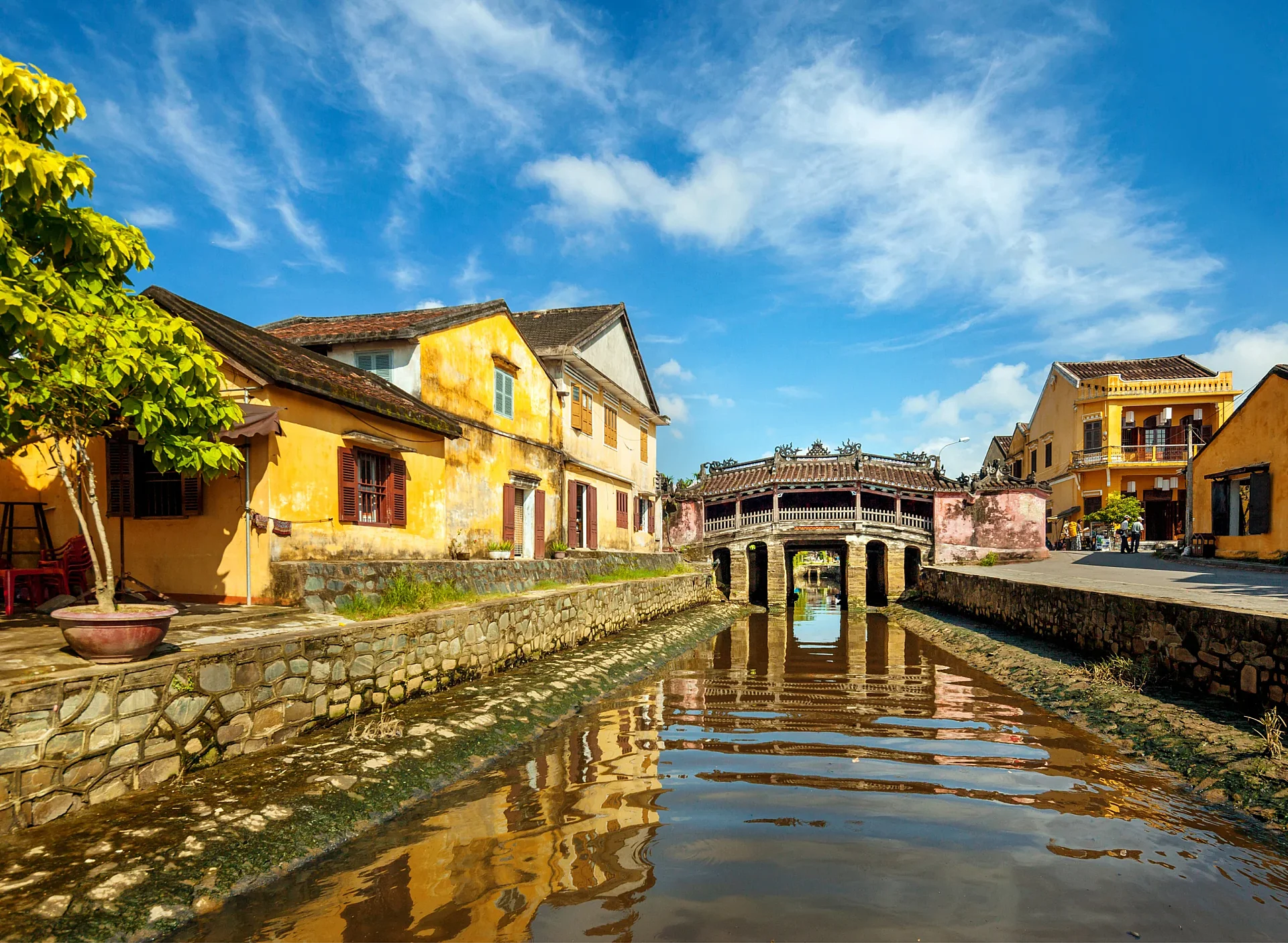
A bridge of wood and tile, guarded by monkeys and dogs
A tiled roof runs from bank to bank over a narrow stream in the old town of Hoi An. At one end, statues of monkeys and dogs stand guard.
On the north side, a small temple is attached to the structure, as if grafted right onto the bridge.
Why visit the Japanese Covered Bridge
The bridge is thought to have been built by the town's Japanese merchant community. It connected the Japanese quarter to the Chinese merchant district, meaning crossing it meant passing from one world to another.
In 1719, Lord Nguyễn Phúc Chu visited Hoi An and named it Lai Viễn Kiều, meaning the bridge of guests coming from afar. Today, locals also recognize it on the back of the 20,000 VND banknote.
The attached temple: Chùa Cầu
The local name, Chùa Cầu, means pagoda bridge. It comes from this small temple, which is actually not Buddhist at all, but dedicated to Bắc Đế Trần Vũ, a Taoist deity.
You walk across on foot, taking a close look at the carvings, guardian statues, and this sanctuary built right into the framework. No special dress code is required.
A bridge rebuilt from scratch
The monument was completely disassembled and then reconstructed during a lengthy restoration project carried out with Japanese advisors. It reopened in August 2024.
Its very new appearance caused quite a bit of debate in Vietnam. Do not expect wood weathered by centuries, as you are looking at a freshly reassembled bridge.
Seeing it at its best
The riverbanks offer the best viewpoints, both by day and in the evening when the old town lanterns light up. It is usually visited alongside nearby sights like the Phúc Kiến Assembly Hall, the Quan Công Temple, or the historic Tấn Ký House.
Friendly tip: Aim for the early morning hours or late afternoon to beat the crowds and catch the best light. During the rainy season, high water can disrupt access and temporarily close down sites in the old town.
How long for this activity
Allow 20 to 30 minutes to cross the bridge, check out the temple details, and take in the architecture from the banks.

This splendid bridge immerses you in 16th century Vietnam. Built entirely of wood and adorned with sumptuous ceramics, you never get tired of crossing it to discover new details each time, like the monkey and dog statues that stand proudly at each end. Inside, prayers multiply in front of a pretty little pagoda that inspires peace and serenity. Unfortunately, the outside of the bridge was under construction during my visit.