
Cité de l'Espace in Toulouse: the space odyssey that sticks with you
Fifty-three meters of white metal pointed toward the sky over Toulouse. The full-scale replica of the Ariane 5 rocket is visible long before you reach the entrance, and it sets the tone: here, everything is on a cosmic scale.
Since its opening in June 1997, this 4-hectare science park has turned the eastern suburbs of Toulouse into a launchpad accessible to everyone, from families and the curious to serious astrophysics enthusiasts.
Why visit Cité de l'Espace?
Toulouse did not become the European capital of aeronautics by accident. The city is home to the headquarters of Airbus, laboratories for the CNES (French National Centre for Space Studies), and a space industry that employs thousands of engineers. Cité de l'Espace is the logical extension of this DNA, a place designed with the support of the European Space Agency and Météo-France (French national meteorological service), where scientific popularization never sacrifices rigor. More than 8 million visitors have passed through its doors since it opened.
What sets this park apart from traditional museums is its obsession with experimentation. You do not just look at panels, you touch, test, and feel. The entry ticket includes access to all exhibitions, the planetarium, the IMAX cinema, the Stellarium, and the day's scheduled activities, with no extra fees.
LuneXplorer: 2g in your body and stars in your eyes
The star attraction has a name that says it all. The LuneXplorer, opened in late 2023 after a 16 million EUR investment, is a centrifuge staged like a lunar mission. The experience lasts about forty minutes:
- First, a preparation hall where you compare the Apollo and Artemis programs.
- Then, a video briefing led by ESA astronauts Thomas Pesquet, Samantha Cristoforetti, and Matthias Maurer.
- Finally, boarding: ten four-seat capsules, seatbelts fastened, with synchronized screens and speakers.
The dynamic phase lasts only five minutes, but the acceleration climbs up to 2g. Your body weight doubles, and your chest presses into the seat. Former astronaut Jean-François Clervoy confirmed the accuracy of the sensations compared to a real liftoff. At the exit, you receive a personalized debriefing with a downloadable mission certificate. This experience has no equivalent in Europe.
Exhibition halls: from lunar soil to orbital debris
The Solar System Quay and the moon rock
This area houses a fragment of lunar rock brought back by the Apollo missions. It is the only lunar sample visible to the public in France. Around this piece, interactive modules allow you to compare the planets of the solar system and track the position of the International Space Station in real time.
The Mir station and the Soyuz spacecraft
The engineering model of the Mir station, fully equipped, can be visited from the inside. The cramped nature of the modules is immediately striking. It is hard to imagine cosmonauts living there for months. In 2025, a new immersive exhibition was added to the station route to show the daily life of astronauts in orbit. Right next door, the first-generation Soyuz spacecraft completes this journey through Soviet and Russian space history.
The gardens and the Martian terrain
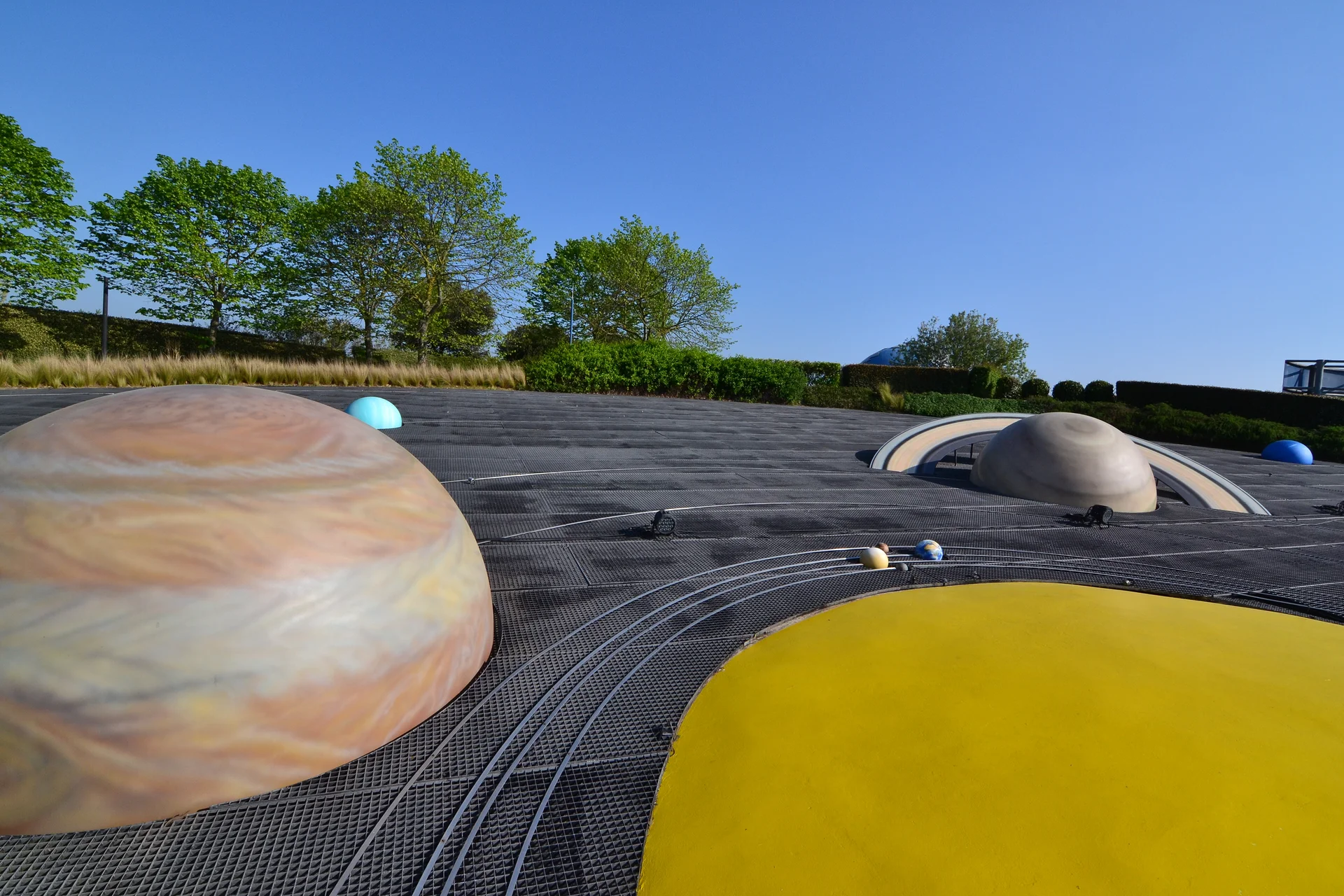
The 4 hectares of outdoor space deserve as much attention as the buildings. The Allée de l'infini (Avenue of Infinity) visualizes the distances of the solar system to scale. The Terrain martien (Martian Terrain) hosts mobile replicas of the Perseverance, Curiosity, and Zhurong rovers, with live demonstrations. The Terradome experiments with growing plants in extraterrestrial conditions.
Friendly tip: pick up the daily schedule as soon as you enter. The planetarium, IMAX, and LuneXplorer sessions have fixed times and sometimes overlap. Plan to arrive at opening to lock in your slots, and count on at least 20 minutes of lead time in the LuneXplorer line.
For whom and for how long?
Children as young as 4 have the Square des petits astronautes (Little Astronauts' Square), a dedicated space with a rocket to assemble and a ship to pilot. Adults without children will also find plenty to do: the scientific content is dense, the Pôle météo (Weather Center) led by a professional forecaster captivates even the skeptics, and the IMAX films shot in space make you forget you are sitting in a chair.
The site recommends a two-day visit. A full day remains realistic if you are willing to make choices. Picnic areas and three dining spots allow you to stay on-site without interruption. Parking is free, including electric charging stations.
Opening hours
In high season (summer, school holidays): open daily from 9:30 AM to 6:00 PM or 7:00 PM. Evening hours until 11:00 PM on select nights in July and August.
In low season: 10:00 AM to 5:00 PM or 6:00 PM, closed on Mondays (except during school holidays).
Annual closure in January.
*Information subject to change

Clearly the kind of place I would have loved to visit as a kid (and that I still appreciate as an adult). There are quite a few impressive and immersive attractions that make you feel like a real cosmonaut. As soon as you see the giant replica of the Ariane 5, you know what you are in for.
Pro tip: bring your own lunch, the restaurant is pretty expensive.