
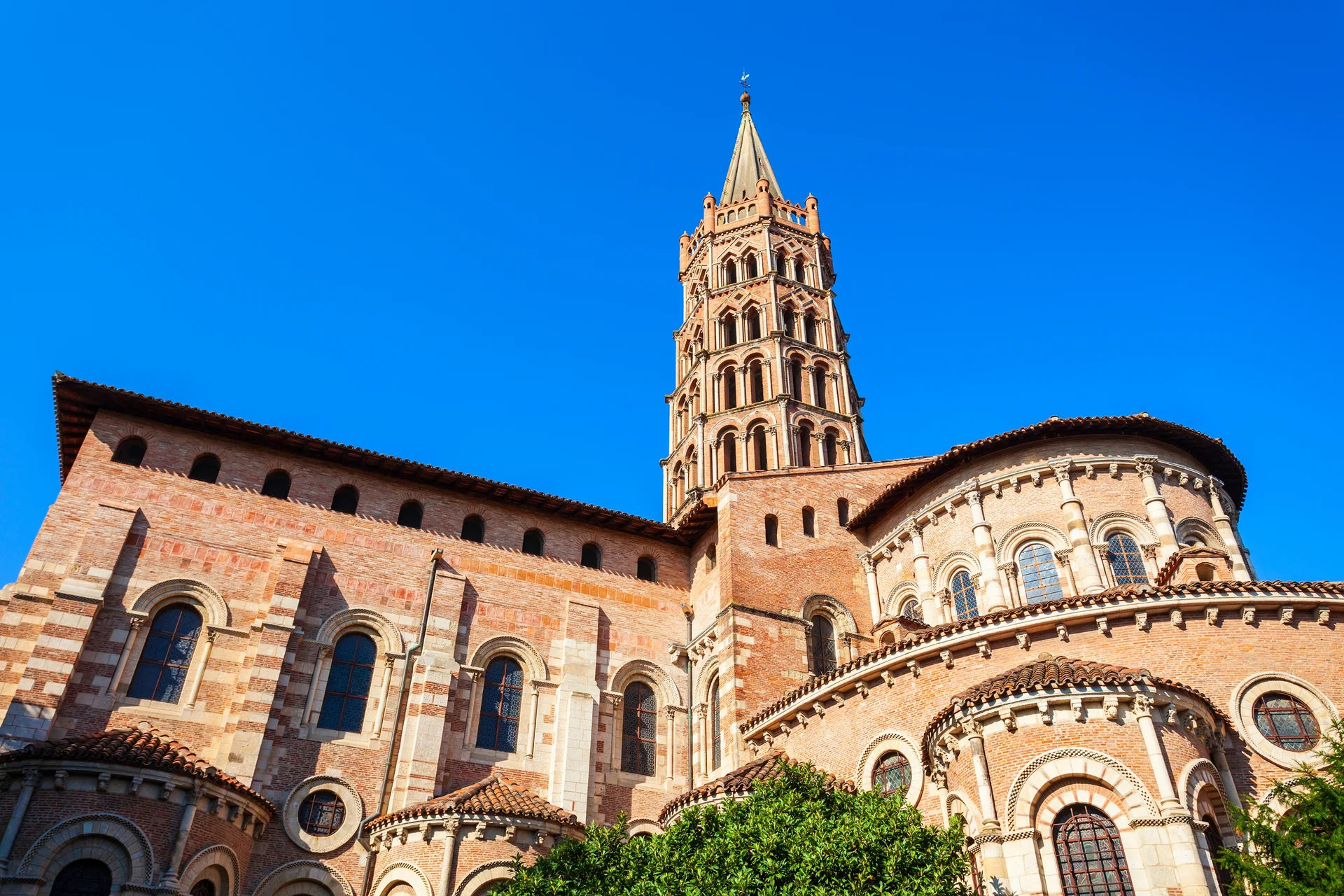
The Basilica of Saint-Sernin: A brick giant that defies time
The Basilica of Saint-Sernin stands at 115 meters long, dwarfing everything around it. As the largest Romanesque church in France, it has held its octagonal bell tower 64 meters into the sky of Toulouse since the 11th century. Its red brick walls earned it the nickname coral flower, a term immortalized by the singer Claude Nougaro. Here, the stone tells a story of a thousand years of faith and pilgrimage.
Why this basilica captivates so many
Built between 1080 and the early 14th century, the Basilica of Saint-Sernin was designed to welcome crowds of pilgrims traveling toward Santiago de Compostela. The building rises over the tomb of Saturnin, the first bishop of Toulouse who was martyred around 250 AD. Legend says he was tied to an angry bull and dragged through the streets until he died. His remains now rest in a Baroque sarcophagus in the heart of the basilica.
A UNESCO World Heritage site since 1998, the church represents the peak of Romanesque pilgrimage architecture. Its design allowed visitors to venerate relics without interrupting Mass, thanks to a circular ambulatory and radiating chapels. Pope Urban II personally consecrated the marble altar in 1096, which was signed by the sculptor Bernard Gelduin.
Architectural treasures that define the legend
The bell tower dominating Toulouse
Constructed in five levels between the 12th and 14th centuries, this octagonal campanile elegantly blends the Romanesque style of the first three stories with the Gothic style of the top two. It is slightly tilted to the west, creating an optical illusion that makes it appear to lean from certain angles. Its spire was added in the 15th century. Visible from almost anywhere in the city, it once guided lost pilgrims.
The sculpted Portes Miègeville and des Comtes
The Porte Miègeville (Miègeville Gate), a masterpiece of Romanesque sculpture dating to 1110 to 1115, reveals a lavish tympanum depicting the Ascension of Christ surrounded by majestic angels. Every detail of the capitals shows the skill of medieval artisans. The Porte des Comtes (Counts' Gate) features the parable of Lazarus and the rich man, with an alcove housing the tombs of four counts of Toulouse.
A monumental nave bathed in light
The interior measures 115 meters long, 64 meters wide, and 21 meters high. Five vaulted naves converge toward the choir, where the barrel vault rests on 260 richly sculpted capitals. Each one tells a biblical story, depicts fantastic creatures, or illustrates scenes from the lives of saints. The recent installation of a contemporary rose window by artist Jean-Michel Othoniel now floods the nave with spectacular polychrome light.
Hidden wonders of the crypts and treasury
Descending into the crypts feels like entering a miraculously preserved medieval sanctuary. The basilica holds one of the most significant collections of relics in France, including the remains of six apostles. The enameled reliquary of the True Cross, shaped like a sarcophagus and dating to the 12th century, is one of the treasury's crown jewels.
Medieval frescoes discovered in the 1970s, painted between 1140 and 1180, still adorn the transepts. Hidden for centuries under a 19th-century layer of plaster, they now reveal their vibrant colors. The monumental organ built in 1888 by Aristide Cavaillé-Coll is among the three most important instruments in France, alongside those at Saint-Sulpice in Paris and Saint-Ouen in Rouen.
Insider tip: Arrive early in the morning before the tourist crowds, when sunlight filters through the stained glass to create a near-mystical atmosphere. Free guided tours on Saturdays at 10:00 AM and 3:00 PM, as well as Sundays at 3:00 PM, reveal architectural details that are easy to miss. In July and August, regular organ concerts make the ancient vaults vibrate.
Opening hours
*Information subject to change

A very beautiful cathedral with Romanesque architecture. At sunset, the light on the pink stones is magnificent. I was impressed by the height of the octagonal bell tower, the large naves, and the richness of the decoration. The baldachin behind the altar is sublime. I also loved the stained glass windows, especially the new rose window by Jean-Michel Othoniel, which creates really beautiful colors. Not to be missed.