
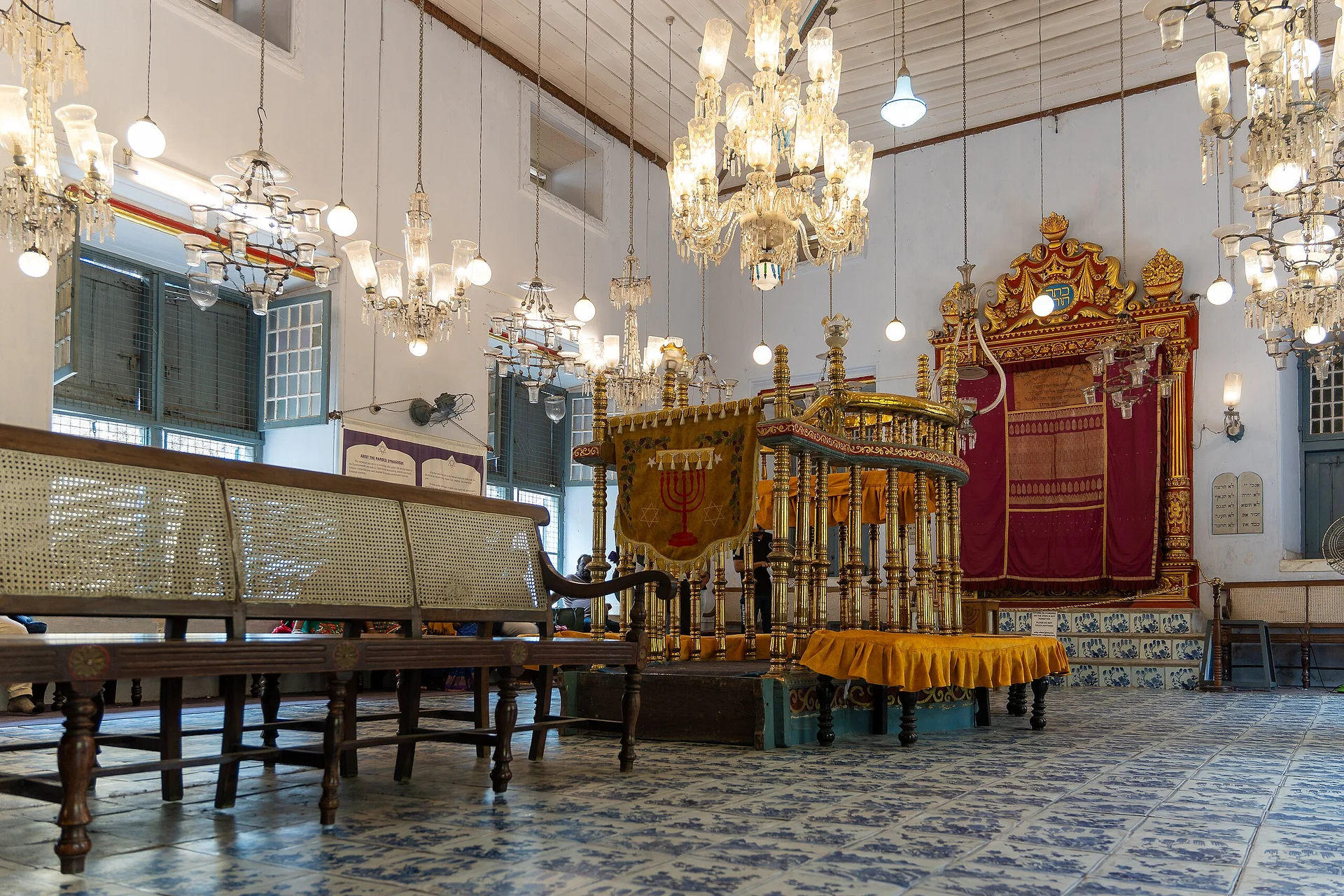
Paradesi Synagogue: A Sephardic gem in the heart of Kerala
Chinese porcelain tiles crunch softly under the bare feet of visitors. Paradesi Synagogue, built in 1568 in the Mattancherry neighborhood, holds the title of the oldest active synagogue in the Commonwealth. Its Belgian crystal chandeliers capture the tropical light filtering through the windows, creating a dance of shadows and golden reflections on the whitewashed walls. Here, the Jewish history of Kerala is told in Malayalam, Hebrew, and Ladino.
Why this place matters in Indian history
When Sephardic Jews fled Iberian persecution in the 16th century, some found refuge on the Malabar Coast. The Raja of Cochin, Rama Varma, granted them land adjacent to his own palace in Mattancherry. Samuel Castiel, David Belila, and Joseph Levi led the construction of this synagogue to serve a composite community, including Malabari Jews established for centuries and new arrivals from Europe and the Middle East.
The term Paradesi, which means foreigner in several Indian languages, designated this synagogue and the community that brought it to life. In 1662, the Portuguese burned the building during their struggle against the Dutch East India Company. The Dutch rebuilt it that same year, giving rise to the current structure. This synagogue even shares a wall with the Hindu temple of the adjacent palace, a unique testament to religious coexistence in Kerala.
Treasures that move visitors
The floor of a thousand blue patterns
Each tile tells a different story. In the 18th century, Jewish merchant Ezekiel Rahabi imported more than a thousand hand-painted porcelain tiles from Canton. No pattern repeats: blue willows, exotic birds, and Chinese landscapes unfold under your feet. This blue and white ceramic, which has become emblematic of the synagogue, requires visitors to enter barefoot to protect it.
Torah scrolls crowned in gold
The carved teak ark, oriented west toward Jerusalem, houses four Torah scrolls in their hammered silver cases. Two pure gold crowns, gifted by the Maharajas of Cochin and Travancore, top these sacred texts. An Ethiopian carpet, a gift from Emperor Haile Selassie in 1956, rests in front of the ark.
The ancient copper plates
The oldest treasure dates back to the 4th century: two copper plates engraved in ancient Malayalam, in mirror writing. These documents granted Joseph Rabban and the Jewish community 72 privileges equivalent to those of the local Nair nobility. These plates constitute the oldest documentary evidence of the Jewish presence in India.
Architecture that marries East and West
The clock tower built in 1760 features four different faces: Latin, Hebrew, and Malayalam numerals, and one blank face. This multiplicity allowed the Maharaja, merchants, and the local population to read the time according to their own system. The 19th-century Belgian chandeliers hang from the teak ceiling, alongside the colorful glass lanterns typical of Kerala that once burned coconut oil.
The women's gallery, adorned with gilded columns, is separated from the main hall by an openwork partition called a mechitza. In the center, the raised bimah with its brass balustrades is used for evening prayers. The architectural ensemble respects Sephardic traditions while integrating local Kerala craftsmanship.
Visiting the synagogue today
The Jewish community of Cochin, which numbered up to 2,000 members at its peak, now consists of only a few families. Services are held only when a minyan of ten men can be gathered. For visitors, the synagogue opens its doors six days a week. The ban on photography, introduced a few years ago, aims to preserve the sanctity of the place.
The surrounding neighborhood, nicknamed Jew Town, lines up its antique, spice, and craft shops. The narrow alleys retain the atmosphere of a tropical shtetl where Hebrew signs sit alongside those in Malayalam.
Friendly tip: Visit the synagogue in the morning, before 11:00 AM, to avoid tour groups and fully enjoy the meditative silence that reigns between these walls heavy with history. Take the time to observe each floor tile: some present complex narrative scenes. The antique sellers of Jew Town open early, which will allow you to explore the Jewish quarter after the visit, when the heat becomes too intense to walk comfortably.
Opening hours
| Monday | 10:00-12:00, 15:00-17:00 |
|---|---|
| Tuesday | 10:00-12:00, 15:00-17:00 |
| Wednesday | 10:00-12:00, 15:00-17:00 |
| Thursday | 10:00-12:00, 15:00-17:00 |
| Friday | 10:00-12:00 |
| Saturday | Closed |
| Sunday | 10:00-12:00, 15:00-17:00 |
Closed on Jewish holidays and certain public holidays. Admission fee applies, barefoot entry is mandatory, and photography is prohibited.

At the entrance, a small museum traces the history of the Jewish communities in Kochi. It is interesting to better understand the place. The synagogue is small, but very pretty and very peaceful. Walk around the Jewish neighborhood, there are plenty of antique shops to discover.