
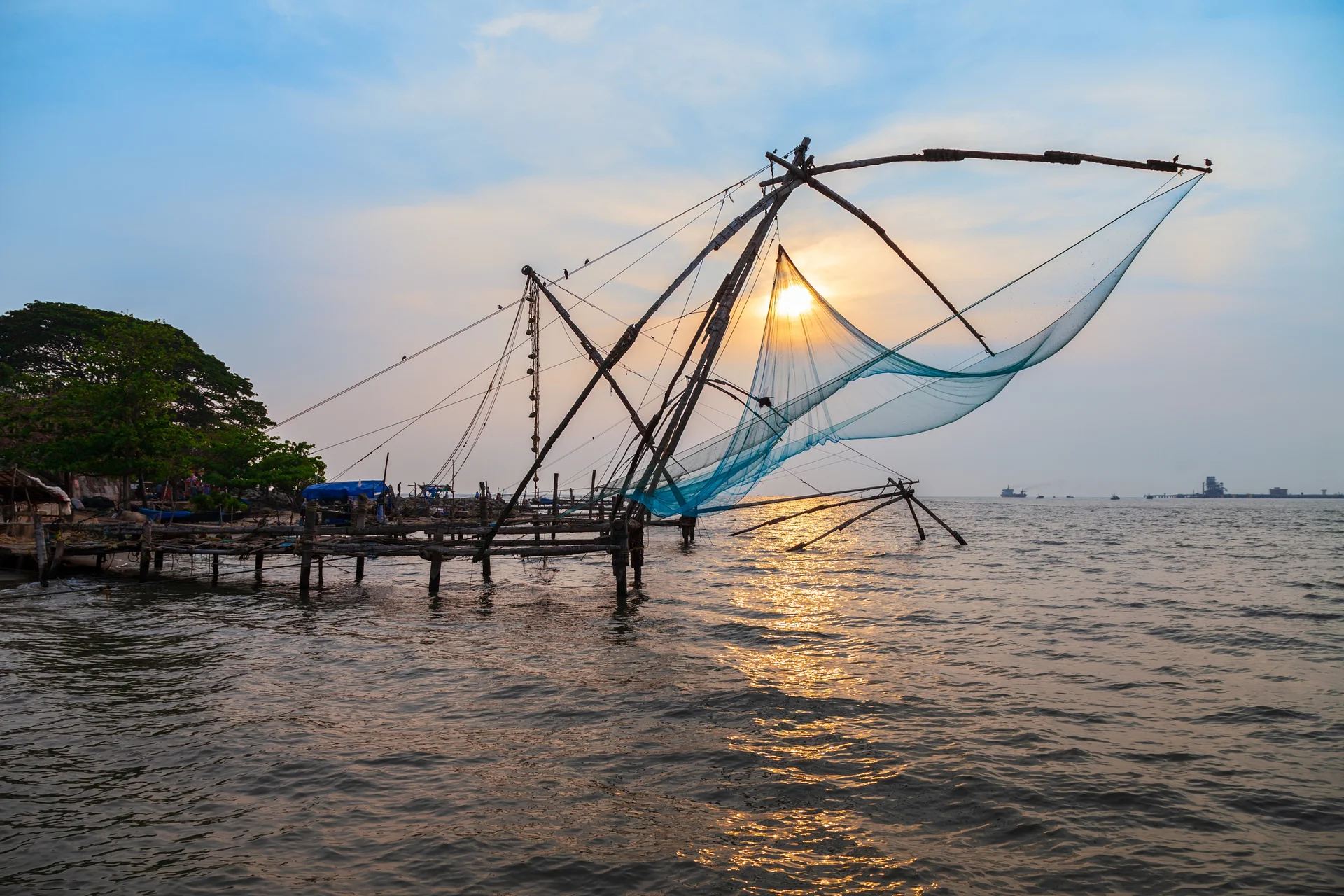
Chinese Fishing Nets, a mechanical ballet on the Arabian Sea
The sun dips toward the Arabian Sea. Wood and bamboo structures cut through the golden light like giant sculptures. In Fort Kochi, six to eight monumental installations defy gravity, lowering and raising their vast nets in a rhythmic ballet that has continued for six centuries. The Chinese Fishing Nets are more than a tourist curiosity. They tell the story of a crossroads city, where the maritime Silk Road met the spices of the Malabar Coast.
A legacy of the Silk Road
Between 1350 and 1450, when the junks of Admiral Zheng He dropped anchor in the port of Cochin, they carried much more than porcelain and silk. These fishing techniques, originating from the southern coasts of China, found a home on the shores of Kerala. Merchants from the court of Kublai Khan introduced them, and local fishermen adopted them, adapting the method to the tides and depths of the estuary.
Locally called cheenavala, literally Chinese nets in Malayalam, these installations testify to an era when Kochi was a major cosmopolitan port. Some point to another origin, the Portuguese colonists from Macau who controlled both cities in the 16th century. The Portuguese names given to the different parts of the nets support this theory.
The mechanics of balance and patience
The ingenuity of the system
Each installation stands about ten meters high and deploys a net spanning twenty square meters over the water. The principle is fascinatingly simple. Teak and bamboo beams form a giant lever, counterbalanced by stones thirty centimeters in diameter suspended from ropes. The system is so finely balanced that the weight of one man walking on the main beam is enough to plunge the net into the water.
Four to six fishermen operate each installation. Their muscles strain on the ropes as their silhouettes stand out against the sky. The net remains submerged for five to fifteen minutes, giving fish and crustaceans time to wander in. Then the men pull together in a synchronized effort. The stones, one by one, come to rest on a platform while the net rises, dripping.
Fishing tied to the tides
Each net has a fixed operating depth. It is impossible to use them continuously in tidal waters. Depending on the state of the tide, some nets work while others rest. This dance with the elements imposes its rhythm on the fishermen, who know the lunar cycles and currents by heart.
The catch is often modest, a few fish, some shrimp, or perhaps a crab. Passersby buy the fresh fish immediately, and nearby stalls cook it on the spot. The smell of the grill mingles with the salty air.
Vasco da Gama Square, the best viewpoint
To admire the Chinese Fishing Nets in all their splendor, head to Vasco da Gama Square, the narrow promenade that runs along the beach of Fort Kochi. This is where the installations line up, creating a spectacular perspective. Street vendors offer fresh coconuts and banana fritters. Local artists display their work. The atmosphere is lively without being chaotic.
At dawn and dusk, the light transforms the structures into theatrical silhouettes. Photographers from all over the world flock here to capture the moment when the nets stand out against a burning sky. It has become one of the most iconic images of Kerala, right alongside the backwaters or the kathakali.
Friendly tip: Visit early in the morning between 6 a.m. and 8 a.m. or in the late afternoon after 5 p.m., when the fishermen are actually at work. In the middle of the day, the nets are often at rest, and you might run into people posing as fishermen who ask for money to pose or simulate a demonstration. Authenticity is found during the hours when the fishing actually happens.
A heritage in danger
Modern fishing techniques make these methods less profitable. Deepening the channel for the Vallarpadam container terminal has reduced the catch. Of the original seventeen nets, only eight remain today, three of which are among the largest in the world. The private owners who maintain them reinforce the structures about every ten years, often with modern materials that alter their traditional character.
The survival of these living monuments depends on a fragile balance between tourism revenue and ancestral practice. Seeing them in action remains a privilege, a window into six hundred years of maritime history.
Opening hours
Open 24/7
*Information subject to change

Typical tourist attraction. For a few rupees, the fishermen let us get onto the platform and show us how to pull the fishing nets. Despite the trash on the beach, the walk along the water is nice. Going at sunset is definitely the best time to take photos.