
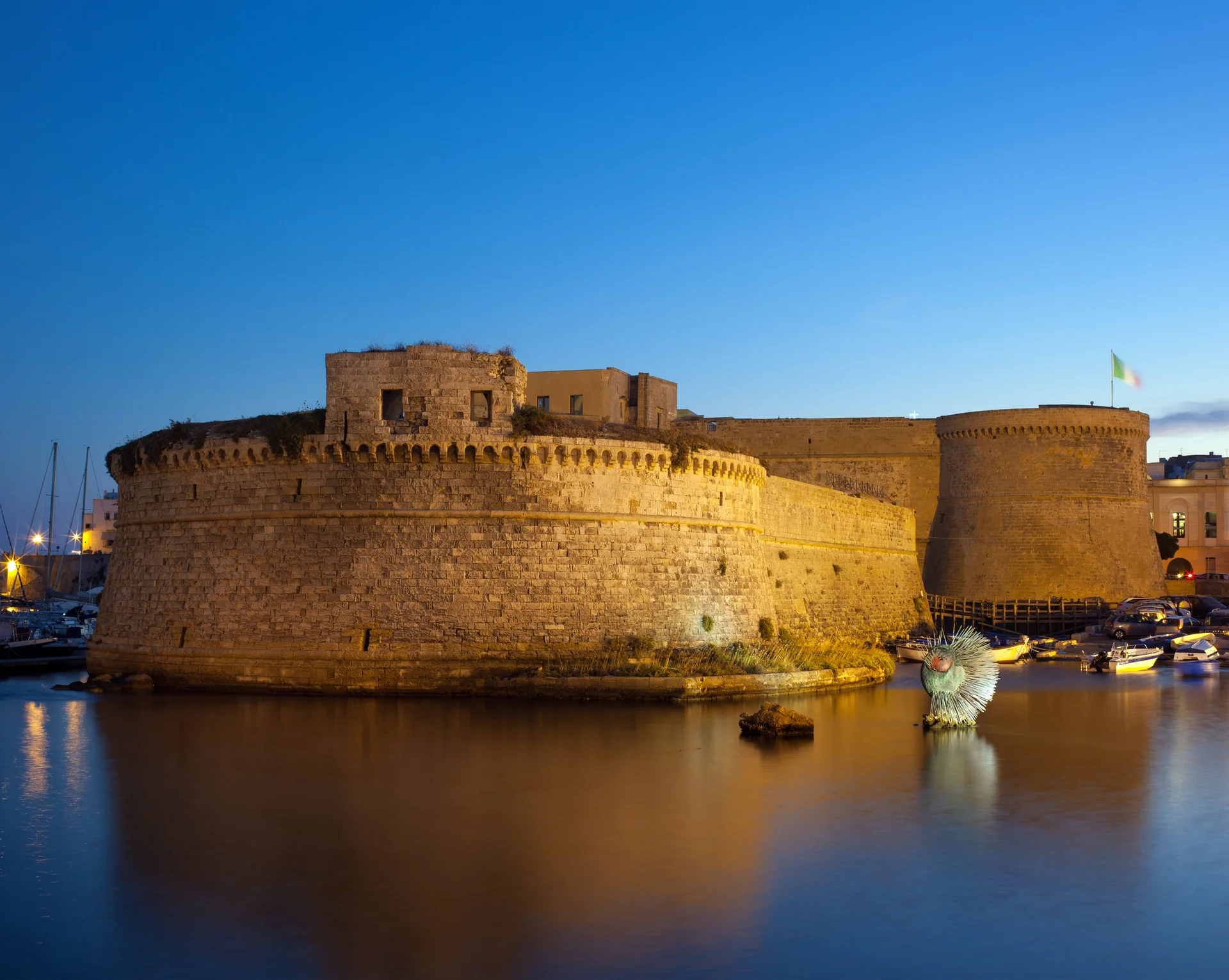
Gallipoli Castle, a stone sentinel on the Ionian Sea
Almost entirely surrounded by the sea, Gallipoli Castle stands at the eastern edge of the old town like a giant block of tuff rising from the water. From the bridge that connects the island to the mainland, its massive silhouette is impossible to miss. This is not just another monument. It is the long-standing guardian of the city, a structure that has watched Byzantines, Normans, Angevins, and Aragonese pass by, still bearing the scars of its past battles.
Why visit Gallipoli Castle?
This fortress captures the turbulent history of the Salento region. Established as early as the 11th century on top of ancient Roman fortifications, then rebuilt in the 13th century under Byzantine rule, it underwent countless transformations until the 17th century. Every conqueror left a mark. Frederick II of Swabia restructured it in the 13th century, the Angevins reinforced it in 1320, and between the 15th and 16th centuries, the Angevins and Aragonese added a protective moat and powerful circular towers.
However, the addition of the Rivellino in 1522 turned it into a masterpiece of military engineering. This fifth tower, designed by the Sienese architect Francesco di Giorgio Martini, stands detached from the main wall, floating in the sea like an advanced outpost. Left abandoned for a long time, the castle reopened to the public in 2014 following an extensive restoration campaign and became municipal property in 2016.
Architecture that defies the ages
The towers and the defensive system
The castle has a quadrangular base flanked by four corner towers: three circular and one polygonal, the latter being a remnant of the Norman era. Built from carparo, a local honey-colored limestone, they rise toward the sky with sloped bases and small decorative arches at the top. The Rivellino, which is lower and wider, still displays its original catapults and cannons pointed toward the sea.
In the past, the castle was accessed via a wooden drawbridge. In the 17th century, it was replaced by the current masonry bridge. The moat that once isolated the fortress was filled in during the 19th century, and the facade was partially hidden by the construction of the covered fish market between 1870 and 1879.
Interior spaces and their secrets
The interior holds impressive architectural details. The large barrel-vaulted and ribbed-vaulted rooms demonstrate the skill of medieval builders. The Sala Ennagonale, a nine-sided room, is striking for its proportions. The Sale Circolari (Circular Rooms) offer an echo effect that fascinates visitors. Do not miss the Matroneo and the Arco Tudor, which served as the former entrance to the fortress.
The underground passages and secret corridors tell a different story. Used as escape routes, they contain mysterious graffiti left by merchants, travelers, and prisoners who passed through here over the centuries. Some inscriptions remain undecipherable today, adding to the enigmatic nature of the site.
A living space between history and culture
Today, the castle is more than just a museum frozen in time. It houses a permanent exhibition on the history of Gallipoli and the trade of olio lampante (lamp oil), the product that brought prosperity to the city from the 16th to the 19th century and illuminated major European capitals. The museum path traces the journey of this pearl of the Ionian Sea through the ages.
The castle regularly hosts contemporary art exhibitions, concerts, and cultural events that bring life to Gallipoli. It hosted an exhibition by Michelangelo Pistoletto in 2015, followed by works by Renato Guttuso in 2025, confirming its role as a bridge between historical heritage and contemporary creation.
Insider tip: Head up to the ramparts in the late afternoon to enjoy a panoramic view of the bay and the old town. The golden light of sunset sets the white facades of the Citta (city) ablaze and turns the sea into a copper mirror. Stay afterward to watch the castle light up at night, which is a highlight of any visit.