
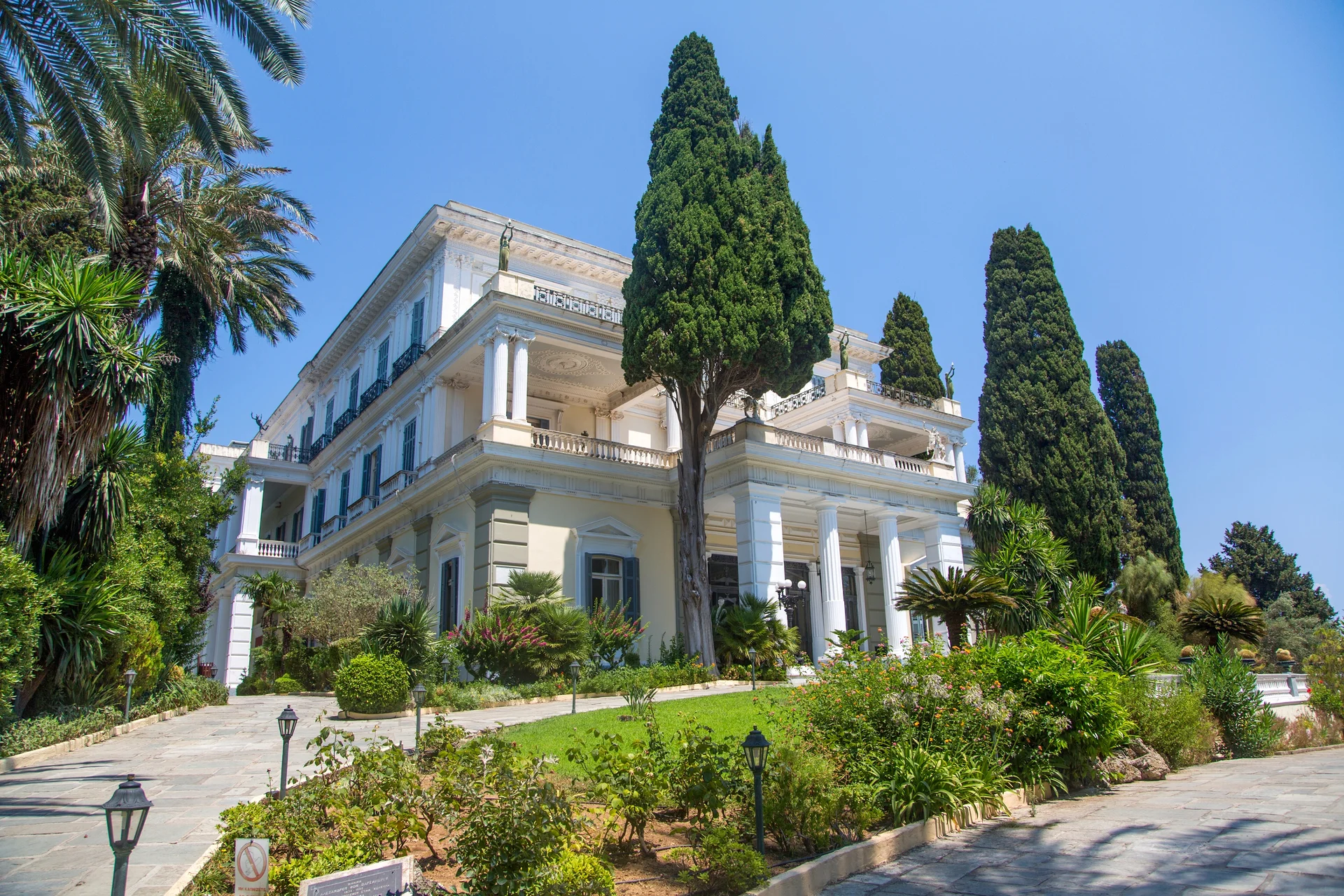
Achilleion Palace, an imperial refuge above the Ionian Sea
Cypress trees stand guard around a white mansion perched on the heights of Gastouri. From the terraces, the view takes in wooded hills that cascade down to the sea. This neoclassical palace, built between 1889 and 1891, bears the name of the most tragic Greek hero, Achilles. Empress Elisabeth of Austria, a woman as fascinating as she was tormented, sought a sanctuary here far from the court of Vienna and its personal wounds.
Why is Achilleion Palace worth the trip?
The history of this site tells of two lives broken by fate. Sissi, as the empress was affectionately nicknamed, had this villa built after the suicide of her only son, Rudolf, in 1889. She entrusted her vision to the Italian architect Raffaele Caritto: a home worthy of the hero Achilles, the one who scorned mortals and feared no gods. The Pompeian style chosen evokes the ancient palaces of Phaeacia described by Homer.
After Sissi was assassinated in 1898, the palace sat abandoned for nine years before being purchased by Kaiser Wilhelm II of Germany. The emperor transformed this melancholy retreat into a European diplomatic hub, hosting intellectuals and crowned heads until the First World War.
Both world wars later converted the building into a military hospital. Today, this museum is open to the public and serves as a testament to an era when the European aristocracy held a passionate fascination for Greek antiquity.
The entrance hall and imperial apartments
The fresco of the Four Seasons welcomes visitors from the ceiling of the main hall. Marble staircases lead to the upper floors, framed by statues of Zeus and Hera. On the landing, an Ionic colonnade marks the former private space of the empress, where the busts of the nine Muses sit alongside those of Greek philosophers.
On the second floor, the grand hall displays the monumental painting by Franz Matsch, which depicts the triumph of Achilles as he drags the body of Hector behind his chariot to the gates of Troy. The salons retain a few period furnishings and personal items that belonged to Sissi and the Kaiser. A small chapel completes the interior tour, modest but poignant in its simplicity.
Mythological gardens and their sculptural treasures
The Peristyle of the Muses
The south terrace forms the emotional heart of the palace. Nine white marble statues representing the Muses surround this columned peristyle: Clio for history, Euterpe for music, Thalia for comedy, Melpomene for tragedy, Terpsichore for dance, Erato for lyric poetry, Polymnia for hymns, Urania for astronomy, and Calliope for epic poetry. The panorama from this esplanade spans the green hills all the way to the shimmering sea below.
The Dying Achilles, a masterpiece by Ernst Herter
At the center of the terraced gardens stands the sculpture that embodies the soul of the palace. The German sculptor Ernst Herter completed this white marble work in 1884. It captures the hero at the precise moment he attempts to pull the arrow from his heel, his only vulnerable spot. With his face turned toward the sky and his features tightened in pain, Achilles still holds a short sword in his right hand.
The half-collapsed posture captures the tragic moment when invincible strength yields to mortality. Sissi could contemplate this statue from her peristyle, perhaps finding an echo of her own vulnerability.
The Kaiser's Triumphant Achilles
At the bottom of the gardens stands a monumental bronze statue over ten meters tall. Wilhelm II commissioned it from the sculptor Johannes Götz to replace Sissi's melancholy vision with an embodiment of martial power. Achilles appears here in full hoplite armor, brandishing his sword, with a shield adorned with a gorgon head designed to petrify enemies.
The palm trees framing it highlight the heroic silhouette, which faces north like a guardian watching over the city of Corfu.
Friendly tip: Visit the palace in the late afternoon, around 5:00 PM or 6:00 PM. The golden light of the setting sun magnifies the white marble statues, the tour buses have cleared out, and you can enjoy the Peristyle of the Muses in a quietude similar to what Sissi sought. The gardens close at 8:00 PM in high season, leaving you plenty of time to explore.
Lush vegetation of palms and bougainvillea
Kaiser Wilhelm II hired the renowned botanist Carl Ludwig Sprenger to restore and enrich the gardens after their nine years of neglect. Rare species imported from around the world thrive today in this mild microclimate: majestic palms, towering cypress trees, ancient olive trees, and vibrant bougainvillea cascading over the ocher walls.
The paths wind between fragrant groves, revealing a fountain, a statue of Dionysus carrying a satyr on his shoulders, or a poet's bust around the bend.
The tiered gardens descend the hill on several levels, offering a new vantage point over the surrounding landscape at every turn. Stone benches and shaded nooks invite contemplation facing the blue expanse of the Ionian Sea.
Opening hours
- April to October: 8:00 AM to 8:00 PM
- November to March: 8:00 AM to 4:00 PM
*Information subject to change

I was curious to discover this palace that served as a residence for Sissi. Just as I imagined, the setting is a real haven of peace. I really loved the gardens, which aren't very well maintained, but they offer a beautiful view of the sea and feature magnificent statues of Achilles. Unfortunately, the interior of the palace is under construction and cannot be visited.