
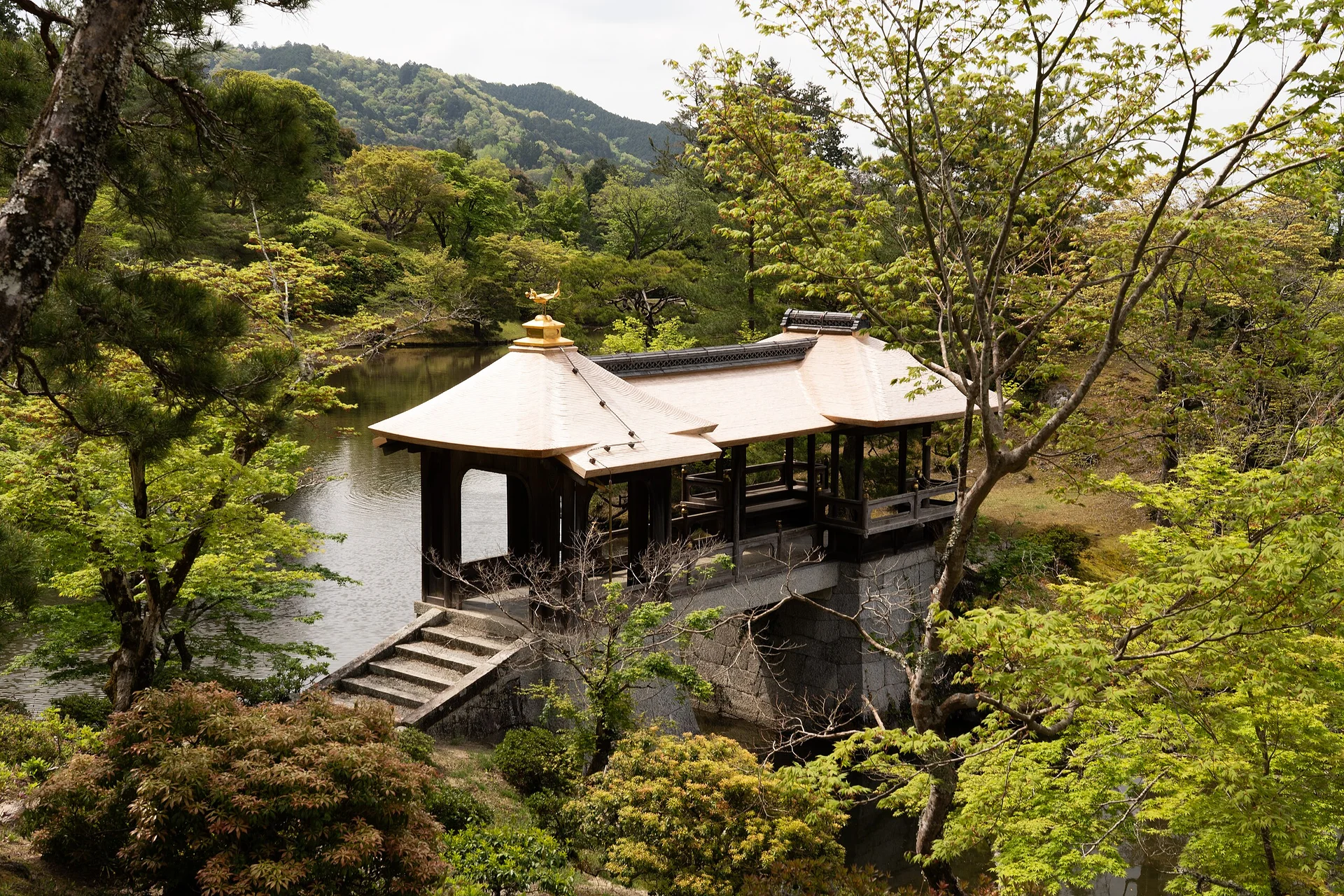
Shugaku-in Imperial Villa: When a Retired Emperor Redesigned the Mountain
Rice paddies ripple in the morning breeze, framed by century-old pines. In the distance, Mount Hiei watches in silence. It is 1656, and the 60-year-old Emperor Go-Mizunoo begins the work of his life here. He sets out to transform this hillside in the northeast of Kyoto into a perfect dialogue between humanity and the natural world.
Why visit the Shugaku-in Imperial Villa?
This imperial residence is a sharp departure from the opulent palaces of the Edo period. Go-Mizunoo, forced to abdicate under pressure from the Tokugawa shogunate, chose to spend his final decades creating a place where the landscape takes precedence over architecture. The villa represents the pinnacle of Japanese aristocratic culture, much like its contemporary, Katsura. The three garden complexes terraced along the slope utilize a bold landscaping technique called shakkei, or borrowed scenery. The surrounding mountains literally become part of the garden, erasing the boundary between human creation and the wild landscape.
The three villas: a contemplative ascent
The Lower Villa and the Jugetsu-kan pavilion
The route begins at the base of the hill. The Jugetsu-kan pavilion, rebuilt in 1824, served as a resting point for the emperor before he climbed the heights. Its raised tatami mats and fusuma paintings signed by masters of the Kano school demonstrate the refinement of the era. The calligrapher of the entrance plaque? Go-Mizunoo himself.
The Middle Villa and the famous kasumi-dana shelves
A pine-lined path crosses rice paddies still maintained by local farmers. The Middle Villa houses the kasumi-dana, one of the three most famous shelves in Japan. Its five boards arranged in a cascade evoke layers of mist floating on the horizon. A persistent legend surrounds the sliding doors decorated with carp. It is said the painted fish had a habit of escaping at night, forcing the guards to cover them with a net.
The Upper Villa and the panorama of the Rin-un-tei
The effort of the climb is rewarded at the Rin-un-tei pavilion, perched at an altitude of 150 meters. The earthen floor mixes red and black pebbles in a pattern called hifumi-ishi. The terrace, open on three sides, overlooks the Yokuryu-chi pond below, which was created by diverting a mountain stream. On clear days, the view embraces the entirety of Kyoto, reaching all the way to the western mountains.
Look for these during your visit:
- The Chitose-bashi bridge that connects the two islands of the upper pond
- The maple valley, which is spectacular in November
- Passages of deer and herons in the rice paddies
A visit that is worth the effort
The Kunaicho (Imperial Household Agency) strictly limits access to 50 people per guided tour, and reservations are mandatory. This constraint preserves an atmosphere that is rare in Kyoto. There are no souvenir shops and no dense crowds. Only the crunch of gravel underfoot and the sound of birds. The three-kilometer route lasts about 80 minutes and requires comfortable shoes.
Friendly tip: The 9 a.m. or 10 a.m. slots offer the softest light on the upper pond. In the summer, try signing up on-site at 11 a.m. for afternoon tours, as the low season often leaves spots available.

I had booked a blacksmithing workshop nearby, and while I was looking for activities in the area, I stumbled upon the villa. What a lovely discovery! The tour lasts about an hour and needs to be booked in advance on the same website as the Imperial Palace and the Katsura Villa. The upper villa was my favorite part of the tour because it offers an incredible view of Kyoto and even all the way to Osaka! The atmosphere is so peaceful, between the pond and the mountains. It is really a nice visit that I recommend if you are in this neighborhood, since it is admittedly a bit out of the way.