
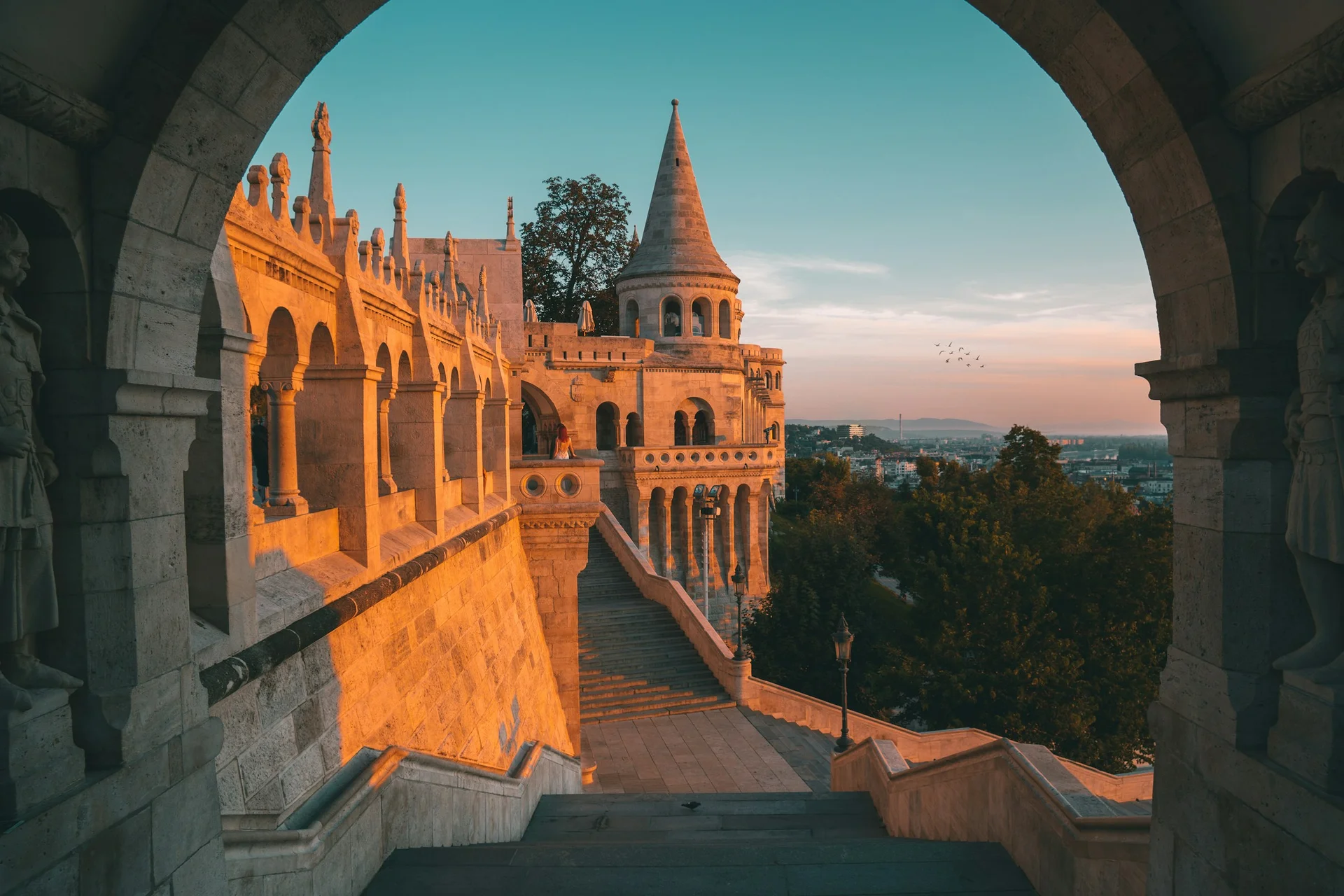
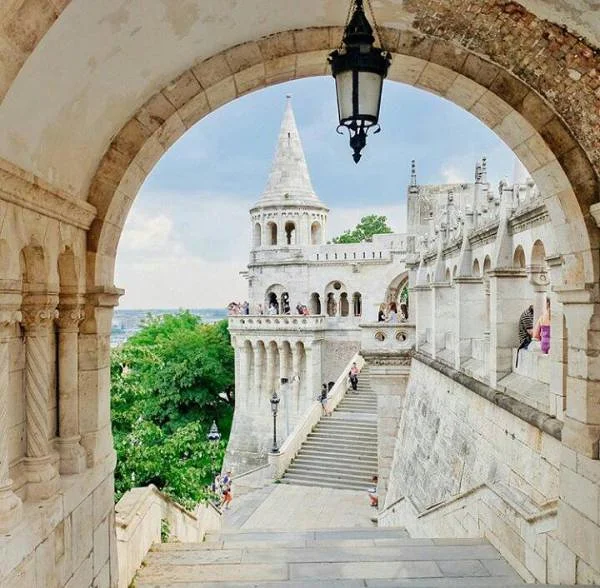
Fisherman's Bastion: seven stone towers facing the Danube
White stone glows differently at dawn. Before 9:00 AM, when the gates are open without a ticket, the terraces of the bastion belong to those who get an early start. An unusually heavy silence reigns over the hill of Buda, while the Parliament on the other side of the river begins to turn crimson in the morning light.
This is when the monument reveals its true nature, not as a fortress, but as a lookout designed for contemplation.
Why visit Fisherman's Bastion?
Built between 1895 and 1902 on the foundations of the old Buda ramparts, the bastion is the work of architect Frigyes Schulek, who also oversaw the restoration of the nearby Matthias Church. The two projects were linked, as the T-shaped terrace of the Fisherman's Bastion was designed to wrap around and highlight the coronation church of the kings of Hungary. Every detail serves a purpose.
Its seven conical towers symbolize the seven Magyar tribes that founded Hungary in 895. This is no coincidence, as the bastion was erected for the millennium of the Hungarian state, during a time when Budapest was flourishing with architectural projects like its metro and parliament. Listed as a UNESCO World Heritage site since 1987, along with the entire castle district, it remains one of the most photographed views in Central Europe.
Schulek's architecture: the medieval illusion
From a distance, the towers look a thousand years old. Up close, the masonry reveals the precision of a goldsmith. Schulek incorporated many details to create the illusion, including no two identical pairs of columns across the entire monument, varied capitals, and arcades that recall Romanesque cloisters. The facade stretches for 140 meters along the banks of the Danube, with a southern wing of about 40 meters, a northern wing of 65 meters, and a central parapet of 35 meters.
Architecturally, this monument is a work of decoration, not defense. Yet, that is exactly what makes it fascinating. Schulek transformed a plain military wall into a beautiful public space at the exact moment when Budapest was seeking to establish itself as a major European capital.
Saint Michael Chapel, discovered by chance
During the foundation work, laborers uncovered the remains of a 14th-century medieval chapel, the former funeral chapel of the Dominicans. It is accessible from the lower level of the bastion. Few visitors find it, but it is one of those detours that is truly worth the effort in this neighborhood.
The statue of Saint Stephen and sculptures to spot
In the courtyard of the south bastion, the equestrian statue of King Saint Stephen has stood since 1906, a work by Alajos Stróbl. Its neo-Romanesque pedestal, designed by Schulek himself, features bas-reliefs depicting major scenes from the reign of the first king of Hungary. From his coronation and the conversion of the country to the founding of bishoprics, it is a sculpted summary of a thousand-year history.
Keep an eye out for these on the northern terraces:
- The statues of the chieftains Előd and Álmos, guarding the esplanade of the main tower
- Heraldic lions and a mythological creature with an open mouth, in the same style
- The ribbed columns of the arcades, where no pair is strictly identical
The panorama: looking at Budapest from the heights
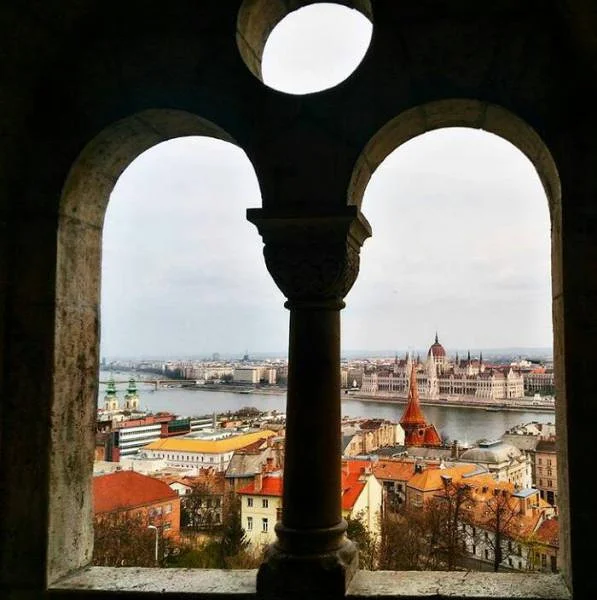
The view from the upper terraces is one of the clearest in the city. Opposite, the neo-Gothic Parliament dominates the Pest bank, its reflections shifting with the time of day. The Széchenyi Chain Bridge connects the two banks below. On a clear day, you can see the Budaörs hills to the southwest. At night, when the facades are illuminated, the entire scene takes on a different dimension.
Pro tip: Access to the upper terraces is free before 9:00 AM and after 7:00 PM (winter) or 9:00 PM (summer). Arrive at opening or end-of-day to avoid the crowds and save on the ticket. The late afternoon light, around 5:00 PM in summer, is particularly good for photos facing the Parliament.
Why it is worth it
- Panorama of the Danube and the Parliament, which is hard to beat in Budapest
- Free access to lower levels and terraces outside of paid hours
- Matthias Church is a few meters away, plus the Saint Michael Chapel to discover underground
- Exceptional light at dawn and sunset
- Fully restored monument with restored white stone
Things to anticipate
- Dense crowds in high season, especially on weekends between 10:00 AM and 4:00 PM
- Upper terrace tickets cost 1,500 HUF (about $4) as of January 2025
- Difficult for wheelchair access due to many stairs and no elevators
- Parts of the castle hill are under construction as part of neighborhood renovations
Ticket price overview
| Category | Price |
|---|---|
| Adult | 1,500 HUF (about $4) |
| Reduced rate (under 14, students, EU seniors) | 750 HUF (about $2) |
| Children under 6 | Free |
| Lower levels (bottom terraces) | Free at all times |
| Access before 9:00 AM and after 7:00 PM (winter) / 9:00 PM (summer) | Free, including upper terraces |
| National holidays (March 15, August 20, October 23) | Free |
Prices are indicative and subject to change
Opening hours
How long for this activity
*Information subject to change

Up on Buda Hill, above the Danube, these multi-level ramparts offer pretty views of Pest, the eastern part of the city... But that is it!
A bit overrated for my taste.
And like Caromexico said, I will stick to the free area. I do not really see what the paid section adds.