
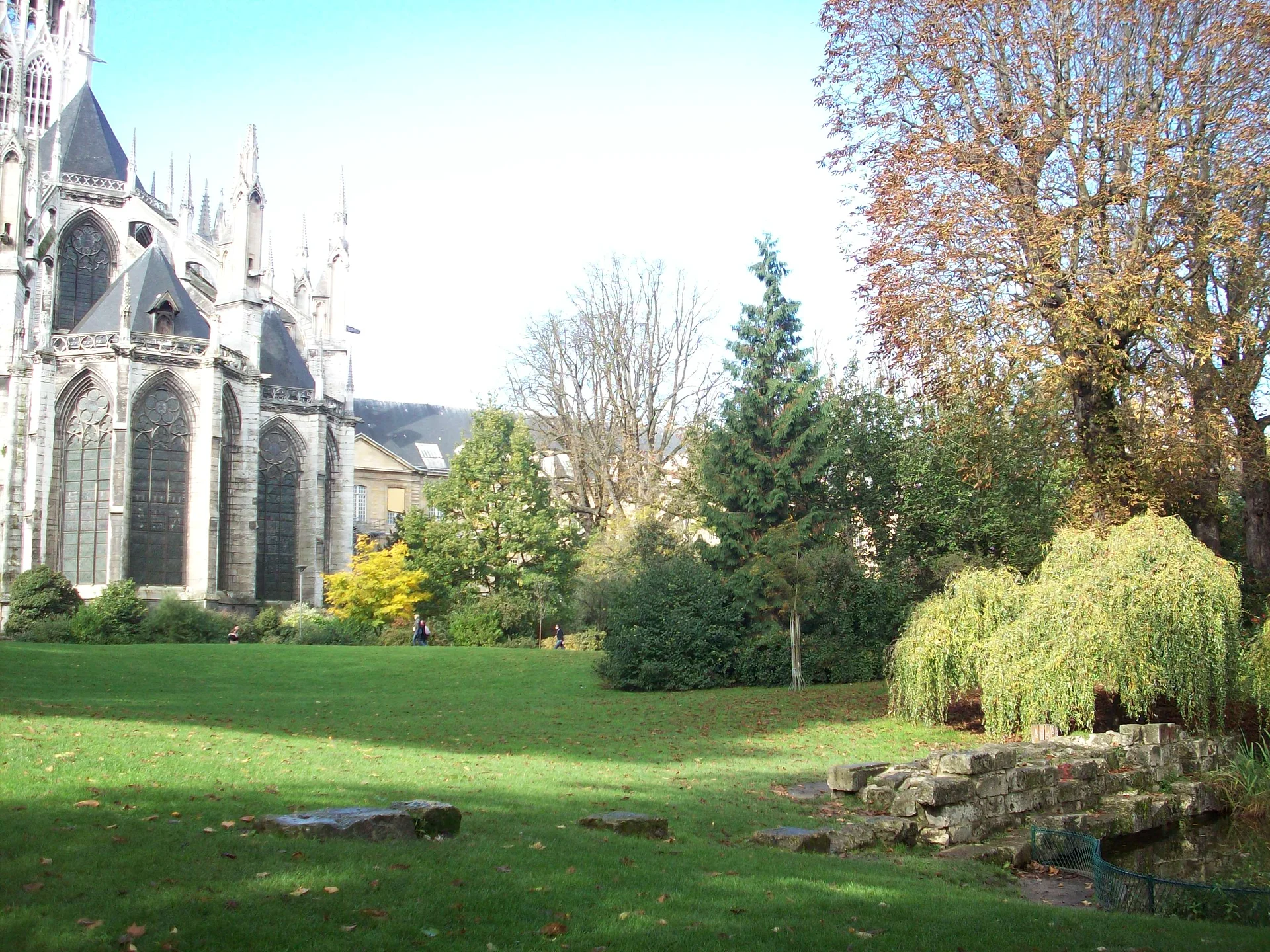
Visiting Saint-Ouen Church
In the city of Rouen, the famous cathedral is not the only jewel of Norman Gothic architecture. While the Saint-Ouen Church may not have the same level of fame, it rivals the cathedral in both prestige and scale. It stands as an iconic example of this distinct architectural style.
History
The abbey of Saint-Ouen was one of the most powerful Benedictine monasteries in Normandy. It was founded in 750 on the site of an earlier Merovingian church. Its name stems from the fact that Saint Ouen was buried there in 684.
In 918, Rollo, the newly appointed Duke of Normandy, restored the abbey. It was not until 1062 that Abbot Nicolas de Normandie rebuilt the church in a Romanesque style. It was dedicated to Saint Peter and received his remains in 1095.
The entire abbey was unfortunately destroyed by fire in 1178 and again in 1248, requiring a long wait before a full reconstruction could take place. In 1318, Abbot Jean Mardargent began transforming the Romanesque church into a Gothic structure.
Construction spanned centuries. The nave was not fully completed until 1537, and the west facade did not see its final work finished until the 19th century.
In April 1944, following the bombing of the city, this church served as the site for religious ceremonies while the devastated cathedral awaited repairs.
The Saint-Ouen Church
While it lacks the fame of the Rouen cathedral, it possesses all of its appeal. Its distinct Flamboyant Gothic style is impossible to ignore. The luminous nave, featuring stained glass across three levels, its choir housing eleven chapels, and a collection of 14th and 15th-century stained glass make it a magnificent and impressive site. The radiating chapels contain the largest collection of 14th-century stained glass in the country.
This is an essential stop in the capital of Normandy.
Opening hours
| Monday | 10:00-12:00, 14:00-18:00 |
|---|---|
| Tuesday | 10:00-12:00, 14:00-18:00 |
| Wednesday | 10:00-12:00, 14:00-18:00 |
| Thursday | 10:00-12:00, 14:00-18:00 |
| Friday | 10:00-12:00, 14:00-18:00 |
| Saturday | 10:00-12:00, 14:00-18:00 |
| Sunday | 10:00-12:00, 14:00-18:00 |

It is smaller than the cathedral, sure, but that does not mean it is tiny either. I found it very charming, and, like in all churches, it is cool inside, which invites some quiet reflection. I know I am repeating myself, but you do not need to be a believer to appreciate these kinds of places.