
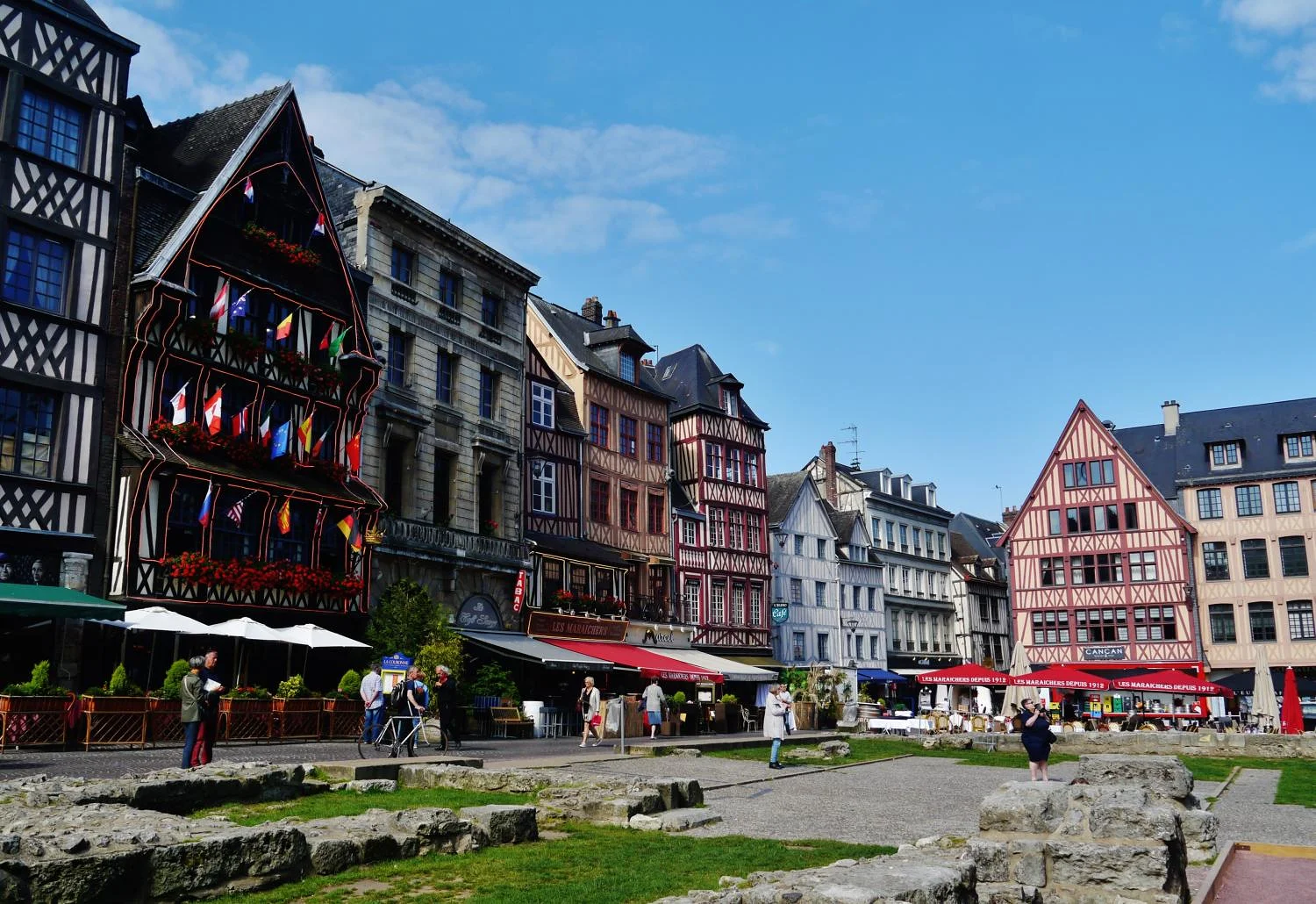
Place du Vieux-Marché in Rouen: Where the history of France turned a corner
On May 30, 1431, a nineteen-year-old woman climbed onto a wooden stake built in front of a massive crowd. That morning, right on this bustling market square in Rouen, Joan of Arc entered the history books. Today, the esplanade has kept its lively crossroads soul, where sidewalk café terraces, colorful produce stalls, and modern design sit side by side with medieval ruins.
Why visit Place du Vieux-Marché?
Few spots stack this many layers of history into a single public space. Back in the Middle Ages, this triangular square served as the butcher and fish market, as well as the site for public executions. The playwright Pierre Corneille was actually baptized in the Saint-Sauveur church that once stood here. Its foundations, uncovered during archaeological digs, are still visible on the south side of the current square.
The execution of the Maid of Orleans completely shifted the identity of this location. Twenty-five years later, in 1456, the nullification trial cleared her name right here in this neighborhood of Rouen. A towering cross marks the exact spot of the pyre, matching what the rehabilitation judgment called for.
The Saint Joan of Arc Church, a striking architectural stance
The building rises from the ground like a frozen wave. Designed by the architect Louis Arretche and opened on May 27, 1979, by President Valéry Giscard d'Estaing, this church has sparked debate ever since it was built. Its silhouette calls to mind an overturned Viking longship, a stylized fish, or the tongues of a burning fire. The slate and copper roof rolls across the square, stretching right into the covered market stalls.
The war-surviving stained glass
Step inside and let your eyes adjust to the dim light. The north wall then displays thirteen brilliantly colored Renaissance panels. These sixteenth-century stained glass windows came from the former Saint-Vincent church, which was destroyed by bombing runs in 1944. The historic preservation office had safely tucked them away starting in 1939. Three of them were crafted by the master glassmakers Le Prince de Beauvais. The light filtering through these centuries-old panels wraps the interior in a quiet, contemplative atmosphere.
Timber-framed houses and the La Couronne inn
The edges of the square hold onto half-timbered facades, with some dating back to the fifteenth century. Several were reassembled here after the war, rescued from flattened neighborhoods. These ochre, blue, and red buildings now house restaurants, shops, and cafés whose outdoor tables spill out onto the cobblestones the moment the weather warms up.
On the south corner, a jetted timber house catches your eye. La Couronne claims to be the oldest continuously running inn in France. Records show it has been in business since 1345, meaning this building was already standing when Joan of Arc crossed the square. Julia Child reportedly had a culinary awakening here that steered her toward French cooking. Duck pressed in the Rouen style remains the house specialty.
Friendly tip: The fruit, vegetable, and flower market runs Tuesday through Saturday from 7am to 7pm, and Sunday mornings until 1pm. On Saturdays, a flea market draws bargain hunters. Get there early to soak in the atmosphere without the crowds.
The statue and memorial
Facing the church and backed against a wall, the statue of Joan at the stake points straight toward the spot of her execution. Sculpted by Maxime Real del Sarte in 1927, it weighs over four tons. The young woman's serene expression contrasts sharply with the flames licking at her dress. Two replicas of this piece exist: one in Buenos Aires, the other in Montreal.
Beneath the extended overhang of the church roof, a memorial walkway displays the words spoken by André Malraux on May 31, 1964, during the Joan of Arc celebrations. Every year, on the last weekend of May, Rouen honors Joan of Arc with medieval shows, parades, and artisan markets.

As a tourist, you obviously come to visit the Place du Vieux-Marché because of the tragic end of Joan of Arc. A small memorial commemorates this event that had such a huge impact on the history of our country. Beyond that, the Place du Vieux-Marché is worth the trip for the old architecture of the houses lining it, and for its restaurants, among which you can find the oldest inn in Rouen. Personally, I do not recommend visiting the church that sits in the middle of the square. I did not really like the modern architecture of the place, as I find that it clashes with the overall atmosphere of the square.