
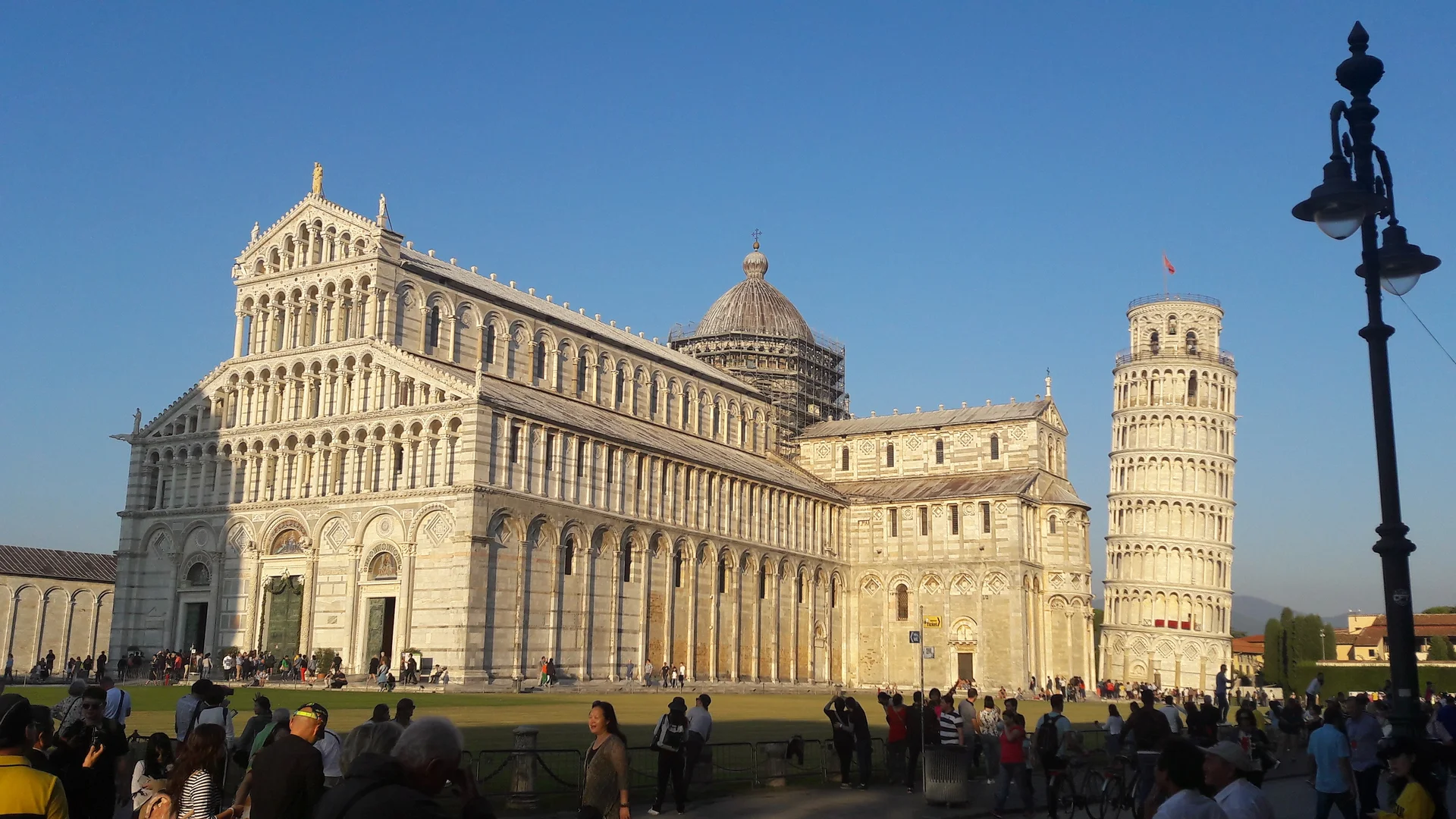
Leaning Tower of Pisa: 294 steps in a defiance of gravity
The steps are worn down, hollowed out by centuries of foot traffic. The higher you climb, the more the floor tilts under your feet. Your body hesitates, searching for balance, while daylight filters in through the openings of the loggia. Climbing the Leaning Tower of Pisa is not just a walk up a tower. It is a disorienting physical experience where gravity seems to follow its own rules.
Why visit the Leaning Tower of Pisa?
This bell tower was never meant to be famous. Construction began on August 9, 1173, to accompany the Cathedral of Santa Maria Assunta, and it was intended simply to house bells. By the third level, however, the clay soil gave way. Work lasted for nearly two centuries, until 1372. Successive architects tried to compensate for the lean by curving the upper levels in the opposite direction. This is what gives the tower its slightly bowed silhouette, visible when you look at it closely.
Today, the tilt is approximately 3.97 degrees. Stabilization work completed in 2001 reduced the lean by 45 centimeters. According to experts, the tower should remain stable for at least three centuries.
What to expect during the climb
The visit lasts 30 minutes, sharp. A guard welcomes each group with a brief historical overview, and then you begin the ascent via a white marble spiral staircase, wound between two concentric cylinders. The sense of imbalance is real. You are pushed toward the inner wall one moment, then drawn toward the open air the next. The polished marble is slippery in spots.
At the top: the view and the bells
Once at the top, the panorama encompasses the entire Piazza dei Miracoli below, the rooftops of Pisa, and, on clear days, the Tuscan hills in the distance. You are also at the level of the cella campanaria (bell chamber) and its seven bells, each tuned to a different note of the scale. The heaviest, the Assunta, weighs three and a half tons. Plan for about ten minutes to soak in the view before heading back down.
The architecture in detail
From a distance, the tower looks simple. Up close, the finesse of the craftsmanship is obvious. Six levels of colonnaded loggias surround the central cylinder, featuring 207 capitals carved from Carrara marble. The Pisan Romanesque style is the same one that defines the neighboring cathedral and baptistery.
Standing 58.36 meters tall and weighing 14,453 tons, it is also the site where, according to legend, Galileo conducted his experiments on the falling of bodies. The story is likely apocryphal, but it has certainly contributed to the tower's mythic status.
Pro tip: Book your time slot online via the Opera della Primaziale Pisana (the organization managing the cathedral complex), ideally several days in advance during the high season. The number of visitors is strictly limited in 15 minute windows. Bags and luggage must be left at the free coat check before the climb. For a quieter experience, choose a slot before 10 a.m. or after 5 p.m.
Opening hours
*Information subject to change

The Leaning Tower of Pisa is impressive, even without going inside.
From the outside, you really wonder how it is still standing.
The site is very photogenic, even if there are almost always a lot of people around.
It is worth seeing if you are in the area, but it is not necessarily a must-see on its own.
I much prefer an extended visit to Florence, which is full of charm and cultural riches.