
The National Museum of Cambodia: Where Khmer Stone Comes Alive
A 7th-century lintel. A Buddha head with a gaze locked onto yours for fourteen centuries. And tucked away in a side room, a doorjamb inscription holding the earliest known graphic representation of zero in human history. The National Museum of Cambodia is the kind of place that catches you off guard because it completely shatters your expectations.
Why visit the National Museum of Cambodia?
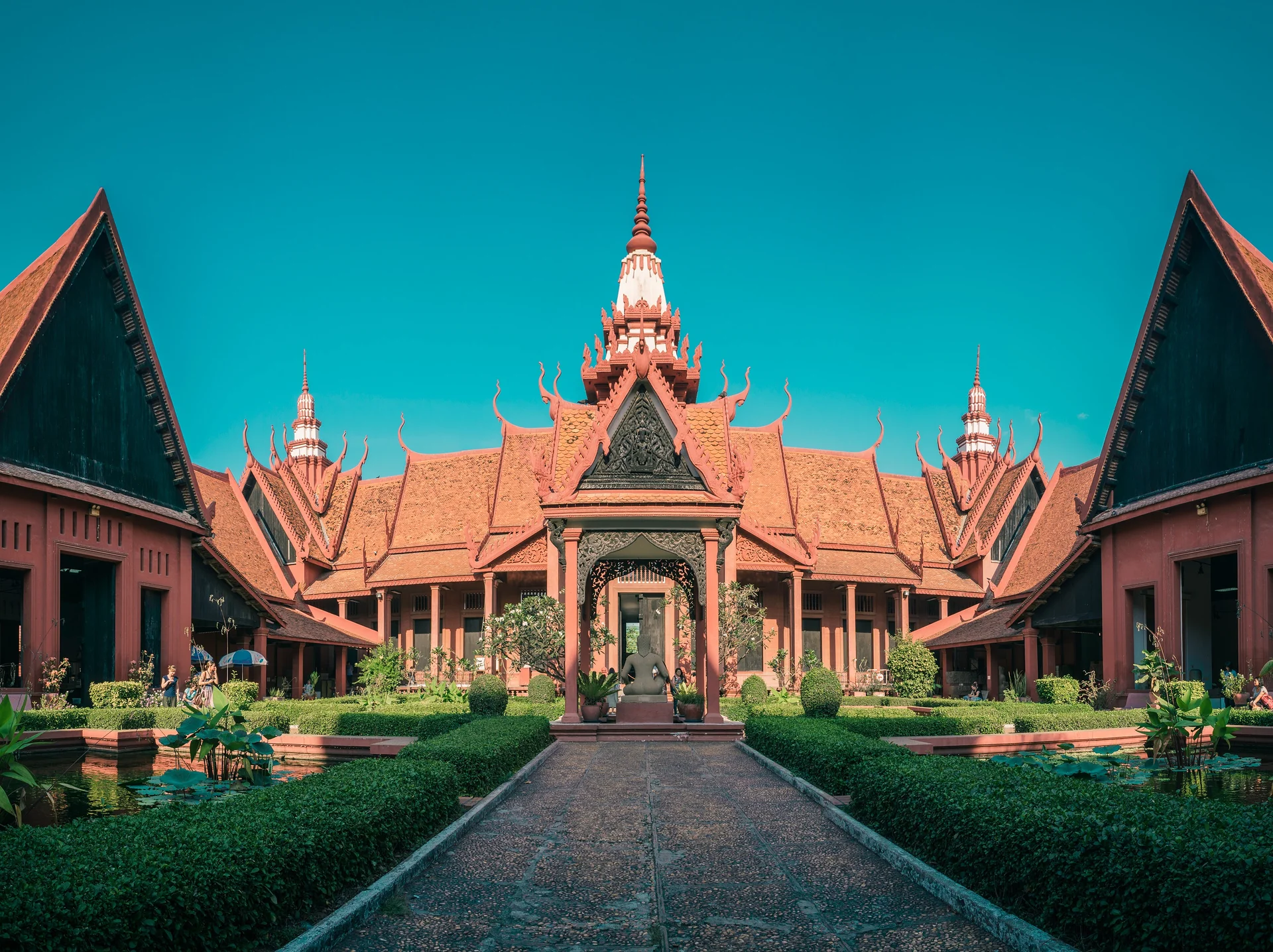
Opened on April 13, 1920, during Khmer New Year in the presence of King Sisowath, this terracotta-colored building was designed by George Groslier, a French archaeologist, painter, and ethnologist, drawing directly from the bas-reliefs of Khmer temples. The building itself is a masterpiece: stepped roofs, columned windows, and carved facades mimic Angkorian prototypes scaled down to museum proportions.
This is not colonial imitation. It is an architectural meditation on what a royal temple adapted for civil use would actually look like.
Housing over 14,000 pieces spanning from prehistory to the 19th century, with around 2,000 on public display, the museum holds the world's largest collection of Khmer sculpture. Neither Angkor nor any other regional museum brings together this many masterpieces under one roof.
Masterpieces you cannot miss
Four galleries wrap around a central courtyard crisscrossed by ponds filled with floating lotus flowers. Light filters in from the inner yards, casting soft shadows over the sandstone and bronze figures. It is quiet here, barely interrupted by the rustle of fellow visitors.
Things to look for:
- The Leper King (actually Yama, the god of death): a copy of the original statue from Angkor Thom, surrounded by his attendants with an almost overwhelming presence.
- The sculpture of Jayavarman VII from Kraol Romeas: the most widely reproduced face in Khmer art, featuring the characteristic inward smile of the Bayon style from the late 12th century.
- The eight-armed Vishnu (1.93 m) and Shiva holding Uma on his lap, a prime example of the 10th-century Banteay Srei style, widely considered the peak of Khmer sculpture.
- The Harihara repatriated by the Guimet Museum of Paris in 2025: a dual-sided head, half Shiva and half Vishnu, discovered in 1882 by the Aymonier mission.
A building that almost vanished
The Khmer Rouge years
Between 1975 and 1979, Phnom Penh was emptied of its residents. The museum was abandoned, its roof partially collapsed, a colony of thousands of bats moved in, and the gardens grew wild. When an inventory was finally taken in 1980, entire collections were gone. What you see today is what survived, which makes every displayed artifact that much more precious.
Renaissance and ongoing updates
The museum underwent major restoration work in the 1990s, followed by a 2013 renovation that added modern lighting and security systems. Since 2024, a vast rehabilitation and expansion project has been underway, led by the Cambodian Ministry of Culture with support from Expertise France and scientific guidance from the Guimet Museum. The goal is to modernize the infrastructure, enrich the visitor path, and improve cultural interpretation. In 2024, the museum welcomed nearly 290,000 visitors.
Friendly tip: Photography is strictly prohibited inside the galleries, though it is allowed in the patio and outside. Dress in clothes that cover your shoulders and knees, or you will be turned away at the door. French-speaking guides are available on-site, which completely transforms the visit since the written captions are sparse and much of the historical context is only shared orally.
Why the visit is worth it
- The largest and finest collection of Khmer sculpture on Earth, all in one spot.
- A striking traditional Khmer architectural building listed as a historic monument.
- Pieces recently repatriated from abroad (France, United States) regularly enrich the galleries.
- A peaceful central patio, ideal for a quiet break right in the heart of Phnom Penh.
Good to know before you go
- No air conditioning in the galleries, making mid-day visits exhausting during the hot season.
- Written guidance is limited, so without a guide or guidebook, some rooms lack context.
- Admission must be paid in cash only (USD or KHR), so check your change at the ticket counter.
- Ongoing restoration work means certain areas may occasionally be off-limits.
Admission ticket rates
| Visitor category | Rate |
|---|---|
| Foreign adult | 10 USD |
| Foreign child | 5 USD |
| Cambodian nationals | Reduced rate |
| Cambodian school groups | Free |
Prices are indicative and subject to change
Opening hours
| Monday | 08:00-17:00 |
|---|---|
| Tuesday | 08:00-17:00 |
| Wednesday | 08:00-17:00 |
| Thursday | 08:00-17:00 |
| Friday | 08:00-17:00 |
| Saturday | 08:00-17:00 |
| Sunday | 08:00-17:00 |
Last admission is at 4:30 PM.
How long for this activity
*Information subject to change

If you want to learn as much as possible about Cambodian culture, art, and history, this is the museum you need to visit. Plan on at least 2 hours.