
Visiting the Pretoria Fountain
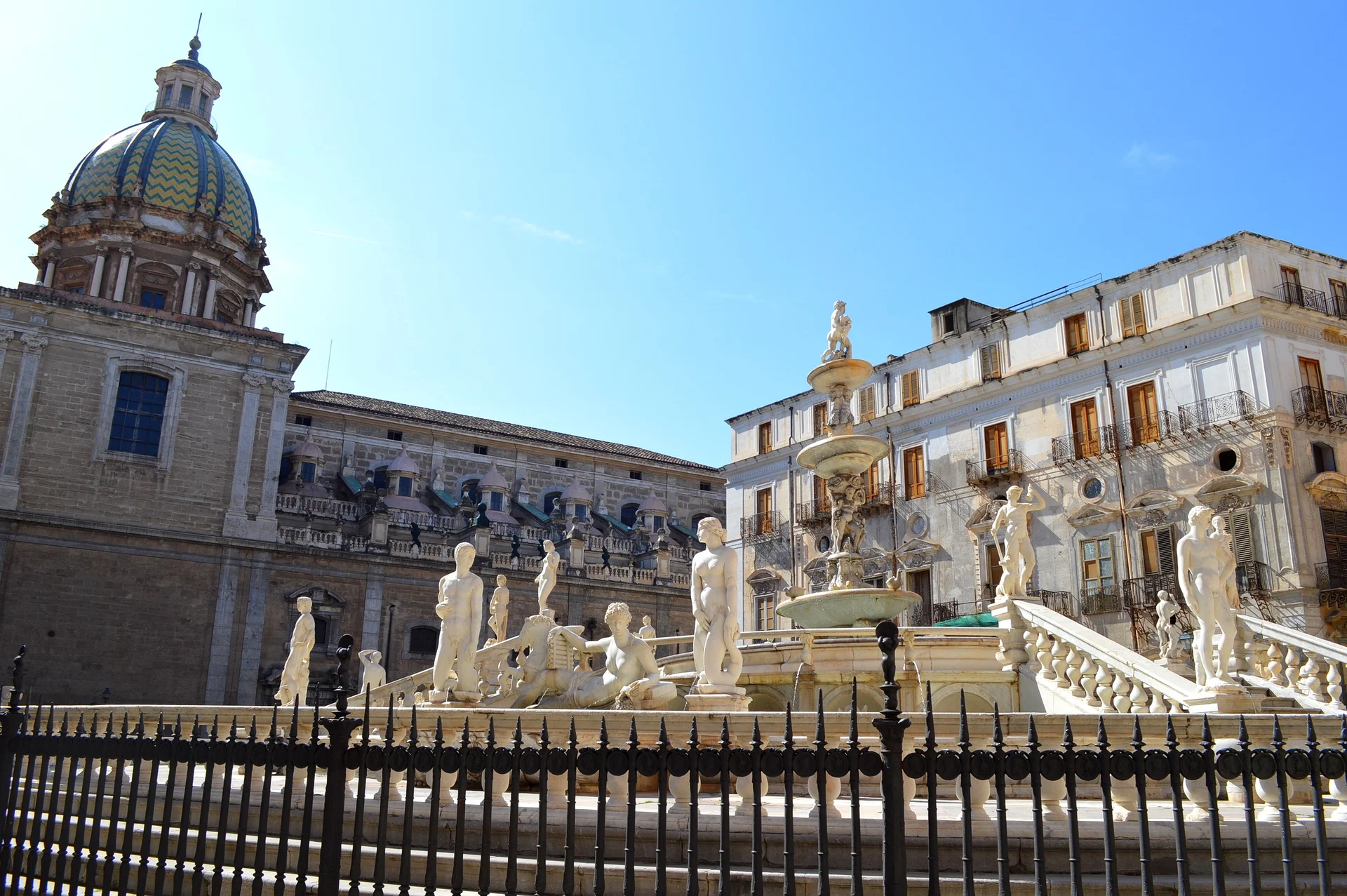
Piazza Pretoria is a legendary square in the historic center of Palermo, and it does not lack for prestigious architecture. Yet, despite the grand palaces, the Palazzo Pretorio (the city hall), or the Santa Caterina church, your eyes will inevitably be drawn to one thing: the Pretoria Fountain dominates the entire space. As a monumental tribute to the twelve Olympian deities and the city four rivers, it sits at the heart of these remarkable buildings with a grace that its sculptures command.
A monumental work with a scandalous past
While the fountain looks like it was made for this square, Piazza Pretoria is not its original home. Sculpted by Francesco Camilliani for Don Luigi Toledo in 1554, it once graced a private garden in Florence. Riddled with debt, Toledo had to sell it to the municipality of Palermo in 1574, setting off a massive logistical operation that required dismantling the structure into 644 pieces. Some of the 48 original statues suffered during the journey, and others took indirect routes. The difficult reassembly was finished in 1581, but while the monument was beautiful, it did not suit everyone. Some saw it as a symbol of municipal corruption, and the area was quickly dubbed Piazza della Vergogna, or Square of Shame. The nudity of the statues likely contributed to this nickname, and a few figures were even vandalized in areas deemed indecent. The gods of Olympus are still represented magnificently, surrounding four bridges with steps that lead to the central basin, forming an impressive masterpiece. Three tiers of basins rise in the center. While he is more often associated with wine than water, Bacchus sits at the top of the ensemble, which also serves as a tribute to the city rivers: Oreto, Papireto, Mareldolce, and Gabriele. A gate now surrounds the fountain to protect it. Radiant by day and night thanks to careful lighting, the Pretoria Fountain remains a remarkable sight.

A must-see little stop, right next to the Chiesa della Martorana. The fountain is very beautiful, and so are the buildings surrounding it, which makes for some pretty photos. Especially since you can only walk around the fountain, which is a shame for the visit itself, but better for avoiding photos crowded with tourists!