
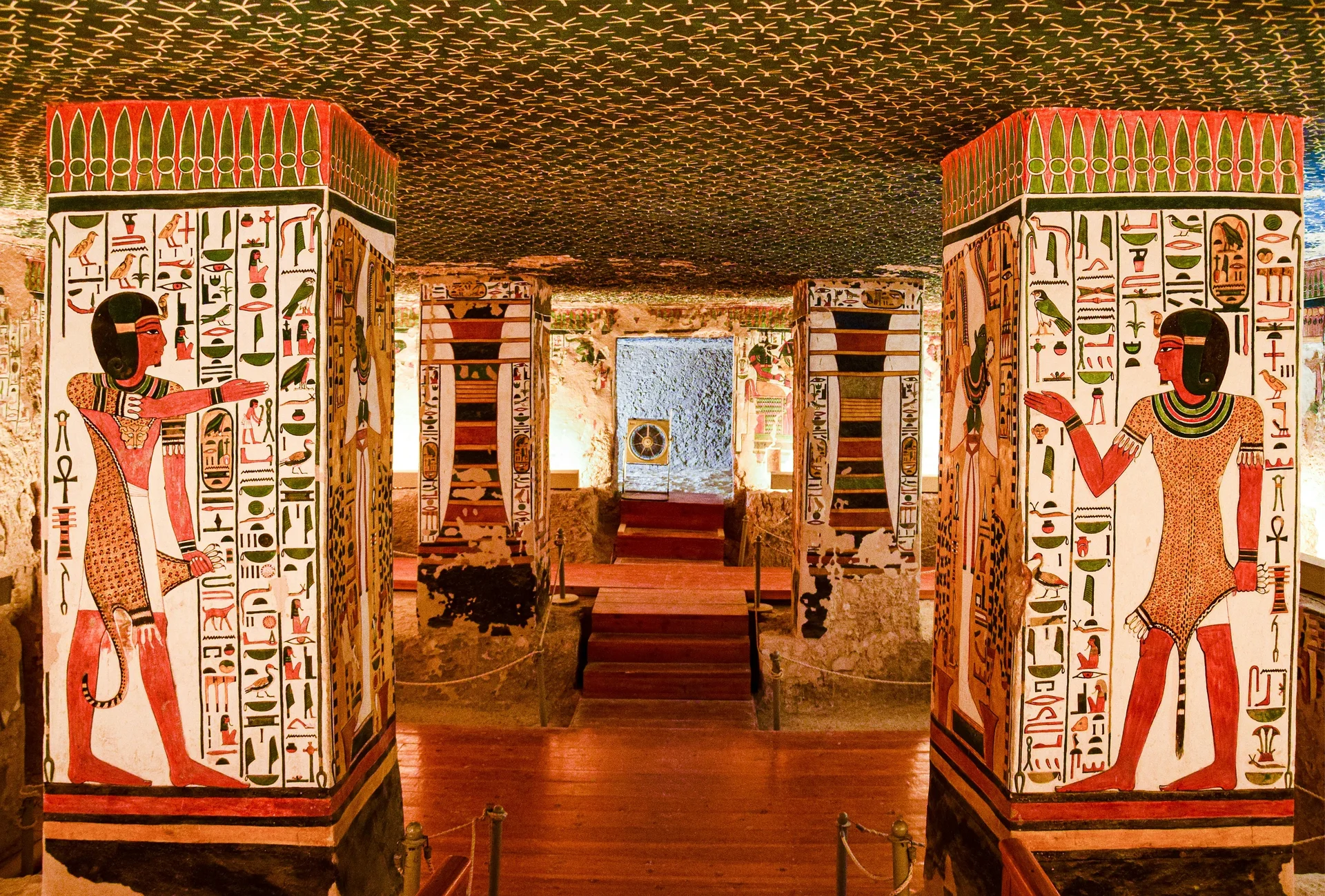
Inside the Theban Mountains, the Eternity of the Pharaohs
The heat hits like a brick wall the moment you step off the little electric tram. The silence of the desert envelops this ochre valley where 63 doorways pierce the limestone rock. For nearly five centuries, from the 16th to the 11th century BCE, the pharaohs of the New Kingdom carved their passages to the afterlife right here. Far from the ostentatious pyramids, they were searching for privacy.
The Valley of the Kings is not just a royal cemetery, it is a gallery of millennia-old frescoes where the pigments defy time.
Why step down into these ancient tombs?
Because nowhere else on earth looks like this. Hieroglyphs run along the walls like frozen musical scores. The ceilings recount the nightly journey of the sun through the twelve hours of darkness. Each tomb is an open book on Egyptian cosmogony, carved and painted with astonishing precision. The colors, lapis lazuli blue, red ochre, and golden yellow, have survived three and a half millennia almost intact.
This site, designated a UNESCO World Heritage Site since 1979, preserves the resting places of titans: Ramesses II, Seti I, Thutmose III, and the most famous of all, the young Tutankhamun. The discovery of his intact tomb by Howard Carter in 1922 shook global archaeology. Teams are still excavating the valley today. The tomb of Ramesses VIII is probably resting somewhere beneath your feet.
The must-see tombs included in the standard ticket
Your entry ticket gives you access to three tombs of your choice out of roughly ten open ones. Choose carefully, because they are not all created equal:
- The tomb of Ramesses IV is a favorite for its easy access, featuring no steep stairs, just a long gently sloping corridor and a beautifully preserved astronomical ceiling where the goddess Nut swallows the sun every evening and gives birth to it again at dawn.
- The tomb of Ramesses IX explodes with color. The blue and red pigments shine as if they were just applied. The eighteen-year reign of this pharaoh allowed for the creation of a vibrant burial site, even though his premature death left the deepest sections unfinished.
- The tomb of Merneptah, son of the great Ramesses II, impresses with its sheer size, ranking as the second largest in the valley. The descent is steep, but the final burial chamber with its four nested sarcophags makes the effort worthwhile.
Friendly tip: Skip Ramesses III during peak season, as it draws every tour group on site. Opt instead for the double tomb of Tausert and Setnakht, which remains remarkably quiet despite its impressive scale. This queen pharaoh originally prepared the sepulcher for herself, but Setnakht later usurped and expanded it. The result is a labyrinth of corridors and pillared halls where you can catch your breath far from the crowds.
The premium tombs that justify the extra cost
Ramesses V and VI: an absolute favorite
For just 180 EGP extra, the double tomb of Ramesses V and Ramesses VI stands out as the best value in the valley. The ceiling of the burial chamber depicts the goddess Nut along its entire length, her star-studded body swallowing and birthing the sun in an eternal cycle. The relief carvings display mind-blowing finesse and vibrant colors. This single tomb alone makes the entire trip worthwhile.
Seti I: the unmatched masterpiece
At 1,400 EGP, the tomb of Seti I is a significant investment. Yet it is also the longest at 137 meters, the deepest, and the most richly decorated across the entire necropolis. The fifteen-year reign of this visionary builder enabled the creation of an extraordinary underground monument. The colors retain a stunning freshness. You will often have the place to yourselves, as most visitors balk at the price.
Tutankhamun: the miniature icon
The world's most famous tomb is also the smallest in the valley. Featuring an awkward staircase, an antechamber, and a burial chamber, Tutankhamun reigned for just ten years, and his tomb was prepared in haste. Still, you get to see his mummy behind a glass case and the golden frescoes adorning the walls. All the treasures discovered by Carter now reside in the Cairo Museum, but the emotion of standing in this legendary space justifies the 500 EGP surcharge.
Tips for a successful visit
Arrive right when the gates open at 6 am. The low morning light on the cliffs is magical, the temperature is manageable, and you will have the tombs to yourself for an hour or two. The staircases leading down into the mountain depths are steep, narrow, and occasionally slick. Pack sturdy closed-toe shoes. The humidity and heat inside the tombs can feel oppressive, particularly when crowds bunch up.
Bring at least two liters of water per person, a hat, and sunscreen. Shade is virtually nonexistent across the valley. Smartphone photography is now permitted free of charge inside all tombs. If you want to shoot with a DSLR camera, a pass costs 300 EGP for three tombs. Guides are not permitted to accompany you inside the tombs for preservation reasons, so they will brief you outside the entrance.
Plan for two to three hours for a complete visit covering three to four tombs. In the dead of summer, the site closes at 5 pm and temperatures routinely exceed 45 degrees. The months from November through March deliver the ideal conditions.
Opening hours
*Information subject to change