
Where to stay in Zaragoza: the 4 neighborhoods to know in 2026
Photo : Petite-Terre
Between Madrid and Barcelona, the high-speed train takes an hour and a quarter one way, an hour and a half the other, and Zaragoza sits in the middle. That is its place, and also its luck: most travellers pass through without stopping, so Spain's fourth city keeps a historic centre that belongs to its own residents. Two thousand years fit into eight hundred metres: a Roman forum under the square, an eleventh-century Muslim palace, a Mudéjar cathedral, and the four-towered basilica you can see from the far bank of the Ebro.
Sleeping here costs little for what you get: $57* at entry level, $85* for a well-rated hotel two steps from the basilica, and a four-star asks $124*. Four neighbourhoods follow. The first holds almost everything, so the other three get chosen on a different criterion: a stadium, a station, or the price.
Even though it is not very well known, the city of Zaragoza has many places of interest, whether it be monuments, churches, or even museums.
Compare hotel prices in Zaragoza
In a hurry? Find the best accommodation deals in 3 clicks.
Compare live deals from Booking, Expedia, Agoda and other partners.
At a glance: our picks by traveller type
Pick the profile that suits you to head straight to the recommended neighborhood.
The neighborhood map in Zaragoza
Get your bearings on the neighborhoods and must-see sights before choosing where to drop your bags. Click a name to jump to its description.
The Casco Histórico: El Pilar, La Seo and the Roman city The basilica of Our Lady of the Pillar and its four towers, the cathedral of San Salvador and its Mudéjar wall, the Plaza del Pilar and the Plaza de España, the Caesaraugusta forum museum under the square, the Roman theatre and the river port museum, the Roman walls and the Zuda tower, the Zaragoza museum and the Pablo Gargallo museum, the Camón Aznar museum, the church of Santa María Magdalena, the Goya statue
to see everything on foot, for the tapas, for a first visit
Eight hundred metres are enough, and they carry two thousand years. The basilica of the Pillar closes off the largest pedestrian square in Spain with its four towers and a dome painted by Goya; a hundred metres away, La Seo lines up Romanesque, Gothic, Baroque and a Mudéjar wall on the World Heritage list. Under the square, the museum of the Caesaraugusta forum shows Augustus's city, and two more Roman museums complete the circuit five minutes away. In the evening, everything happens in the lanes of El Tubo, where the tapas bars touch each other.
The historic center is particularly well preserved and very pleasant for walking around.
Where to stay in this neighborhood
Catalonia El Pilar Mid-range
The best score in this guide: 9.0 from over three thousand six hundred reviews, with 9.7 for location, 9.3 for cleanliness and the same for comfort, 9.0 for facilities and 8.8 for value for money. A building on Calle Manifestación, two streets from the basilica and in the middle of the tapas bars. Budget $124*.
Hotel Inca Boutique Budget
The largest review count in this guide: 8.6 from over four thousand six hundred, with 9.7 for location, 9.2 for cleanliness, 9.1 for comfort, 9.0 for staff and 8.9 for value for money, which is rare at this price. A hundred metres from the Plaza del Pilar, around $85*.
Pros
- The basilica, the cathedral and three Roman museums on foot
- The tapas bars of El Tubo at the hotel door
Cons
- Noisy at weekend nights
- Full and twice the price in the week of 12 October
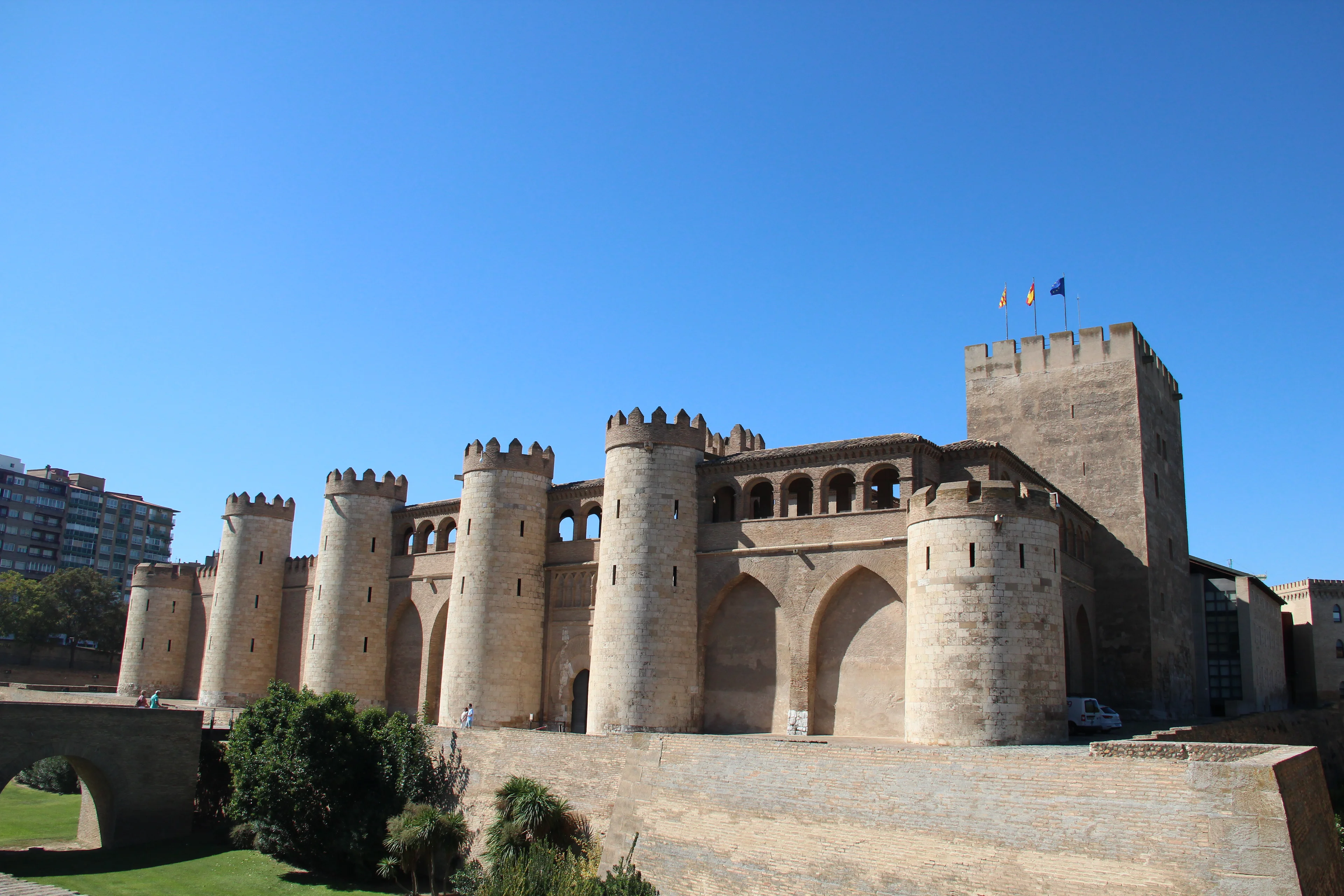
The Aljafería, Delicias and the station The Aljafería palace, an eleventh-century taifa palace now the seat of the Aragonese parliament, the monument to Agustina de Aragón, the Delicias high-speed station, the Valdespartera exhibition grounds to the west
for the trains, for the palace, for city prices
The Aljafería palace is the piece nobody expects: a pleasure palace built in the eleventh century by the Muslim kings of the taifa of Zaragoza, enlarged by the Catholic monarchs, turned into barracks, and today the seat of the parliament of Aragon. Its interlacing arches and orange-tree courtyard are on the World Heritage list, and admission costs a few euros. Around it, the Delicias district is the one with the high-speed station: ordinary streets, neighbourhood bars, and the lowest rates in the wider centre.
Where to stay in this neighborhood
Hotel Delicias Budget
7.7 from over three thousand reviews, with 8.9 for staff, 8.3 for cleanliness, 8.1 for comfort and 8.0 for value for money. Its two weak figures say what it is: facilities 7.7 and wifi 7.4, for a simple hotel on a quiet street, ten minutes on foot from the station. Around $57*.
Pros
- Ten minutes on foot from the high-speed station
- The Mudéjar palace and neighbourhood prices
Cons
- Fifteen minutes' walk to the basilica
- A district with no charm, outside the palace
Universidad, La Romareda and the south The historic campus of the University of Zaragoza, the La Romareda stadium, the Neptune fountain, the Primo de Rivera park and its avenues, the Príncipe Felipe arena, the city's amusement park
for a match, for the terraces along the paseo, for a week in town
South of the centre, Zaragoza becomes the city people live in: the big Primo de Rivera park and its avenues of plane trees, the historic campus of the university, the terraces along the paseo, and two venues that fill up on event nights, the La Romareda stadium and the Príncipe Felipe arena. It is also the district that matters in 2027: the city will be European Capital of Sport, and most of the facilities are here.
It is a city full of charm, lively and bustling.
Where to stay in this neighborhood
Ilunion Romareda Mid-range
8.7 from over four thousand two hundred reviews, with 9.3 for staff, 9.0 for cleanliness, 8.9 for comfort, 8.7 for location and the same for facilities and 8.5 for value for money: a rare evenness. The hotel is right beside the stadium and the conference centre, with the park opposite. Budget $96*.
Pros
- The big park and the terraces with no tourists
- The stadium and the sports arena on foot
Cons
- Twenty minutes' walk or ten by tram to the Pillar
- Full on match and concert nights
The Actur, the left bank and the north The Goya park, the left-bank exhibition centre, the Luis Buñuel water park, the Aula Dei charterhouse eighteen kilometres to the north
for a conference, for a water park with children, for the quiet
The left bank of the Ebro was rebuilt for the 2008 international exhibition, and it keeps the large facilities from it: the exhibition centre, the bridges designed for the occasion and tree-lined avenues. The Actur is a 1980s housing district, quiet and well served by the tram, where people come for a trade fair or for the water park. Further north, the Aula Dei charterhouse holds paintings by Goya, but it is eighteen kilometres away and can only be visited by appointment: check before taking the road.
Pros
- The tram links the left bank to the centre in a quarter of an hour
- The water park and the big parks for families
Cons
- No address worth naming: this guide names none
- Nothing old, and few restaurants in the evening
Our tips for booking the right place
- A stop, not a detour: Madrid and Barcelona are ninety minutes away: This is the argument that decides it, and it is a timetable: the high-speed train links Zaragoza to Madrid in an hour and a quarter and to Barcelona in an hour and a half, from Delicias station. Two nights here therefore slot in with no detour between the two big cities, for the price of one night in either. And the station is a ten-minute walk from the Aljafería, which lets you arrive, drop your bag and visit a Mudéjar palace before lunch.
- The week of 12 October: the city doubles in size: The Pilar festivities run for a whole week around 12 October, and they are the biggest festival in Aragon: the floral offering to the Virgin covers the square with a pyramid of bouquets, the brass bands play until morning, and every room in the city is taken months ahead, at double the rate. Two possible readings: come on purpose, booking in June, or avoid that week and enjoy a city that goes quiet again on 20 October.
- Two thousand years underfoot, and four museums to see them: Zaragoza was called Caesaraugusta, founded by Augustus for his veterans, and the Roman city is still there, below street level. Four museums tell it, three of them five minutes apart: the forum under the Plaza del Pilar, the river port behind La Seo, the theatre with its tiers cleared in the middle of town. The fourth, the public baths, is two streets from the theatre and does not yet appear in our lists: it completes the joint ticket for all four.
- In 2027 the city will be European Capital of Sport: The designation is official, and it changes two things for a traveller. First the calendar: 2027 will bring competitions one after another, so fully booked weekends, and it will pay to check the programme before picking dates. Then the facilities: the city is investing in its venues, mostly around the La Romareda stadium and the Príncipe Felipe arena, in the south. Outside events, it changes nothing in the Casco Histórico.
- Booking on the left bank expecting to walk to the Pillar: it is a quarter of an hour by tram, and this guide names no address there.
- Coming in the week of 12 October without booking months ahead: the Pilar festivities fill the whole city and double the rates.
- Driving to the Aula Dei charterhouse without checking: it is eighteen kilometres north and can only be visited by appointment.
- Allowing an hour for the Bardenas Reales: it is a hundred and thirty kilometres, an hour and a half of driving, and the desert takes half a day.
FAQ: where to stay in Zaragoza
Which neighbourhood should you stay in in Zaragoza?
How much does a night in Zaragoza cost?
How many days do you need in Zaragoza?
Is Zaragoza worth a stop between Madrid and Barcelona?
When is the best time to come?
What can you see in Zaragoza in one day?
 Keep exploring
Things to do in Zaragoza
Keep exploring
Things to do in Zaragoza
Comments (0)
No comments yet. Be the first!