

Where to stay in Düsseldorf: the 5 neighborhoods to know in 2026
A member summed Düsseldorf up in one line, and this guide does not disagree: a pleasant centre, but not enough to fill a week. So the city is seen in two days, and the whole programme fits into two kilometres of riverbank, between the old town and the converted docks. The rest is a regional capital at work.
What does move a hotel rate here is not the neighbourhood but the calendar. Düsseldorf lives off its trade fairs, and one week of Messe tears up every price list. Outside fair weeks, reckon on $51* for the first room, $91* for the chain by the station, $220* for the five star in the docks. The five neighbourhoods below start at the old town and move away from the Rhine.
Behind the modern buildings of this city, there is an old center that is much warmer, right on the banks of the Rhine, with plenty of little restaurants and beer bars.
Compare hotel prices in Düsseldorf
In a hurry? Find the best accommodation deals in 3 clicks.
Compare live deals from Booking, Expedia, Agoda and other partners.
At a glance: our picks by traveller type
Pick the profile that suits you to head straight to the recommended neighborhood.
The neighborhood map in Düsseldorf
Get your bearings on the neighborhoods and must-see sights before choosing where to drop your bags. Click a name to jump to its description.
From the Altstadt to the station, along the Königsallee The town hall and the market square, the tower of the old castle and St Lambertus with its twisted spire, the Rhine promenade and the covered market on Carlsplatz, four museums in the same block (film, ceramics, city history, the Heinrich Heine Institute), the run of major collections to the north with the North Rhine-Westphalia art museum, the Kunstpalast, the Kunsthalle and the academy of fine arts, the opera house and the Tonhalle, the Hofgarten with the Goethe museum at its far end, the Schauspielhaus, the Kom(m)ödchen cabaret, the theatre an der Kö and the Stilwerk on the Königsallee side
for the brewhouses, for two days without transport, for the river
This is the guide's neighbourhood, and nearly everything is in it. The Altstadt measures five hundred metres across and packs in a density of brewhouses the city lays claim to: you drink the brown Altbier standing at the counter, served in twenty-centilitre glasses the waiter replaces without being asked. Around it, everything is on foot: the Rhine promenade terraced above the river, the covered market on Carlsplatz, and to the north the run of museums as far as the Kunstpalast. Eastwards, the Königsallee lines a planted canal and reaches the station in a quarter of an hour.
Between the pints of blonde beer and the huge sausage sandwiches, plan on a little diet for when you get back ;) The center is nice, but there is not enough to keep you amazed for a whole week. A weekend is enough
Where to stay in this neighborhood
Motel One Düsseldorf Hauptbahnhof Mid-range
8.4 from more than three thousand five hundred reviews, of which 9.1 for location, 8.8 for cleanliness, 8.6 for comfort, 8.5 for value for money and 8.3 for facilities. It stands on Immermannstraße, so two minutes from the station and fifteen minutes' walk from the Altstadt: this is the compromise the guide keeps, because its score does not shift from one page to the next. Around $91*.
Pros
- The museums, the brewhouses and the river without ever taking a tram
- The station at the end of the Königsallee, fifteen minutes on foot
Cons
- Altstadt nights carry up to the upper floors, Thursday to Saturday above all
- Rates start higher here than anywhere else, fair week or not
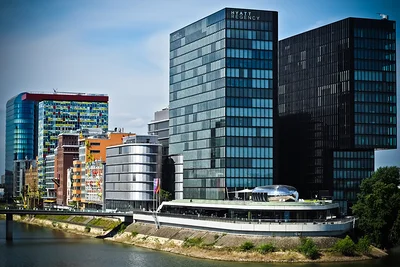
The MedienHafen and the Rhine tower Gehry's three leaning buildings and the Neuer Zollhof, the television tower with its clock of lit portholes, the North Rhine-Westphalia parliament and the city gate at its foot, the harbour basin and its bridge, the K21 space in the former chamber of estates, the Kunst im Tunnel below the promenade, the Forum Freies theatre
for the architecture, for dinner, for a quiet night
Two kilometres south of the old town, the commercial harbour has become a district of agencies and restaurants, and it is the only architecture Düsseldorf exports. Gehry's three buildings stand askew at the edge of the basin, one white, one brick, one clad in stainless steel, and they photograph from the far quay. Beside them, the Rhine tower carries a clock halfway up made of lit portholes, and its revolving restaurant gives you the city plan in an hour. At night the district empties: almost nobody lives in it.
Where to stay in this neighborhood
Hyatt Regency Düsseldorf Luxury
8.6 from more than three thousand one hundred reviews, with 9.2 for comfort, 9.1 for cleanliness and location, 9.0 for facilities and 8.9 for staff, but 7.8 for value for money, its only score under 8. It sits on the point of the basin, on Speditionstraße, with the river on two sides. Around $220*.
Pros
- The architecture and the restaurants around the same basin
- Silent after midnight, unlike the Altstadt
Cons
- Nothing open in the morning: the district works and dines, it does not do breakfast
- Twenty minutes on foot from the Altstadt, or one tram
The north: the Messe, the arena and Kaiserswerth The exhibition grounds and their congress centre, the city's covered arena, the ISS Dome sports hall further east, the ruins of the imperial palace at Kaiserswerth on the riverbank, Kalkum castle in its park
for a trade fair, for a match, for the ruins on the bank
Six kilometres north, the city changes trade: here stand the exhibition grounds, the congress centre and the arena, and it is this triangle that fills Düsseldorf's hotels several times a year. Two reasons nonetheless to come without a badge: the ruins of the imperial palace at Kaiserswerth, a gutted basalt wall set on the edge of the Rhine, and the village around them, with its low houses and its ferry. The S-Bahn takes twenty minutes from the station, and the area keeps itself apart from everything else.
Where to stay in this neighborhood
Schnellenburg Mid-range
8.3 from more than six hundred reviews, and 9.4 for location, which nothing else in this guide reaches: it stands on the bank itself, on Rotterdamer Straße, and several reviews say you could fish from the window. The rest follows: cleanliness 8.7, comfort 8.5, facilities 8.2, value for money 8.1. Two kilometres from the exhibition grounds. Around $124*.
Pros
- The exhibition grounds and the arena on foot, on the days that matters
- Kaiserswerth and its riverbank, away from the city
Cons
- A fair week multiplies the rates and empties the availability
- Twenty minutes by S-Bahn to the Altstadt, and nothing to do here in the evening
Oberkassel and the left bank The Heerdt leisure park, and above all the bank opposite: it is from this side of the river that you see the whole Altstadt, twisted spire included
for the view from across, for the quiet, for a family stay
The left bank has almost nothing to visit, and that is its whole argument. Oberkassel is a district of turn-of-the-century blocks, plane trees and corner shops, and its riverbank faces the old town: this is where you photograph it, and where people walk on Sundays. The Oberkassel bridge is ten minutes across on foot, four by tram, and in the evening you come home from a noisy district to one that sleeps. This guide keeps nothing to see here, and one address to sleep in.
Where to stay in this neighborhood
Me and All Hotel Düsseldorf Oberkassel Mid-range
8.3 from more than two thousand four hundred reviews, with 8.8 for cleanliness and comfort, 8.7 for staff and location, 8.5 for facilities and 8.1 for value for money. It is on Hansaallee, five minutes from the bridge, and not one of its six scores drops below 8. Around $141*.
Pros
- The whole Altstadt from the bank, and ten minutes of bridge to reach it
- Streets that sleep, a tram ride from the centre
Cons
- Almost nothing to visit: a single entry in this survey
- You have to cross the river to dine anywhere but a neighbourhood restaurant
Beyond the ring: Bilk, Benrath and Grafenberg Benrath palace and its park at the far south, the Classic Remise and its collector cars in a former depot, the university and Mickeln castle beside the Rhine bends nature reserve, the Grafenberg wildlife park to the east, the Mitsubishi Electric hall, the Capitol Theater, and three neighbourhood leisure parks
for the pink palace, for the cars, for a long stay
Everything that needs a tram or an S-Bahn belongs to this chapter, and two things justify it. To the south, Benrath palace is an eighteenth-century pink palace set in a formal park, and it takes half a day including the train back. Halfway there, the Classic Remise occupies a former locomotive depot: collector cars behind glass, and a public that is not the museum public. Around them, the university, the Rhine bends and the Grafenberg wildlife park belong to the people who live here.
A unique feature of this museum is that the cars are available for sale. But hey, that is not for everyone's budget.
Pros
- Benrath palace and its park, with the train stopping outside
- Neighbourhood prices, far from the centre's lists
Cons
- Not one address kept here: this guide names none
- Everything is done by transport, and the last S-Bahn matters
Our tips for booking the right place
- Check the trade fair calendar before you look at neighbourhoods: It is the first move, and it comes before everything else. Düsseldorf holds several of Europe's largest trade fairs, and a week of Messe is like no other week: the centre's availability goes first, the north's next, and the price lists bear no relation to this guide's. The most telling measurement is the one from the hotel built into the arena: 9.3 for location, 6.6 for value for money, a gap of 2.7 points. You pay for the address, and the guests say so.
- Altbier comes in twenty-centilitre glasses, and you do not order: The local beer is brown, it is called Altbier, and it is served in small cylindrical glasses the waiter replaces as soon as they are empty, without being asked. He chalks the rounds on your beer mat, and you stop him with a gesture when you have had enough. The Altstadt brewhouses that brew on the premises can be counted on one hand, and they serve standing at the counter: that is where the city shows itself best, and it costs next to nothing.
- The left bank, for the one thing the old town cannot offer: From inside the Altstadt, you cannot see it. You have to cross to the other bank, to Oberkassel, to get the whole line: St Lambertus's twisted spire, the castle tower, the promenade and the plane trees. The bridge is ten minutes across on foot, four by tram, and the light is good in the late afternoon, the river lying to the west. That is also why people sleep on this side: you hear the river and not the bars.
- November and December are the city's two seasons: Carnival opens on the eleventh of November at eleven minutes past eleven, on the market square, and picks up again in February to peak on Rose Monday, when the parade crosses the Königsallee. Between the two, the Christmas market occupies six squares of the old town, from the last Thursday in November to New Year's Eve. Both windows fill the centre and push the rates up the way a trade fair does: if you are coming for the city and not for the party, aim for May, June or September.
- Booking without having looked at the Messe dates: it is the one factor that really moves this city's rates.
- Choosing an Altstadt address on its location score alone: the one in this survey that shows it highest has an overall score ranging from 6.7 to 7.8 depending on the page read.
- Counting on the MedienHafen for breakfast or a Sunday: the district is made of offices and evening restaurants.
- Planning a week: the member who scored the city four out of five writes herself that a weekend is enough, and this guide agrees.
FAQ: where to stay in Düsseldorf
Which neighbourhood should you sleep in in Düsseldorf?
How much does a night in Düsseldorf cost?
How many days for Düsseldorf?
Can Düsseldorf be seen on foot?
When is the better time to come to Düsseldorf?
What is there to see in Düsseldorf in two days?
 Keep exploring
Things to do in Düsseldorf
Comments (0)
No comments yet. Be the first!