
Where to stay in Cancun: the 5 neighborhoods to know in 2026
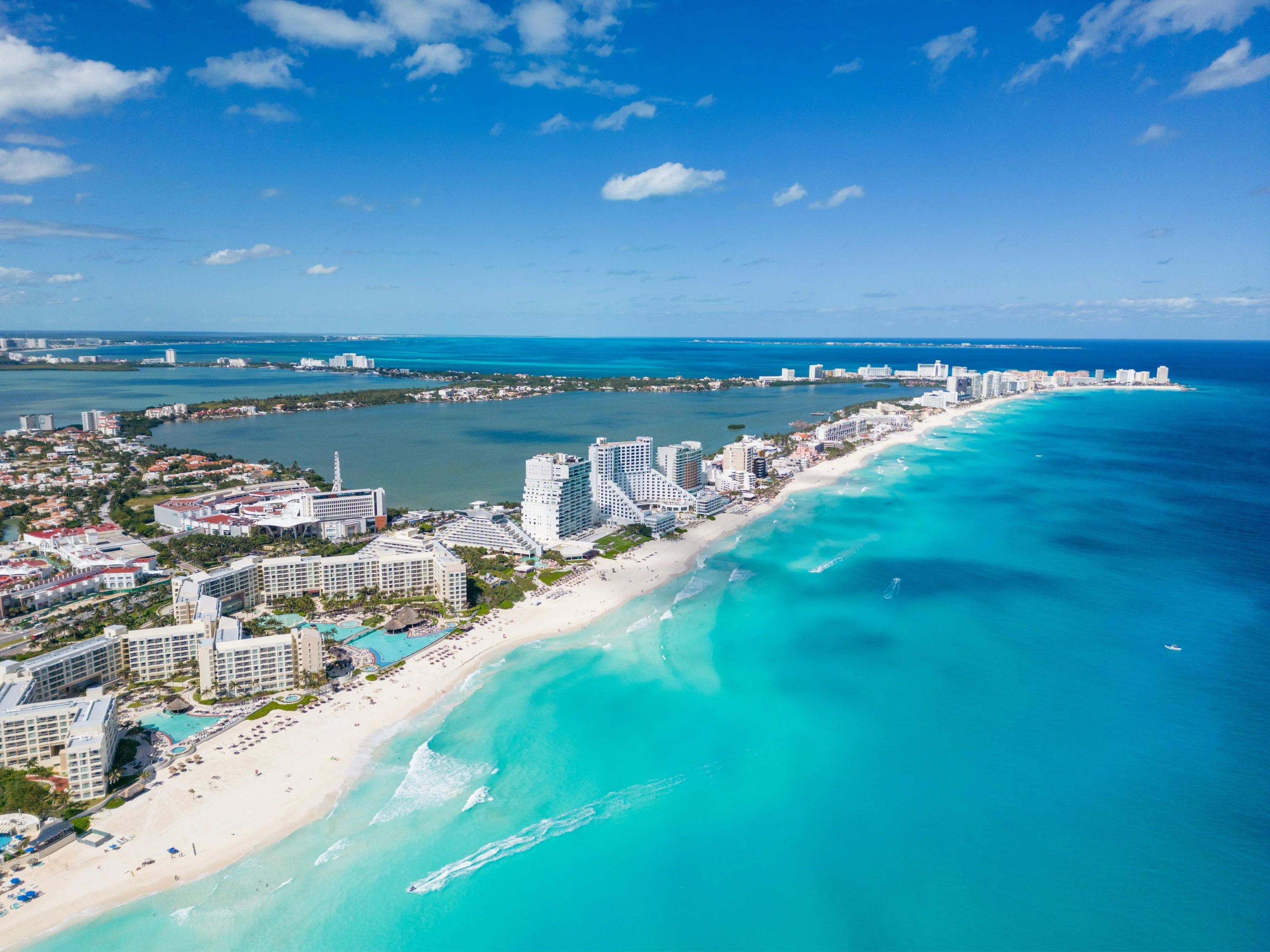
Here an address is a kilometre marker. The Zona Hotelera is a twenty-two kilometre island shaped like a 7, tied to the mainland by two bridges, and everything on it is located by its km on Boulevard Kukulcán: km 9 for the clubs, km 17 for the ruins, km 21 for the quiet. Behind the lagoon, fifteen minutes away by taxi, Cancun is a city of six hundred thousand people that nobody comes to see.
That kilometre figure settles the bill, and the gap is brutal: $62* for the chain room downtown, $250* for this guide's first all-inclusive, $890* for its last. Fourteen times over, across fifteen kilometres of boulevard. The date counts as much as the km, though, and that is this guide's second subject. What follows runs down the boulevard, from the first bridge to the airport.
So, yes, if you like completely wild partying, you have to experience a spring break in Cancun at least once. Leave your inhibitions at the airport ;)
Compare hotel prices in Cancun
In a hurry? Find the best accommodation deals in 3 clicks.
Compare live deals from Booking, Expedia, Agoda and other partners.
At a glance: our picks by traveller type
Pick the profile that suits you to head straight to the recommended neighborhood.
The neighborhood map in Cancun
Get your bearings on the neighborhoods and must-see sights before choosing where to drop your bags. Click a name to jump to its description.
The northern Zona Hotelera, from km 0 to Punta Cancún The sheltered beaches that face Isla Mujeres, Las Perlas, Linda, Langosta and Tortuga, the Embarcadero viewing tower and the Mexican folk art museum right beside it, the Pok Ta Pok golf course on its loop, the convention centre and Plaza Caracol at km 9, the Caracol, Chac Mool, Forum and Gaviota Azul beaches at the foot of the clubs, the Nautilus dive centre and the Delphinus Dreams aquarium
for calm water, for the clubs at km 9, for a first time
This arm of the 7 faces north, and so faces Isla Mujeres, which makes all the difference: the water here is shallow, flat and warm, and the Langosta and Tortuga beaches can be walked with a child by the hand. Then the boulevard turns at Punta Cancún, at km 9, and changes trade: within three hundred metres stand the convention centre, the malls and the clubs that made the city's name. You sleep eight hundred metres from the party, or eight kilometres from it: both are defensible, and they are not the same holiday.
Cancun is a city where you can party, even excessively, just as it is possible to spend your day visiting or admiring fabulous sites.
Where to stay in this neighborhood
Grand Fiesta Americana Coral Beach Cancun Luxury
8.9 from more than seven hundred reviews. Location is scored 9.5, staff, cleanliness and comfort 9.3, facilities 9.0, and value for money 8.5, its lowest mark. It stands at km 9.5, on the elbow of the 7, with the sea on one side and the clubs on the other. Around $470*.
Pros
- Shallow, flat water with no breakers, from km 0 to km 8
- The clubs and the convention centre at the end of the same pavement
Cons
- The nights at km 9 carry a long way, closed windows included
- The beaches here are narrower than on the ocean face
The southern Zona Hotelera, from Punta Cancún to Punta Nizuc The ocean-facing beaches, Gaviota Azul, Ballenas, Marlin and Delfines at km 17, the Maya museum and the Yamil Lu'um archaeological site, the El Rey ruins further south, La Isla and its canals, Kukulcan Plaza, Luxury Avenue, the sensory tequila museum, the interactive aquarium, the Aquaworld marina, the Iberostar golf course and the Oasis Arena
for the open sea, for the museums and the ruins, for the all-inclusives
Past km 9 the boulevard runs due south and the sea changes: more swell, more wind, wider sand. This is where the three things you can do without leaving the island are gathered: the Maya museum and the Yamil Lu'um site at km 16, the El Rey ruins at km 18, and the viewing platform at Playa Delfines, the only public beach high enough to show the whole gradient of blues at once. And it is the all-inclusive district, from the best to the worst in this guide.
Where to stay in this neighborhood
Iberostar Selection Cancun Mid-range
8.0 from more than three hundred and eighty reviews, with 8.8 for location, 8.6 for cleanliness and staff, 8.4 for comfort, 8.3 for facilities and 7.8 for value for money. It is at km 17, with a golf course on the other side of the boulevard. Around $370*.
Grand Oasis Cancun Budget
6.4 from more than two thousand eight hundred reviews, and no other entry here carries as many: cleanliness and comfort 7.0, facilities 6.8, value for money 6.5, while location holds 8.1. The name is famous, the beach is vast, and it sits at km 16.5, five hundred metres from the previous one: two addresses on the same beach, one point six apart. Around $250*.
Pros
- The Maya museum, El Rey and the Delfines platform on foot from the boulevard
- The widest choice of all-inclusives in the city
Cons
- The current and the breakers: several beaches go to red flag
- Twenty minutes by bus to downtown, and as long coming back
El Centro, the city that works Market 28 and its food aisles, the smaller and more Mexican mercado 23, the house of culture and Plaza Ceviche, the Cristo Rey church and the Benito Juárez town hall, the Américas waterfront, the bullring, the two casinos on Avenida Tulum, the Plaza Las Américas, La Gran Plaza and Plaza Nichupté malls, the Kabah urban park, the Beto Ávila baseball stadium and the Andrés Quintana Roo Olympic stadium
for the prices, for eating Mexican, for seeing the city live
On the other side of the lagoon, six hundred thousand people live in a city laid out in supermanzanas, and no brochure mentions it. Yet this is where the country's food is eaten: Market 28 lines up its canteens under one roof, and the smaller mercado 23 serves the people who live next door. The Palapas park fills up as the day goes down, families circle the ice cream sellers, and the bill drops to a fifth of the island's. In exchange, no beach on foot.
Where to stay in this neighborhood
Ibis Cancun Centro Budget
8.2 from more than two thousand two hundred reviews. The category scores do not hold from one language page to the next, so only the total is given here: that is the figure that does not move. It stands on the corner of Tulum and Nichupté, so on the Zona Hotelera bus route, and it costs four times less than the first all-inclusive in this guide. Around $62*.
Pros
- A fifth of the island's price, for the same night's sleep
- The two markets and the Palapas park, where nobody sells you anything
Cons
- No beach within walking distance: it takes the R1 or R2 bus
- Nothing old to visit, and avenues built for the car
Puerto Juárez and the north, the boat harbour The Gran Puerto Cancún terminal and its departures for Isla Mujeres, the El Meco archaeological site on the road north, and the north beach of Isla Mujeres on the far side of the channel
for the first boat, for El Meco, for a single night
Four kilometres north of downtown, the boulevard stops at a jetty. It is from Puerto Juárez that the boats for Isla Mujeres leave, all day, in twenty minutes, and that is the only reason to come here. On the road just above, the El Meco site lines up a pyramid and some fifteen Maya structures that nobody visits, because everyone has gone south. This guide keeps no address in the area, and says so: the entries here do not have the review volume it requires.
Pros
- The first boat of the morning caught without a taxi
- El Meco two kilometres away, and never anyone in front of it
Cons
- Not one address to cite: this guide keeps none here
- A harbour district, with no evening restaurant and no shops
Punta Nizuc and the south, as far as the airport The Nizuc headland at the end of the boulevard, the Parque Nizuc water park at km 25, and three golf courses on the road to the airport and the Riviera, Moon Palace, Riviera Cancun and the Cancun Country Club
for the airport ten minutes away, for the quiet, for the golf
At the end of the 7 the boulevard leaves the island and the noise stops dead. Punta Nizuc closes the lagoon, the sea turns calm again because a reef cuts it, and the few addresses in the area all play the same card: you do not come here to go out. The other argument is administrative and it weighs heavily: the airport is ten minutes away by road, against forty from km 0. For an early flight or a last night, the arithmetic does itself.
Where to stay in this neighborhood
NIZUC Resort & Spa Luxury
The highest score in this guide: 9.2 from more than five hundred reviews, with 9.6 for cleanliness and comfort, 9.5 for facilities, 9.4 for location, but 8.2 for value for money, its only mark under 9. It is at km 21, on the headland, a three minute walk from Punta Nizuc beach and a ten minute drive from the runways. Around $890*.
Pros
- Ten minutes from the airport, against forty from the first bridge
- A sea cut by the reef, and silence in the evening
Cons
- Nothing on foot: no restaurant, no shop, no frequent bus
- The highest rates in this guide, by a long way
Our tips for booking the right place
- The km on the boulevard settles the price, and nearly everything else: There is only one road on the island, and every address is given by its kilometre marker. Km 9 is the elbow: the clubs, the convention centre, the malls. Before it the water is shallow and the beaches face Isla Mujeres. After it the swell rises and the all-inclusives line up as far as km 21. And the same boulevard carries a ratio of fourteen between its cheapest and its dearest room: asking for the km before asking for the price saves time.
- March is the driest month, and it is also spring break: The two overlap, and you have to pick a side. March gets only 30 mm of rain over three days, and April gives eight and a half hours of sun a day: it is the best weather window of the year. It is also when the American universities arrive en masse, when the clubs at km 9 run all night and when the rates double. Anyone coming for the party will aim for March; anyone fleeing it will aim for December, January or the second half of April.
- September and October are to be avoided, and the figures say so: The Caribbean coast's rainy season peaks at the end of summer: September gets 220 mm over thirteen days and gives only six hours of sun a day, October 180 mm over twelve days. It is also the peak of the Atlantic hurricane season, which runs from June to November. The temperature, for its part, barely moves all year, from 20 to 28 degrees in January and from 25 to 33 from May to August: what changes is the water that falls.
- The R1 and R2 buses do everything, and they cost a few pesos: One road, so one useful line: the white and blue buses run up and down Boulevard Kukulcán all day and part of the night, and they go through downtown. You get on, you pay the driver a few pesos, you get off at the km you want. That is what makes El Centro viable despite having no beach, and what makes a hire car pointless: on an island with no junction, it only buys you a parking space.
- Picking an address on the district's reputation: at km 16.5 and km 17, five hundred metres apart, two hotels in this guide are one point six apart.
- Planning September or October: 220 and 180 mm of rain, twelve to thirteen wet days, six hours of sun a day.
- Expecting an old city: Cancun was drawn up in 1970 on an empty island, and its only past is Maya, at El Rey and El Meco.
- Sleeping at Puerto Juárez for anything other than the first boat: this guide keeps no address there, and there is nothing in the evening.
FAQ: where to stay in Cancun
Which neighbourhood should you sleep in in Cancun?
How much does a night in Cancun cost?
How many days for Cancun?
The Zona Hotelera or downtown?
When is the better time to come to Cancun?
What is there to see in Cancun besides the beaches?
 Keep exploring
Things to do in Cancun
Comments (0)
No comments yet. Be the first!